

Buying and Selling 90% Silver Coins
U.S. Junk Silver, 40% Silver Halves
and Silver War Nickels
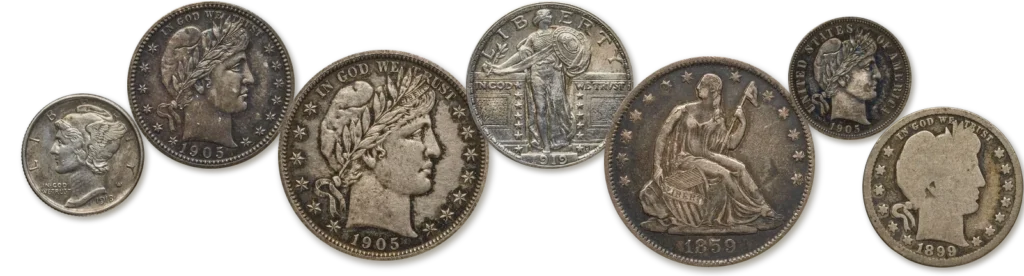
90% silver coins are the U.S. dimes, quarters and half dollars dated 1964 and earlier. They are widely known as “junk silver” because most are valued for their silver content rather than as collectibles, yet they are one of the easiest forms of silver to buy, sell and divide. Every coin is a known size, weight and fineness struck by the U.S. Mint, so they are easy to identify and trade with confidence.
American Rarities has bought and sold U.S. coins since 1990. In more than 30 years we have purchased over $400 million in coins, currency and precious metals. We buy 90% silver by the roll, the bag or the coffee can, along with 40% silver halves, silver war nickels, silver dollars and all gold and silver bullion, including bars. Payment is immediate by company check, wire or ACH.
Ready to sell? Start on our sell 90% silver coins page, visit our junk silver buyers page, or read A Seller’s Guide to Choosing a Reputable Silver Coin Buyer.
Buying or Selling 90% Silver by the Roll or Bag
Because 90% silver coins are already in a uniform, recognized form, they are simply counted and traded by face value. A roll of dimes is $5 face value (50 coins), a roll of quarters is $10 face (40 coins) and a roll of half dollars is $10 face (20 coins). Larger amounts trade in $100, $250, $500 and $1,000 face value bags. A $1,000 face bag of dimes, quarters or halves holds about 715 troy ounces of pure silver and weighs about 55 pounds.
Learn more on our junk silver bag page, see how to get the best price for junk silver bags, and read What to Avoid When Selling Your 90% Silver Coins.
How 90% Silver Coins Are Priced
90% silver is priced by face value against the silver spot price. Coins lose a little silver to wear in circulation, so the trade standard is about 0.715 troy ounce of pure silver per $1 face value (new coins held 0.7234 oz).
The spot price changes throughout the day, so check the live Kitco silver chart. As a dated example, silver was $54.05 per ounce on October 24, 2026. At that price, $1 face value of 90% silver held about $38.65 of silver, and a $1,000 face bag about $38,650. Actual offers move with the market and with demand for junk silver, which can trade above or below melt value. See the approximate melt value of each coin in our coin melt value table, and the metal content of U.S. coins in the NGC coin melt values guide.
Storing Silver vs. Gold
Silver takes up far more room than gold for the same dollar value. On October 24, 2026, gold was about $3,997 an ounce and silver about $54.05, so one ounce of gold was worth roughly 74 ounces of silver. With a $1,000 face bag of 90% silver weighing about 55 pounds, a large holding needs a sturdy, secure place to store it. Check current gold prices on the Kitco gold chart.
Key Dates and Rare Dates to Watch For in 90% Silver
“Junk” silver does not always mean melt value only. Our buyers regularly find better dates and mint marks mixed into ordinary rolls and bags of 90% silver dimes, quarters and halves. We cannot list every valuable date here, but when we evaluate your coins we check each one for numismatic value and pay the collector premium where it applies. We offer free in-house grading, and as a PCGS and NGC authorized dealer and an ANACS submission center we can help submit coins that merit certification. For values of common U.S. coins, see our coin price guide.
90% Silver Dimes: 0.0723 oz of Silver Each

- Barber (Liberty Head) dimes, 1892–1916 – most are common, but key dates such as the 1901-S carry significant value above their silver content.
- Winged Liberty (“Mercury”) dimes, 1916–1945 – common dates trade as junk silver, while dates and mint marks such as the 1916-D carry strong collector premiums.
- Roosevelt dimes, 1946–1964 – nearly all circulated silver Roosevelt dimes trade on their silver value. The U.S. Mint removed silver from the dime in 1965.
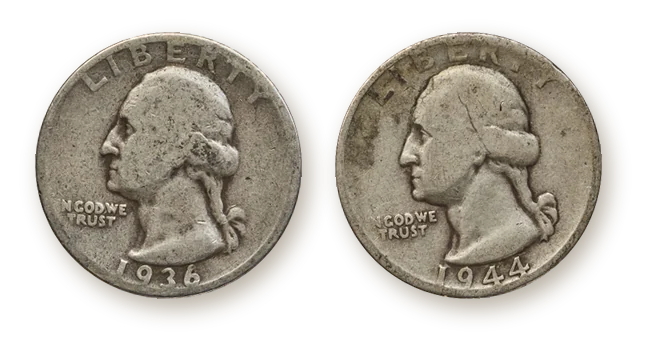
90% Silver Quarters: 0.1808 oz of Silver Each

- Barber (Liberty Head) quarters, 1892–1916 – an 1896-S or 1901-S can command a considerable premium over other Barber quarters.
- Standing Liberty quarters, 1916–1930 – the 1916, the first year of the design, had a very small mintage and is valuable.
- Washington quarters, 1932–1964 – most are common and trade on silver value, but the 1932-D and 1932-S are quite valuable.
90% Silver Half Dollars: 0.3617 oz of Silver Each

- Barber (Liberty Head) half dollars, 1892–1915 – the 1892-O is an especially valuable date.
- Walking Liberty half dollars, 1916–1947 – worn common dates, especially from the 1940s, often trade close to silver value, while earlier dates and coins in better condition can bring premiums. Do not confuse them with the modern American Silver Eagle bullion coin, which uses a similar design.
- Franklin half dollars, 1948–1963 – most trade on silver value, but certain dates, proofs and coins with full bell lines draw extra value.
- 1964 Kennedy half dollars – 1964 is the only year the circulating Kennedy half was struck in 90% silver. They are common and trade on silver value.
40% Silver Kennedy Half Dollars (1965–1970): 0.1479 oz Each
Kennedy half dollars dated 1965 through 1970 are 40% silver and contain about 0.1479 troy ounce of silver each. The Coinage Act of 1965 removed silver from dimes and quarters and cut the half dollar to 40%. Since 1971, circulating Kennedy halves have contained no silver. 40% silver Eisenhower dollars were also struck for collectors from 1971 to 1976, mainly in uncirculated and proof sets; each contains about 0.3161 oz of silver. We buy 40% silver in any quantity.
35% Silver War Nickels (1942–1945): 0.0563 oz Each
Jefferson nickels struck from mid-1942 through 1945 contain 35% silver because nickel was needed for the war effort. Look for the large mint mark (P, D or S) above Monticello on the reverse. Each coin holds about 0.0563 troy ounce of silver.
Silver Content of U.S. 90%, 40% and 35% Silver Coins
| Coin | Dates | Pure silver per coin |
|---|---|---|
| Dime (90% silver) | 1964 and earlier | 0.0723 oz |
| Quarter (90% silver) | 1964 and earlier | 0.1808 oz |
| Half dollar (90% silver) | 1964 and earlier | 0.3617 oz |
| Kennedy half dollar (40% silver) | 1965–1970 | 0.1479 oz |
| Eisenhower dollar (40% silver, collector issues) | 1971–1976 | 0.3161 oz |
| Jefferson war nickel (35% silver) | 1942–1945 | 0.0563 oz |
Figures are troy ounces of pure silver as minted. Circulated 90% silver is traded at about 0.715 oz per $1 face value to allow for wear. Source: NGC coin melt values. See current melt values in our coin melt value table.
Formula to Find Your Silver Coins’ Value

To estimate the silver value of circulated 90% silver coins:
(Face value) × 0.715 × (silver spot price) = approximate silver value
Example: $20 face value of 90% silver quarters (80 quarters) × 0.715 = 14.3 troy ounces. At the October 24, 2026 example price of $54.05 per ounce, that is about $773. For 40% Kennedy halves, multiply the number of coins by 0.1479 oz; for war nickels, by 0.0563 oz. “Oz” here means troy ounce.
Offers are based on this value and current market demand. Silver dollars are valued differently; see our silver dollar buyer page.

Why Sell Your 90% Silver to American Rarities
- Rare coin dealer since 1990, with more than 30 years of experience and over $400 million in coins, currency and precious metals purchased
- Rated 4.7 on Google from 86 reviews and A+ with the BBB
- ANA Life Members, PCGS and NGC authorized dealer, and ANACS submission center
- Free in-house grading and XRF testing to confirm silver content
- Immediate payment by company check, wire or ACH
- We buy all bullion, including bars, plus 90% and 40% silver in any quantity
- Nationwide home visits for larger holdings
- Mail-in shipments fully covered, with no deductible, and free or discounted shipping on selected collections
Related pages: Junk Silver Buyers · Junk Silver Bag · Sell Silver & Gold Bullion · Silver Dollar Buyer · Choosing a Silver Coin Buyer · Coin Melt Values
90% Silver Coins: Quick Answers
How much silver is in a 90% silver coin?
About 0.0723 troy ounce in a dime, 0.1808 in a quarter and 0.3617 in a half dollar. Circulated coins trade at about 0.715 ounce per $1 face value.
What years are 90% silver?
Dimes, quarters and half dollars dated 1964 and earlier, plus silver dollars dated 1935 and earlier. Kennedy halves from 1965 to 1970 are 40% silver.
How is 90% silver priced?
By face value against the spot price: multiply the face value by 0.715, then by the silver spot price. Better dates can bring collector premiums.
Get a Free Offer to Buy or Sell Now
Email, Text, or Use This Form To Send Us Your Inventory List or Pictures
Email: staff@americanrarities.com | Text: 720-600-4740
Professional Associations
