
Sell U.S. Paper Currency
U.S. Paper Currency Values

Want to sell paper currency or find out what your paper money is worth? American Rarities has bought rare U.S. and world paper money, coins and collections since 1990, with over $400 million purchased. Our buyers bring hundreds of years of combined experience. We are ANA Life Members with an A+ BBB rating and a 4.7-star Google rating, and an authorized NGC, PCGS and ANACS dealer.
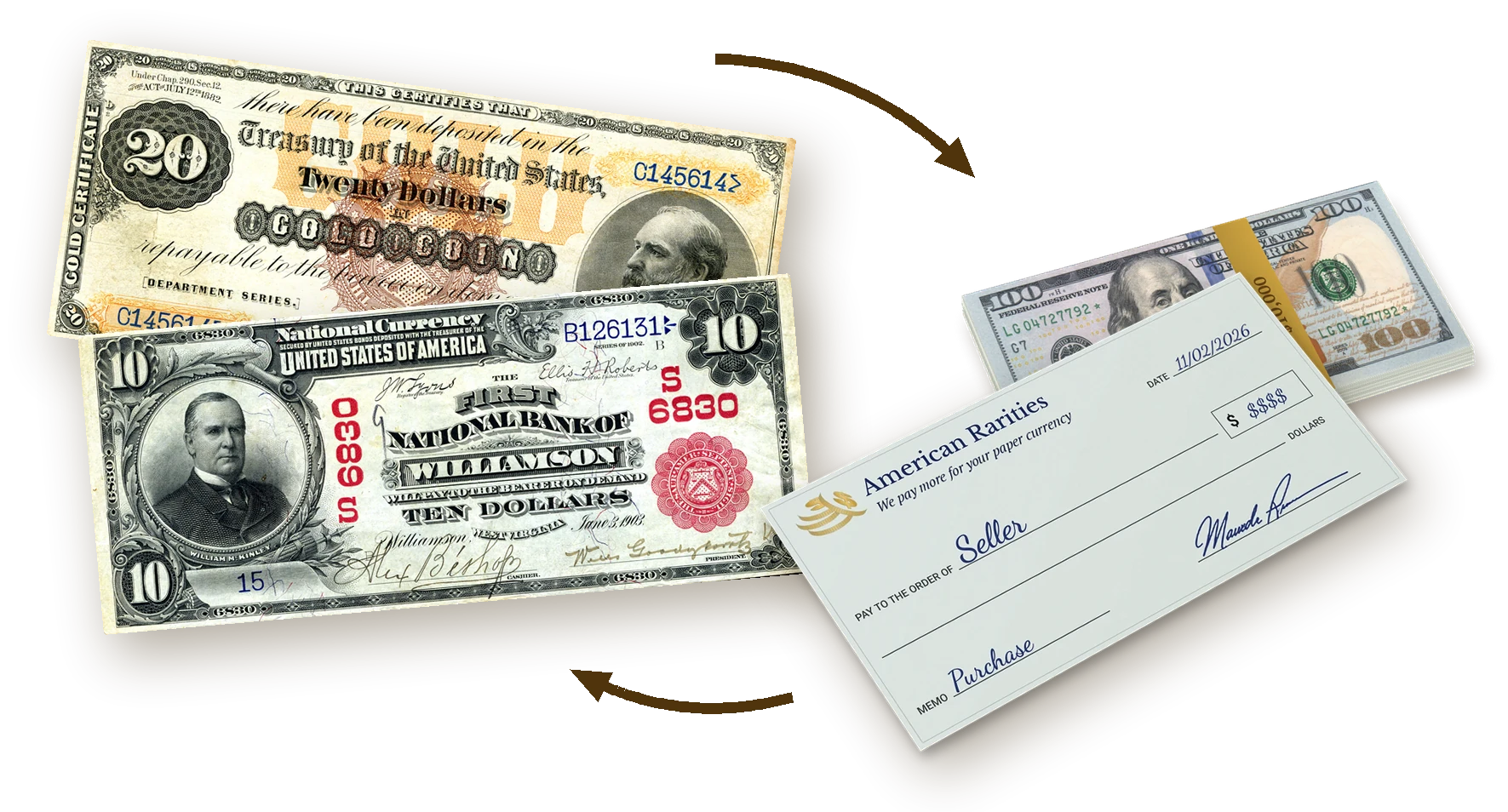
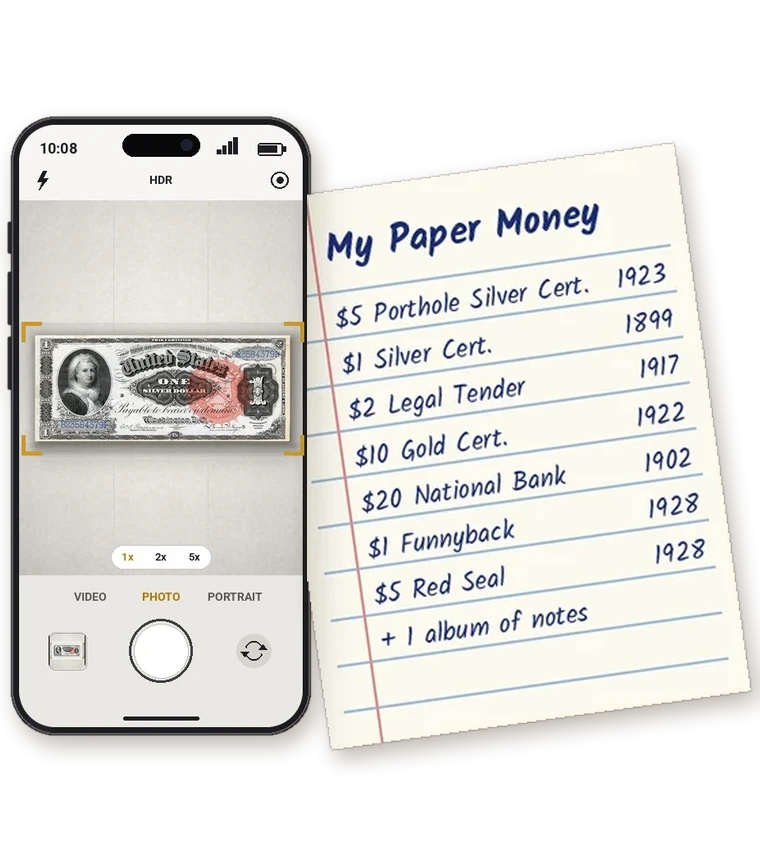
Send us photos of the front and back of your notes, or an inventory list, and an experienced currency buyer will give you a complimentary appraisal. All appraisal requests are reviewed in the order they are received. Some appraisals take minutes, while larger, more complex collections can take a few days. Either way, you’ll get a response from us. With no obligation to sell. If you accept our offer, we pay immediately by cash, check, ACH or wire transfer, and we buy nationwide.
Figuring out a currency collection’s value can be a daunting task for a seasoned paper currency collector. It can be even more difficult for someone less familiar with paper money looking to sell their paper currency collection for a fair market value. Our expert paper money dealers are constantly studying the market, ensuring we can provide paper currency sellers with accurate paper money values for their material. Countless times, we have found valuable paper money notes tucked in the most mundane of paper money collections.
We Have Helped Currency Collectors Appraise and Sell Rare Paper Money Since 1990
Let a Professional Paper Currency Dealer Advise You What Your Rare Currency is Worth
Our rare paper money buyers can provide you with a free online appraisal of your rare paper money collection. Our buyers accurately appraise foreign paper money and American Currency of all types on a daily basis, and can tell you how valuable your old paper money notes truly are. We can quickly find any extra “collector value” your rare paper money notes may have. It’s as easy as emailing us pictures or an inventory list of your paper money collection.
You can provide us information about your notes in whatever manner is easiest for you. We recommend sending us an inventory list and/or pictures of your collection. A partial list or photos of a few specific paper currency notes works well as a starting point. From here, our paper currency buyers can begin the process of providing you with paper currency values for your collection.
What Determines Paper Money Values
Two notes that look alike can be worth very different amounts. When our buyers determine U.S. paper money values, they look at:
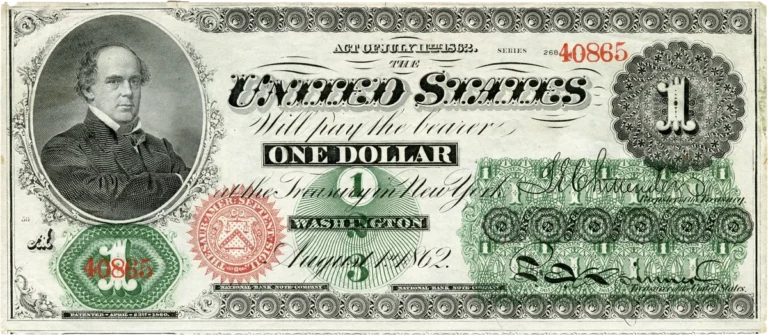
- Type and series. Large-size notes issued before 1929, such as 1861 Demand Notes, Legal Tender Notes, Silver Certificates, Gold Certificates and Treasury Notes, are generally more sought after than the small-size notes printed since.
- Rarity. How many were printed and how many survive, including scarce signature combinations, seal colors and issuing banks.
- Serial numbers. Star notes (replacement notes), very low serial numbers and fancy serials such as solids, ladders and radars can carry collector premiums.
- Condition and grade. Folds, tears, stains, pinholes and trimming all affect value. Third-party grading from PMG can help on high-value notes, but it is not required to sell to us.
- Errors and demand. Printing errors such as misaligned or inverted overprints, and what collectors are paying right now.
The Bureau of Engraving and Printing and the U.S. Treasury explain how U.S. currency is produced. For published price ranges by type, see our coin and paper money price guide, and learn how notes are graded on our coin and paper currency grading page.
High-Denomination Notes: $500, $1,000, $5,000 and $10,000 Bills

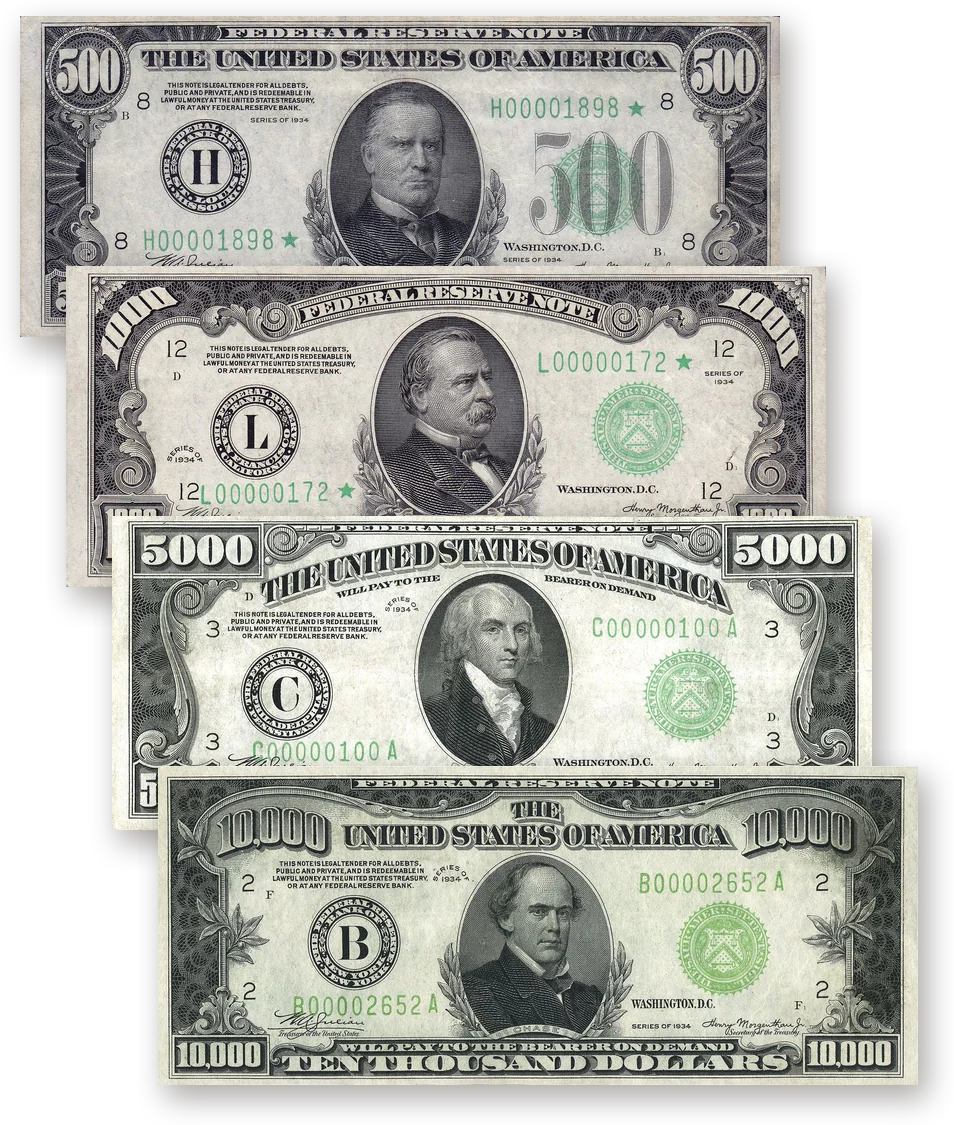
The $500 (William McKinley), $1,000 (Grover Cleveland), $5,000 (James Madison) and $10,000 (Salmon P. Chase) bills are the largest notes most collectors will ever see. They were last printed in 1945 and officially discontinued in 1969. According to the Federal Reserve, they remain legal tender, but their collector value is usually well above face. A bank will only give you face value, so ask us for an appraisal before you spend or deposit one.
We buy Series 1928 and 1934 Federal Reserve Notes and Gold Certificates in all of these denominations. Star notes, low serial numbers, scarce Federal Reserve districts and crisp, high-grade notes are the ones collectors want most.
What about the $100,000 bill? The largest U.S. note ever printed is the Series 1934 $100,000 Gold Certificate with Woodrow Wilson. It was used only for transfers between Federal Reserve Banks and was never released to the public, so collectors cannot legally own one. Any $100,000 bill you see offered for sale is a replica or novelty note. If you have a genuine $500, $1,000, $5,000 or $10,000 bill, we would like to see it.
Famous Notes We Buy
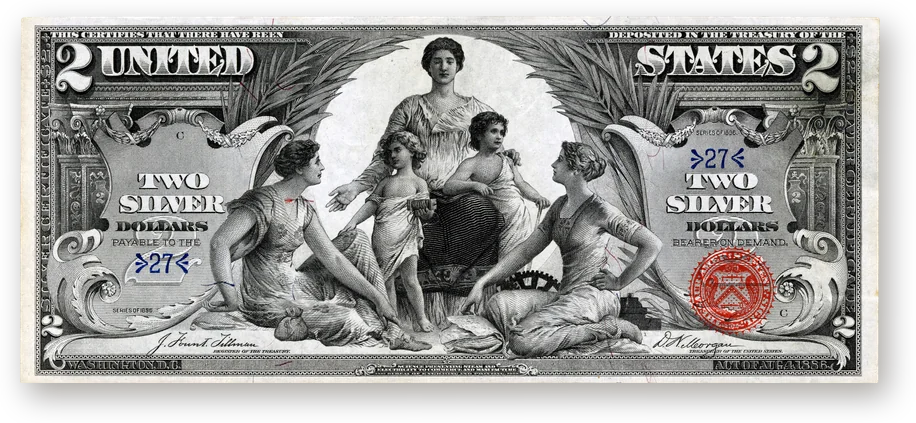
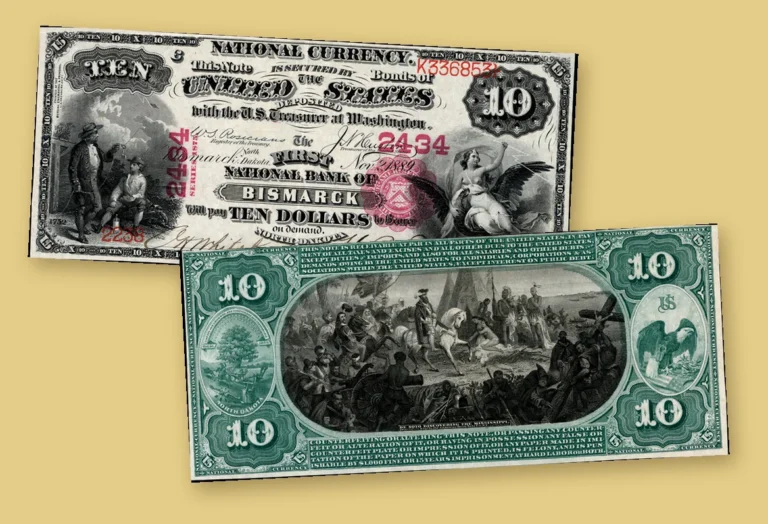
These are some of the most famous designs in U.S. paper money, and we buy all of them in any condition. Large-size notes like these were issued before 1929 and are larger than today's bills, so they are shown here at the same scale. Learn more about each type on our U.S. paper currency information page.
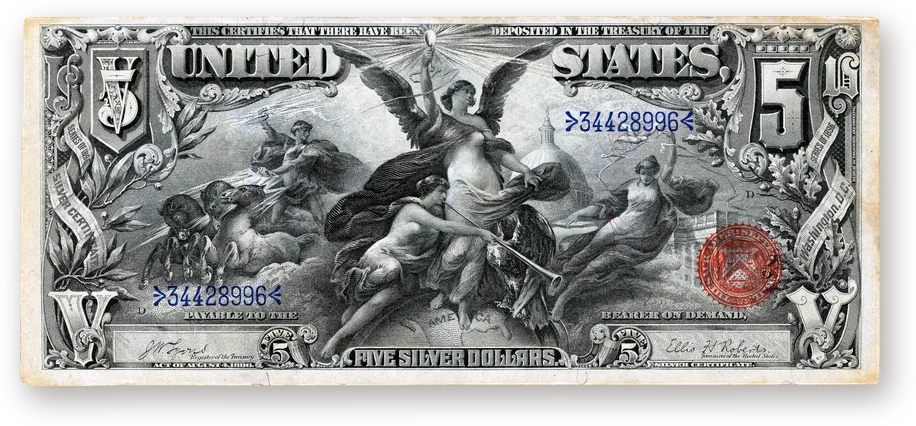
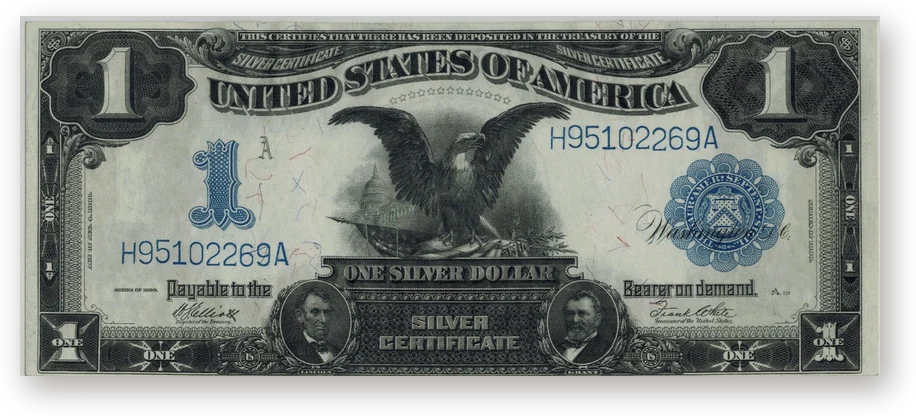
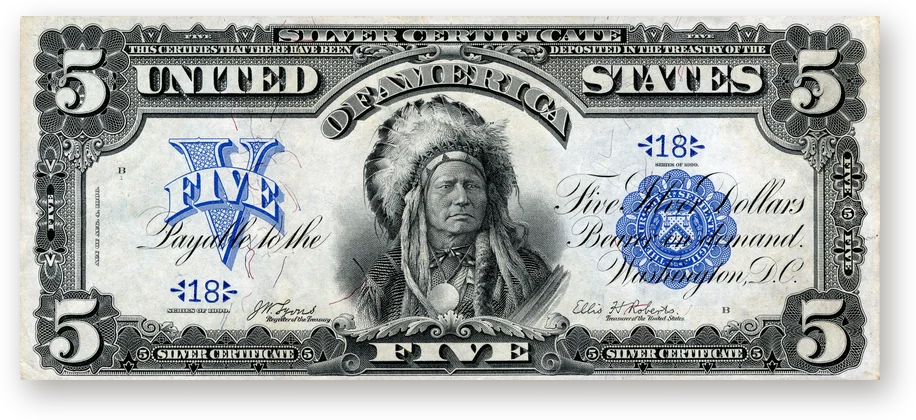
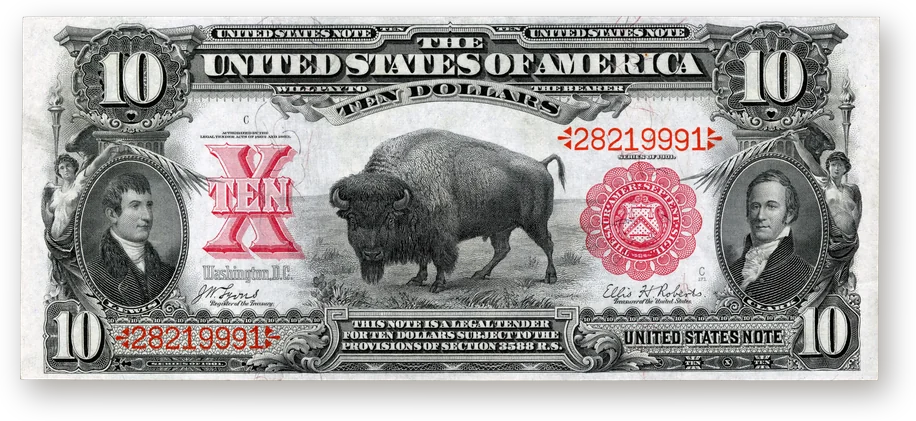
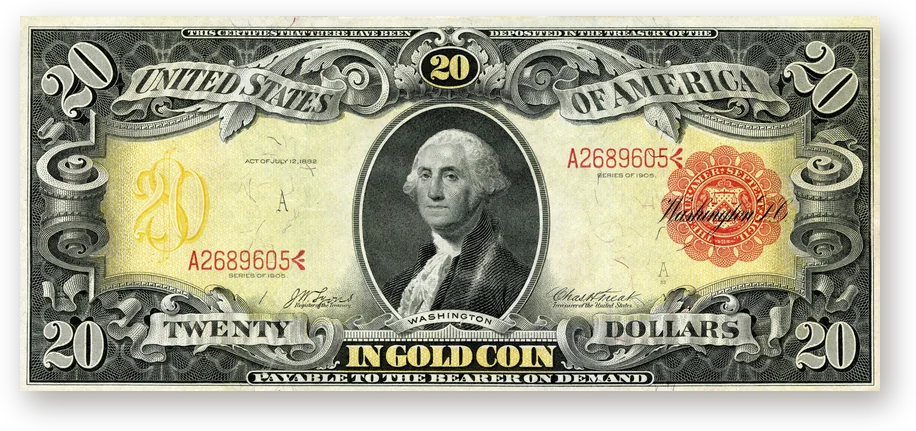
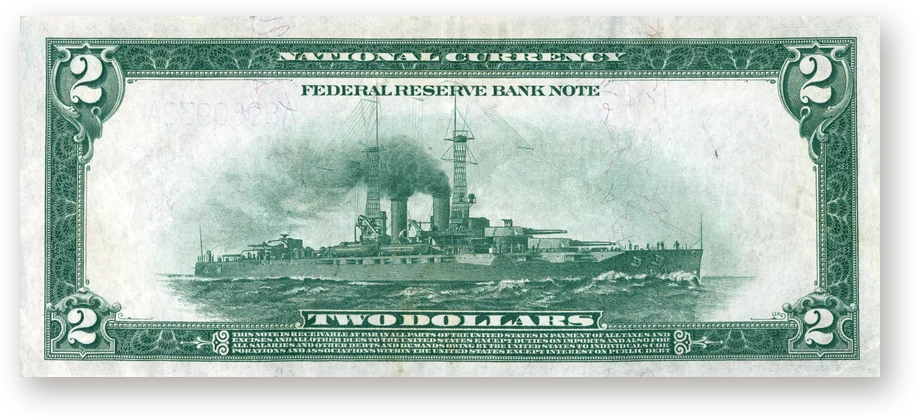
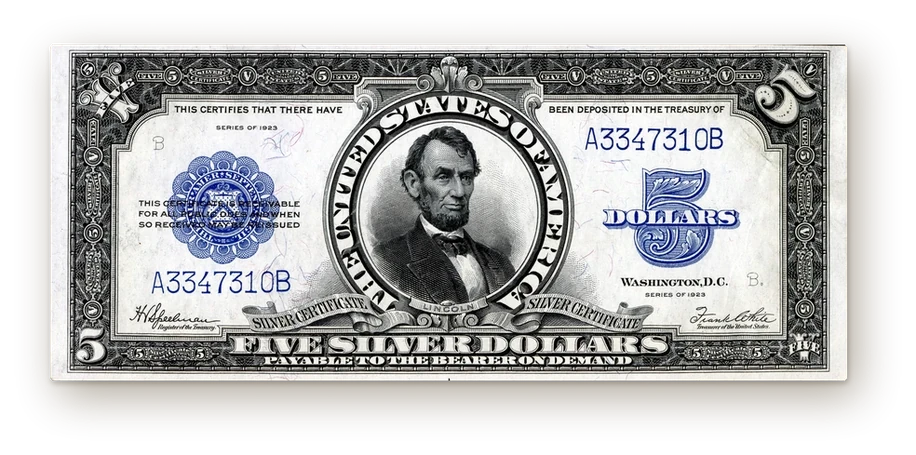
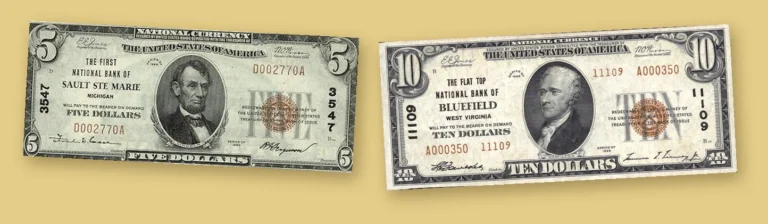
Have a large-size note from your hometown bank? See sell national currency notes.
Fancy Serial Numbers, Low Serials and Star Notes

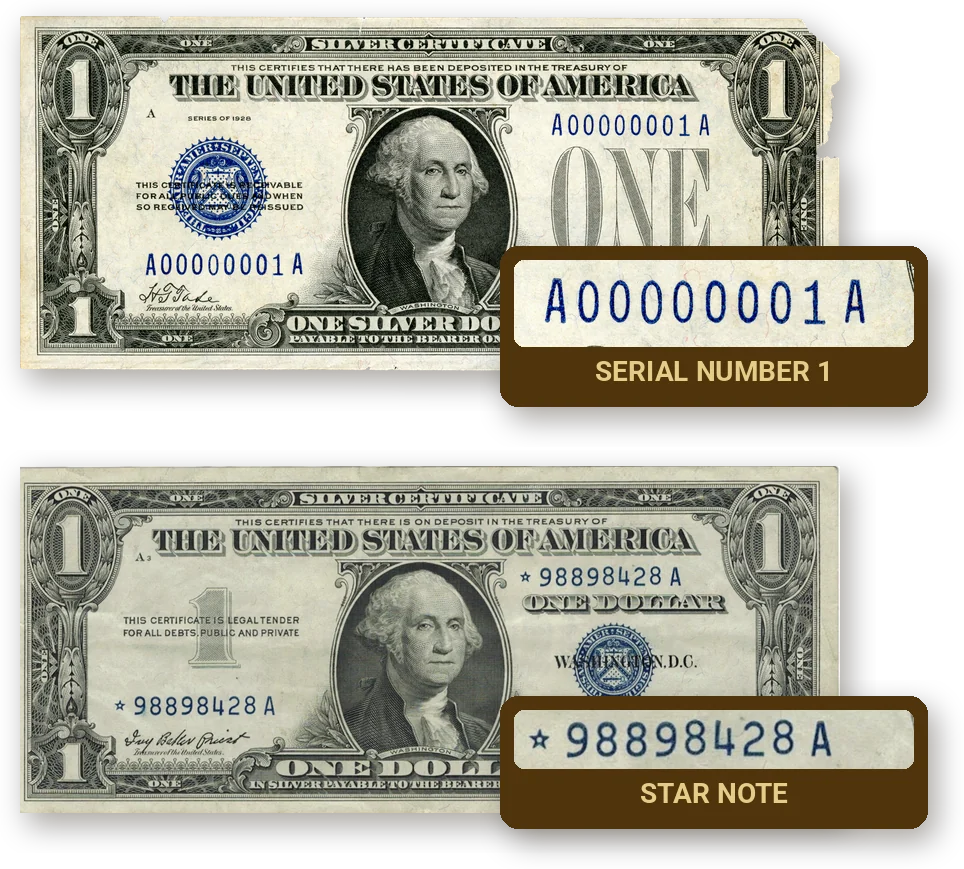
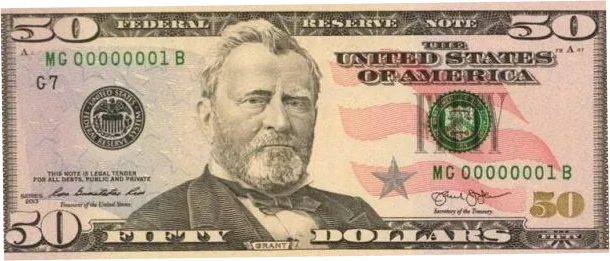
The serial number can make an everyday note worth far more than face value. Collectors pay premiums for low numbers, patterns and replacement notes, so check every note in your collection, including modern bills. Serial number 1 notes like the Series 1928 $1 A00000001A shown here are among the most wanted.
Fancy serial numbers are judged on the full eight digits. Star notes are replacement notes printed to take the place of misprinted sheets, and a star appears in place of a letter at the end of the serial number. Older star notes, short print runs and high grade all add to the value.
| Type | Example | What to look for |
|---|---|---|
| Serial #1 and low serials | 00000001 | Number 1 is the top prize. Serials under 100, and especially single digits, also carry strong premiums. |
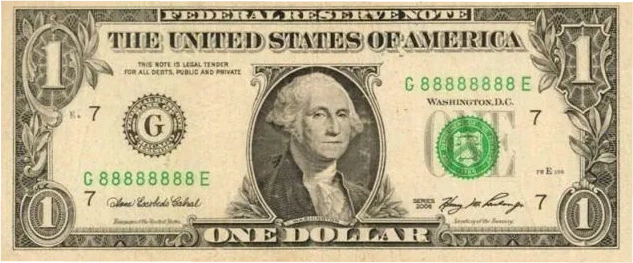
| Solid | 77777777 | All eight digits the same. One of the most sought-after patterns. |
| Ladder | 12345678 | Digits that climb or fall in order. A true ladder runs 12345678 or 87654321. |
| Radar | 12344321 | Reads the same forward and backward. |
| Repeater | 12121212 | A group of digits that repeats, such as 12121212 or 12341234. |
| Binary | 10010110 | Made only of two digits, usually 0 and 1. |
| Star note | 00012345★ | A replacement note with a star in the serial number. Low-print-run stars and older series bring the most. |
Not sure what you have? Send us a photo of the serial number and we will tell you. If something is out of the ordinary, we price it at its full collectible value.
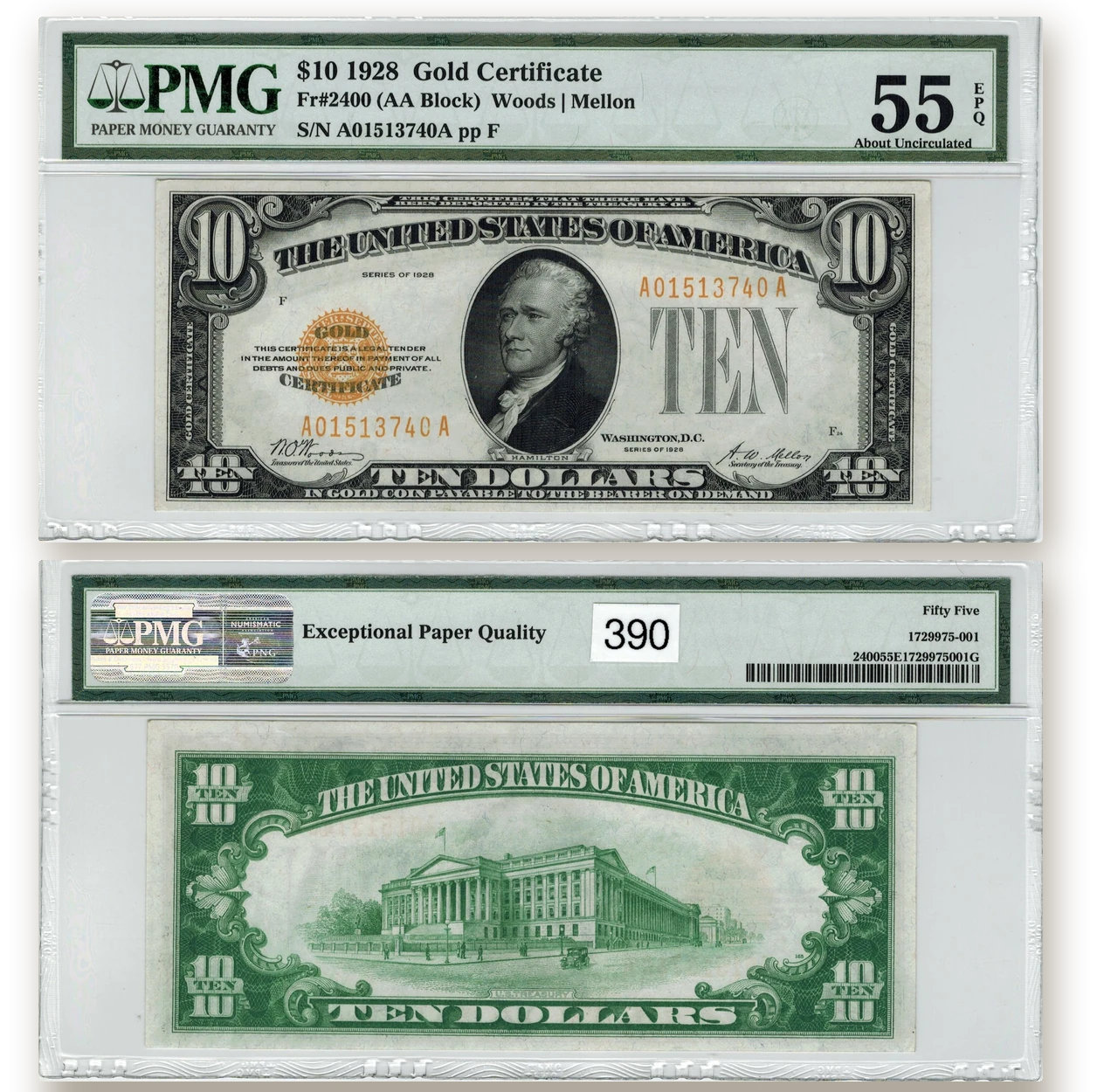
Certified Paper Money: PMG and PCGS Banknote

We buy notes graded by PMG (Paper Money Guaranty) and PCGS Banknote, from single notes to large certified collections. Both services grade notes on a 1 to 70 scale and seal them in tamper-evident holders. Designations such as PMG EPQ (Exceptional Paper Quality) or PCGS Banknote PPQ (Premium Paper Quality) mean the paper is original and has not been pressed or repaired.
Not graded yet? You do not need to grade a note to sell it to us. We give a free grading opinion on raw notes, and for valuable notes we can help you with PCGS and NGC/PMG submissions as an authorized NGC, PCGS and ANACS submission center dealer. Learn how grading works on our coin and paper currency grading page.
Common Questions
Some of the most common questions we get asked is what’s my American currency collection value? Or what is my star note value? Or what are my U.S. paper money values? We can readily provide you with the answers you seek. When you search for “paper currency buyer near me”, or “ paper money collectors near me” you want to find a paper currency dealer like us. Consider us your personal paper money price guide.
American Rarities is a reputable paper currency dealer you can trust. If you have a currency collection for sale contact us today to request a free, no-obligation appraisal and offer on your U.S. paper currency collection, and even your foreign paper currency notes, including Mexican paper money from Mexico’s state banks, the Revolution and the Banco de México! Our expert currency buyers can provide a fair, accurate assessment of your paper money collection.
If you would like to take a deeper dive into the intricacies of collecting U.S. paper currency, check out our U.S. Paper Currency Information page.
Selling your Rare Paper Money Collection
Once you understand the true value of your currency collection, you will be in a position to decide whether or not to sell your rare and valuable notes. Our rare paper currency dealers offer expert, professional and confidential assistance when you’re ready to sell. We are interested in everything from common star notes to the most rare and valuable early large size American Currency notes, and we would be glad to make you an offer on them.
If you are ready to sell your rare currency collection, or have questions that need answers, then assistance is just a click or text away. To get started, simply fill out the form below to tell us a little about what you have. For a full walkthrough, read our guide on how to sell paper currency.
How to Sell Paper Currency in 4 Steps

Share photos or an inventory list
Send pictures of the front and back of your notes, an inventory list, or both, using the form on this page, a text to 720-600-4740 or an email to staff@americanrarities.com. Please do not clean, press, tape or flatten your notes.
Get your complimentary appraisal and written offer
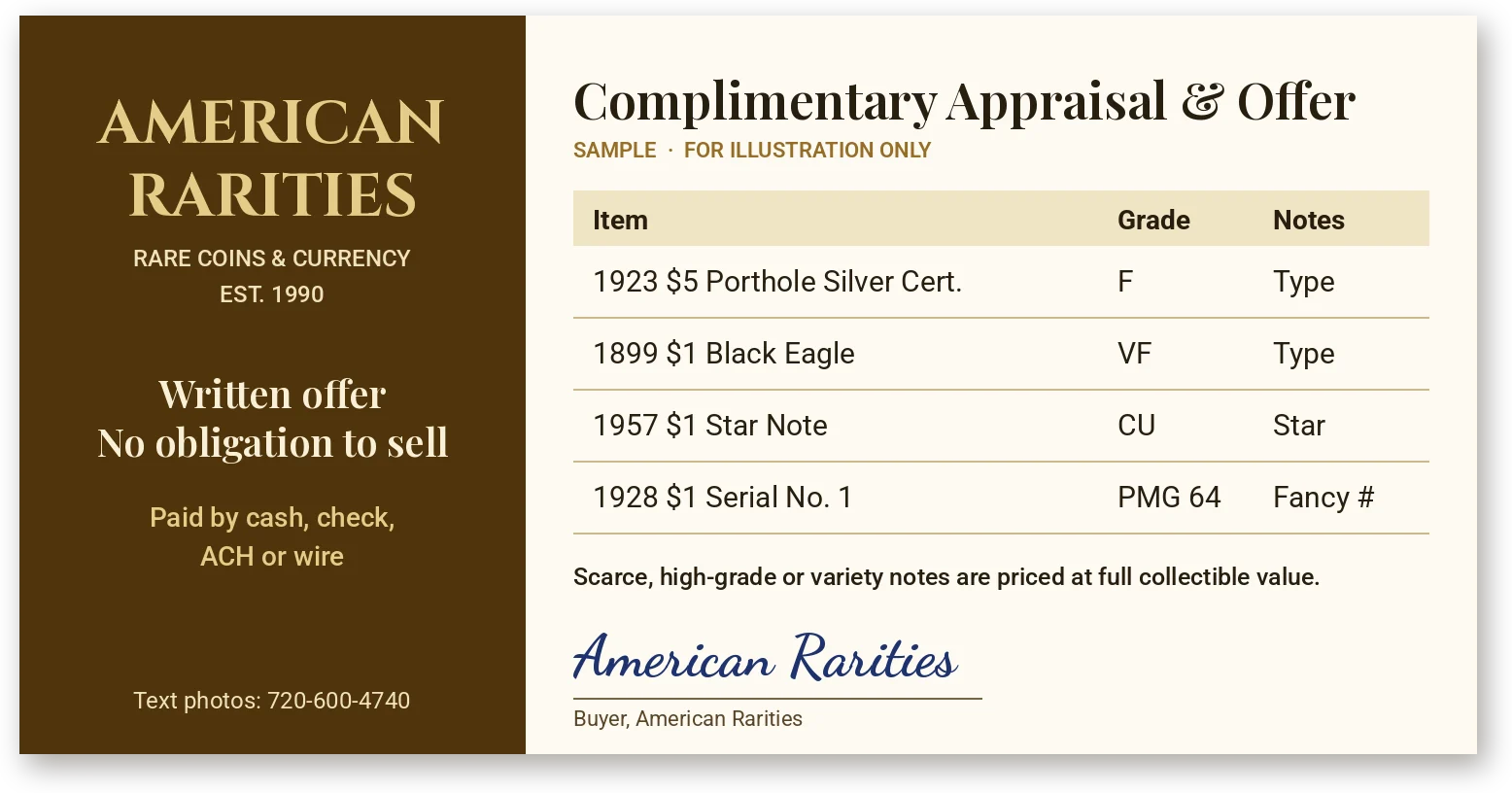
An experienced buyer reviews each note and sends a complimentary appraisal and written offer. All appraisal requests are reviewed in the order they are received. Some appraisals take minutes, while larger, more complex collections can take a few days. Either way, you'll get a response from us. The grading opinion is free and no slabbing is required. Scarce notes, varieties and high grades are priced at full collectible value, and there is no obligation to sell.

Ship fully insured, or meet a buyer
Ship your notes fully insured at our expense with no deductible (we do not provide shipping materials). For larger collections, ask about a home visit through our nationwide buying network, or we can meet you at your bank. If you decline, we return your notes fully insured.
Get paid immediately
Accept the offer and we pay immediately by cash, check, ACH or wire transfer.
Settling an estate? Our IRS-compliant appraisals and our guide to understanding an inherited estate can help.
American Rarities Buys U.S. Paper Currency of All Types

We buy single notes and entire collections, including:
- Large-size U.S. notes: Demand Notes, Legal Tender (United States) Notes, Silver and Gold Certificates, Treasury (Coin) Notes, Federal Reserve Bank Notes and the 1896 Educational Series.
- National Bank Notes from hometown banks across the country. See sell national currency notes and our national currency notes guide.
- Small-size notes since 1928: star notes, fancy and low serial numbers, error notes, uncut sheets and Hawaii and North Africa World War II notes.
- High-denomination notes: $500, $1,000, $5,000 and $10,000 bills.
- Fractional Currency from 1862 to 1876, Confederate and Southern States notes, and obsolete (broken bank) notes.
- World paper money and banknotes from around the globe. Learn more in exploring world currency.
Paper Money Values: Quick Answers
How much is my old paper money worth?
It depends on the note’s type, series, serial number, rarity and condition. Many circulated small-size notes from 1928 onward are worth close to face value, especially common $1, $5 and $10 Federal Reserve Notes. Large-size notes issued before 1929, National Bank Notes, gold certificates, star notes, fancy serial numbers, printing errors and crisp uncirculated notes can be worth much more. A note’s grade can change its value many times over, so send photos of both sides for a free appraisal.
Are star notes worth more than regular notes?
Sometimes. A star note is a replacement note, printed to replace a sheet found defective, and it has a star next to its serial number. Star notes from older series, short print runs and notes in high grade can carry a strong premium, while most recent star notes trade close to face value. The size of the print run matters most: runs of 640,000 notes or fewer are the ones collectors look for. We will tell you which kind you have.
What makes a serial number fancy?
A fancy serial number has a pattern collectors pay extra for. Favorites include very low numbers such as 00000001 to 00000100, solids such as 77777777, ladders such as 12345678, radars that read the same both ways, repeaters such as 12121212, binary numbers made of only two digits, and birthday or year numbers. The rarer the pattern, the bigger the premium, and condition still matters. Send us a photo of the serial number and we will tell you if it carries a premium.
Are paper money errors worth money?
Yes. Genuine printing errors made at the Bureau of Engraving and Printing are collectible and often worth well over face value. Look for misaligned or off-center printing, cutting errors showing part of the next note, inverted backs, missing or partial printing, ink smears called offsets, mismatched serial numbers and butterfly folds. Bigger, more dramatic errors and higher denominations bring more. Damage that happened after a note left the printer, such as tears or fading, is not an error.
Are $500 and $1,000 bills worth more than face value?
Usually, yes. The $500, $1,000, $5,000 and $10,000 bills were last printed in 1945 and withdrawn starting in 1969, but they are still legal tender. Most are worth well above face value to collectors, with higher values for Series 1928 notes, star notes, scarce Federal Reserve districts and notes in crisp condition. A bank will only give you face value, so get an appraisal before you deposit one.
Can I sell a $100,000 bill?
No genuine $100,000 bill can be legally owned by a collector. The Series 1934 $100,000 Gold Certificate was printed only for transactions between Federal Reserve Banks and was never released to the public; the known examples are held by government institutions. Any $100,000 bill offered for sale is a replica or novelty note. The largest notes a collector can own are the $5,000 and $10,000 bills.
Do I need to get my paper money graded before I sell it?
No. Most notes sell best as they are. We give you a free in-house grading opinion with no slabbing required, and we buy notes already certified by PMG and PCGS Banknote, from single notes to complete collections. Third-party grading can add value to rare or high-grade notes, and we can tell you which notes are worth submitting. Please do not clean, press, tape or flatten a note, since that can lower its value.
Free Appraisal and Offer To Purchase Paper Currency
Send Us Your Pictures or Inventory List
Email: staff@americanrarities.com Text: 720-600-4740
Paper Money Guides
How to Sell Paper CurrencyFive steps to take before you sell
U.S. Paper Currency InformationHistory, types and how to identify U.S. notes
Collecting Paper MoneyNote types, grading, condition and care
Paper Money Price GuideApproximate values for common U.S. notes
Paper Currency GradingHow PMG and PCGS Banknote grade notes
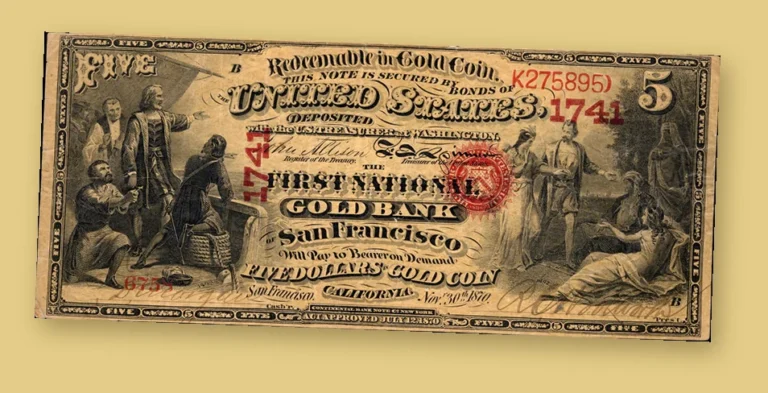
National Currency Notes GuideIdentify and value National Bank Notes
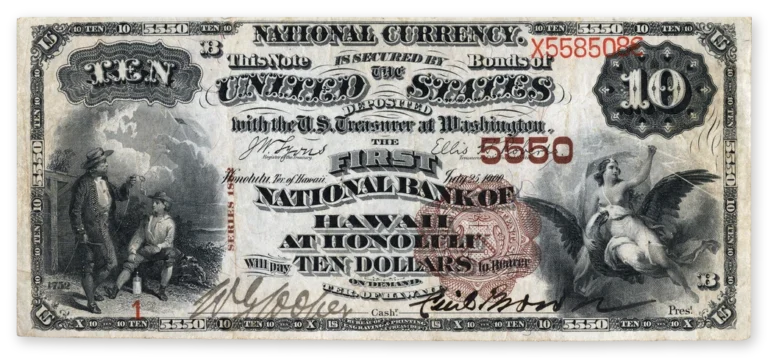
Sell National Currency NotesHow we appraise and buy National Bank Notes
Sell Mexican Paper MoneyBank, Revolution and Banco de México notesProfessional Associations