
Sell Mexican Paper Money
Banknotes of Mexico’s Banks, the Revolution and Banco de México
Looking to sell Mexican paper money? Esta página también está disponible en español. American Rarities buys Mexican banknotes of every era: the notes of the private and state banks of the 1800s and early 1900s, the emergency notes of the Mexican Revolution and the notes of the Banco de México, from its first issues of 1925 to modern specimens and errors.
Mexican paper money is full of history, and its value depends on the issuer, the series and the condition of the note. Our buyers know these notes and can tell you what you have.
Get a free, no-obligation appraisal by email, text or the form on this page. We have been buying rare coins and paper money since 1990.
On this page:
A Short History of Mexican Paper Money
Mexico’s first government paper money was issued in 1822 and 1823 under Emperor Agustín de Iturbide, in 1, 2 and 10 pesos. The new republic made similar issues later in 1823, and Emperor Maximilian issued 10 pesos notes in 1866. These early government notes are rare.
For most of the 1800s and early 1900s, though, Mexican paper money came from banks and local authorities rather than the national government. The Banco de Londres, México y Sudamérica opened in Mexico City in 1864, and the Banco Nacional de México was formed by a merger in 1884. A banking law of 1897 set the rules for banks of issue, and many states gained a bank that printed its own notes.
The Mexican Revolution broke this system apart. Rival governments and armies printed huge numbers of notes, and the old banks of issue were closed. In 1925 the new Banco de México was founded with the sole right to issue the country’s money. You can read more about the history of the Mexican peso.
Coins tell the earlier part of the story. See our pages on Mexican War of Independence coins and the Independence SUD copper coins of Morelos.
Private and State Bank Notes We Buy

Before the Revolution, dozens of banks issued notes in Mexico. National banks circulated across the country, while state banks issued notes for their own regions. Notes we buy include those of:
- National banks, such as the Banco Nacional de México and the Banco de Londres y México.
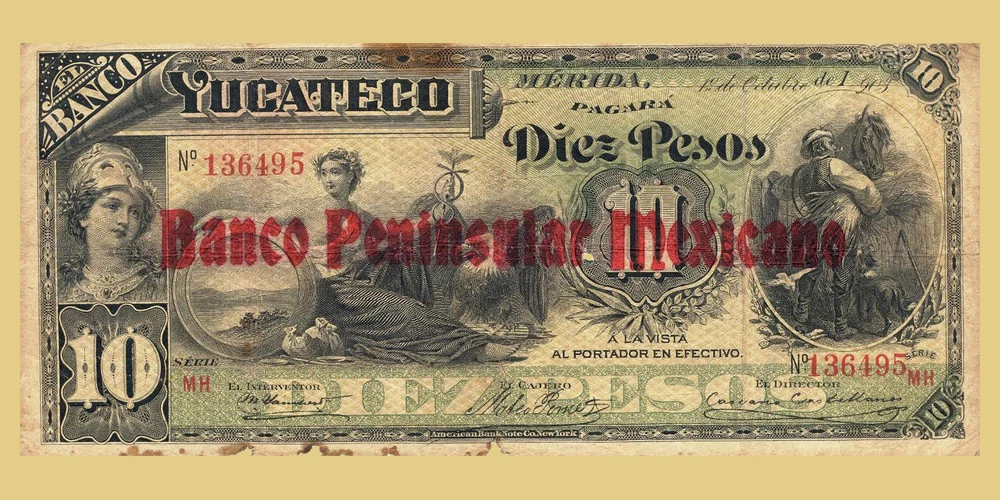
- State and regional banks, such as the Banco Minero de Chihuahua, the Banco Oriental de México in Puebla and the banks of Yucatán, including the Banco Yucateco and the Banco Peninsular Mexicano.
- Overprinted, revalidated and signed notes, where later stamps and signatures can change what a note is and how collectors value it.
- Proofs and specimens made by the bank note printers for these banks.
Many of these notes were beautifully engraved by American and European printers. Notes from small banks, high denominations and early dates are often the scarcest.
Mexican Revolution Banknotes, 1913–1916

During the Revolution, roughly 1913 to 1916, each faction paid its troops and suppliers with its own paper money. These notes are among the most popular Mexican paper money with collectors. They include:
- Chihuahua and the Division of the North. Notes issued in Chihuahua while it was under the control of Francisco Villa’s forces, including the 1914 State of Chihuahua notes known as “dos caritas” for their portraits of Francisco I. Madero and Abraham González, shown at the top of this page.
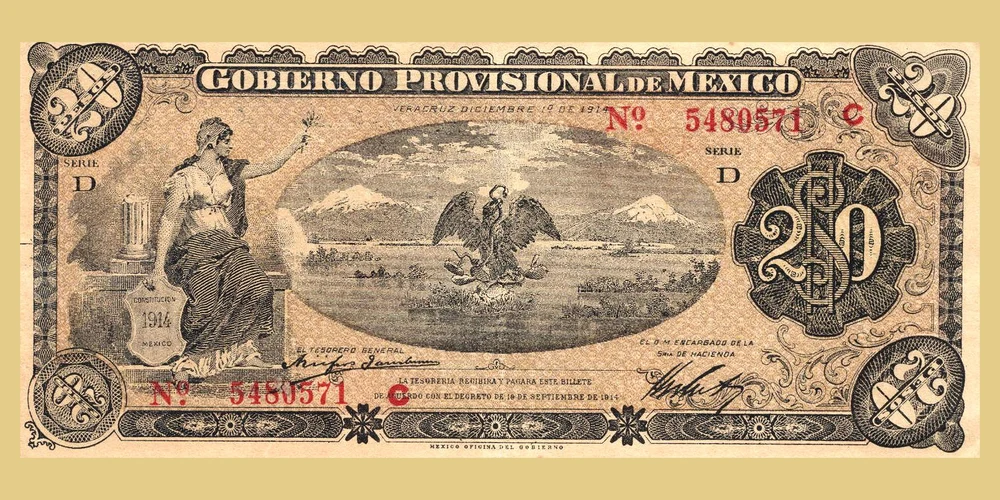
- Constitutionalist notes. Issues of Venustiano Carranza’s Ejército Constitucionalista and of the Gobierno Provisional de México, like the 20 pesos shown here.
- State and local issues. Notes from states, towns, haciendas and companies, and from Yucatán’s Comisión Reguladora del Mercado de Henequén.
Many revolutionary notes were printed in great numbers and are still common. Others, especially local issues, are rare. Fakes and modern reproductions also exist, so it pays to have notes checked.
The Revolution also produced emergency coins in silver and copper, from Zapata’s mints to Villa’s Chihuahua issues. See our page to sell Mexican Revolutionary coinage.
Banco de México Notes, 1925 to Today
The Banco de México was founded in 1925. Its first notes were issued from 1925 in 5 to 100 pesos, with 500 and 1,000 pesos following in 1931. For decades the notes were printed by the American Bank Note Company, and from 1969 the bank printed notes of its own.
Most Banco de México notes are common, but some are worth more than face value or more than their exchange value. We look for:
- Early series from the 1920s and 1930s, especially high denominations.
- Uncirculated notes with original crisp paper.
- Specimens, proofs and low or special serial numbers.
- Error notes, such as misprints, missing prints and cutting errors.
- Old peso notes issued before the 1993 currency reform, when 1,000 old pesos became 1 new peso.
PMG Grading and Condition
Condition is a big part of value for any banknote. Folds, tears, stains, pinholes and repairs all lower the grade, and so does washing or pressing a note to make it look better.
Many collectors prefer notes certified by PMG (Paper Money Guaranty), which grades notes on a 70-point scale and adds designations such as EPQ (Exceptional Paper Quality) for notes with original, unprocessed paper. See the PMG grading scale to learn how notes are graded.
You do not need to grade your notes before selling. We offer free in-house grading without slabbing, and as a PCGS and NGC authorized dealer we can tell you whether a note is worth certifying. Read more about rare coin grading services and paper currency grading.
Tip: do not clean, iron, tape or flatten your notes. Keep them as they are and send us photos.
What Affects the Value of Mexican Paper Money?
We do not publish prices for Mexican banknotes, because values depend on the exact note. These are the main things that affect value:
- Issuer. Notes from small banks, short-lived governments and local issuers are often scarcer.
- Series, date and denomination. Some dates and signature combinations are much rarer than others, and high denominations were often saved less.
- Condition. Uncirculated notes can be worth many times more than worn ones.
- Overprints, stamps and signatures. These can make a common note scarce, but fake overprints exist too.
- Authenticity and certification. Genuine, PMG-certified notes are easier to sell.
If you want a number, ask us. We will give you a free appraisal based on your actual notes and today’s market.
How to Sell Your Mexican Paper Money
Selling your Mexican paper money to American Rarities is simple:
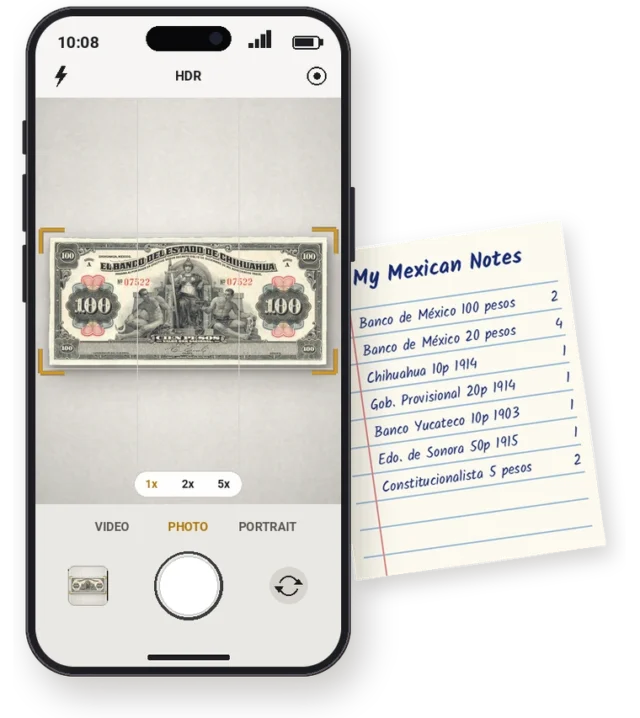
Send photos or an inventory list. Email clear pictures of the front and back of your notes, a simple list of what you have, or both, to staff@americanrarities.com, text them to 720-600-4740, or use the form on this page.
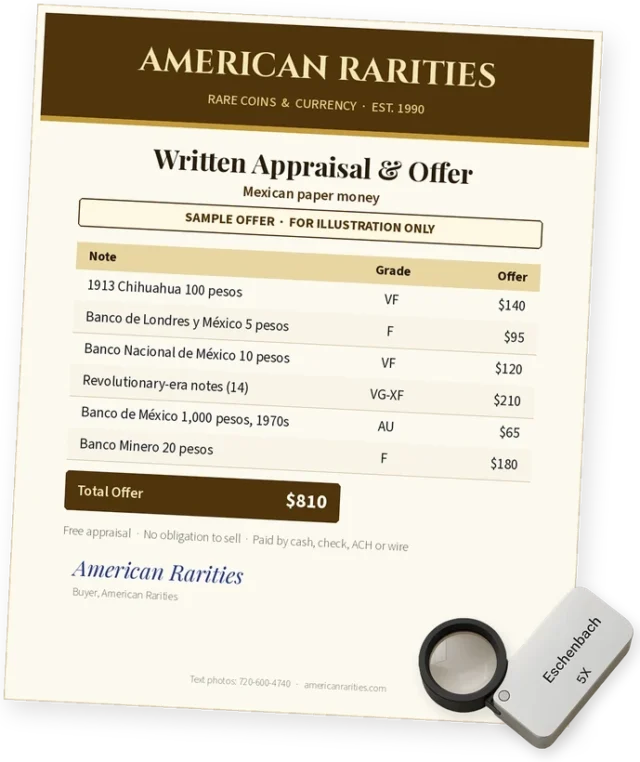
Get a free written appraisal. A numismatist reviews your notes. All appraisal requests are reviewed in the order they are received. Some appraisals take minutes, while larger, more complex collections can take a few days. Either way, you’ll get a response from us. with an appraisal and, if you want to sell, a written offer. There is no obligation.
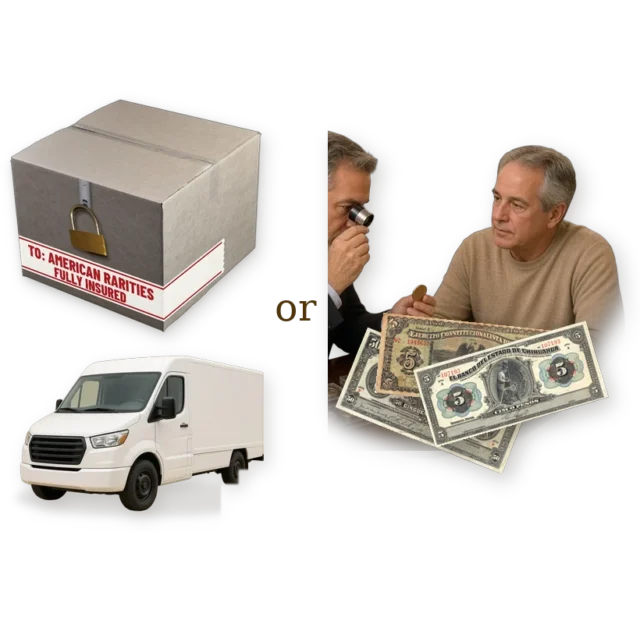
Choose how to deliver. Ship fully insured at our expense (we do not provide shipping materials), or have a buyer from our nationwide buying network meet you in person. We can also meet you at your bank.
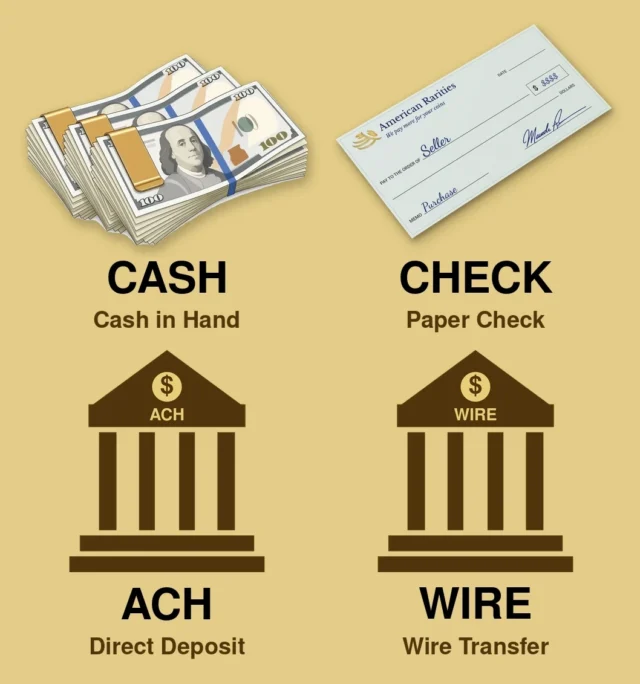
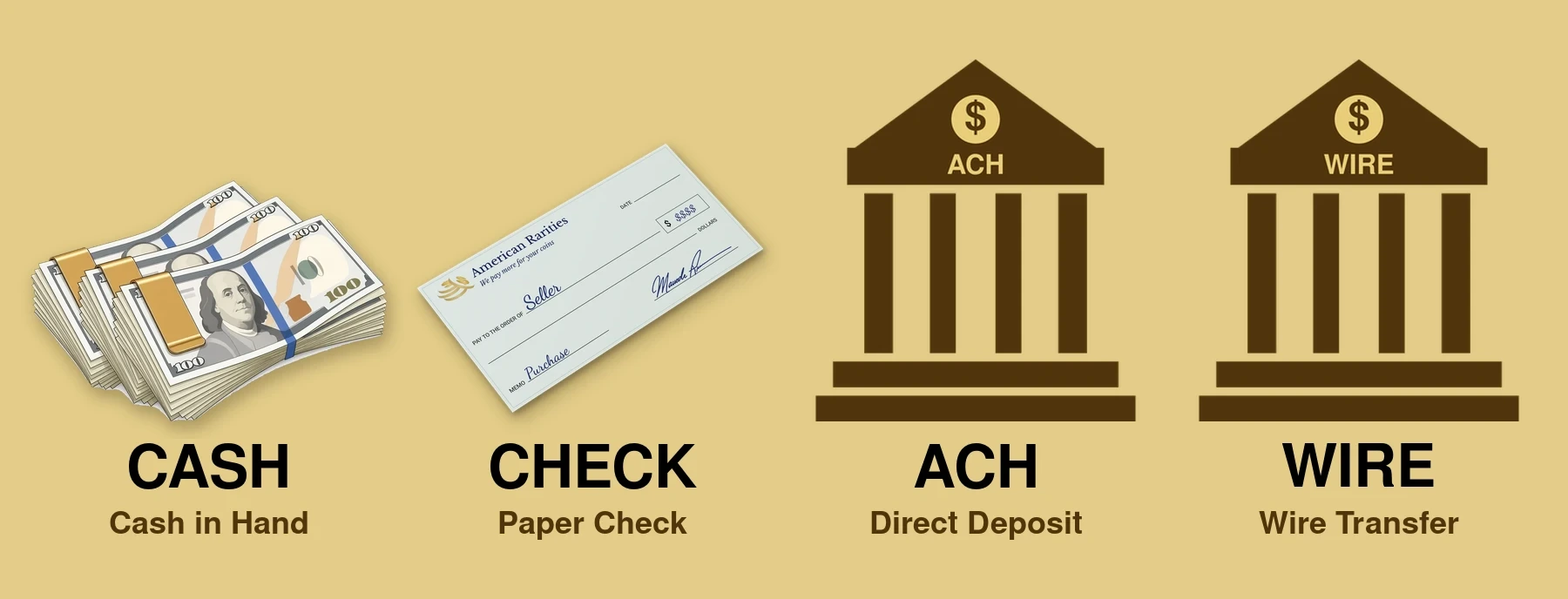
Get paid immediately. Once you accept our offer, we pay immediately by cash, check, ACH or wire.
Why sell to us? American Rarities was founded in 1990 and has purchased over $400 million in rare coins, paper money and precious metals. Our team members are ANA Life Members, we have a BBB A+ rating and a 4.7-star Google rating, and we are an authorized PCGS, NGC and ANACS dealer. For estates, we provide IRS-compliant appraisals. All appraisal requests are reviewed in the order they are received. Some appraisals take minutes, while larger, more complex collections can take a few days. Either way, you’ll get a response from us. See our estate appraisals and liquidation services.
Have U.S. notes too? See Sell Your U.S. Paper Currency, national currency notes and our paper money collector page.
Mexican Paper Money: Quick Answers
How much is my old Mexican paper money worth?
It depends on the issuer, series, date, denomination and condition. Many revolutionary and modern notes are common and worth a few dollars or less, while notes from small private and state banks of the 1800s and early 1900s, early Banco de México issues and high-grade notes bring more. Crisp, uncirculated notes can be worth many times worn examples of the same type. Send photos of both sides for a free appraisal.
Are Mexican Revolution banknotes valuable?
Some are. Many revolutionary notes, such as the common Gobierno Provisional and Constitucionalista issues, were printed in large numbers and are inexpensive. Scarce local issues from individual states, towns, generals and haciendas, rare varieties and notes in high grade are in demand from specialists. Reproductions exist too, so authenticity matters.
Can I still exchange old Mexican pesos at a bank?
Usually not for their face value. In 1993 Mexico introduced the new peso, worth 1,000 old pesos, so notes issued before the reform are in old pesos and now have little or no exchange value. Older series have been withdrawn from circulation. Their value today is usually as collectibles, and some older notes are worth far more to collectors than they ever were at a bank.
How can I tell if a Mexican banknote is a reproduction?
Reproductions of revolutionary and early bank notes are common, often sold as souvenirs. Warning signs include modern, bright white or glossy paper, blurry printing or visible inkjet dots under magnification, the wrong size, uniform fake aging and missing or repeated serial numbers. Genuine notes usually show crisp engraved or printed detail and natural wear. If you are unsure, send close-up photos and we will tell you.
What is a specimen Mexican banknote?
A specimen note is a sample printed for banks and officials to recognize new notes, usually overprinted or perforated with “MUESTRA” or “SPECIMEN” and often with zero serial numbers. Specimens were never meant to circulate, so they are usually in excellent condition and are collected for their rarity and quality. Specimens of early bank notes and Banco de México issues can be valuable.
Do you buy Mexican coins too?
Yes. We buy Mexican coins of every era, from colonial silver and gold escudos to Caballito pesos, revolutionary coins and modern gold and silver bullion such as the 50 pesos Centenario and the Libertad. Mixed Mexican collections are common, so send photos or a list of the coins and notes together. See our sell Mexican coins page for more.
Explore related pages: Mexican War of Independence coins, Mexican Independence SUD copper coins, Mexican Revolutionary coinage, Mexico gold pesos, Mexico Caballito pesos, Mexico gold escudos, Sell Your U.S. Paper Currency, U.S. paper currency information and paper money collector.
Have Mexican coins or other world coins too? See our sell foreign coins page.
Paper Money Guides
Sell Your U.S. Paper CurrencyFree appraisal and a cash offer for your notes
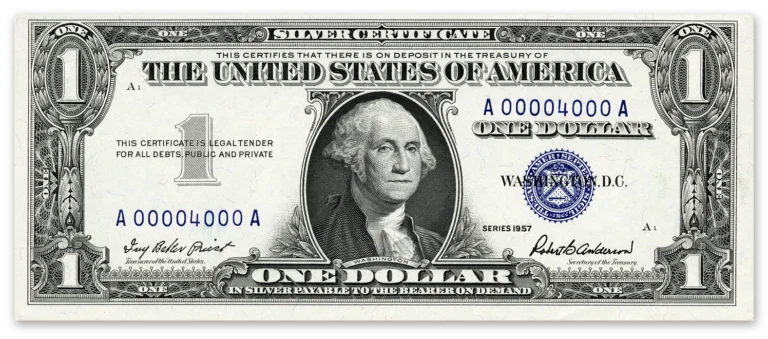
How to Sell Paper CurrencyFive steps to take before you sell
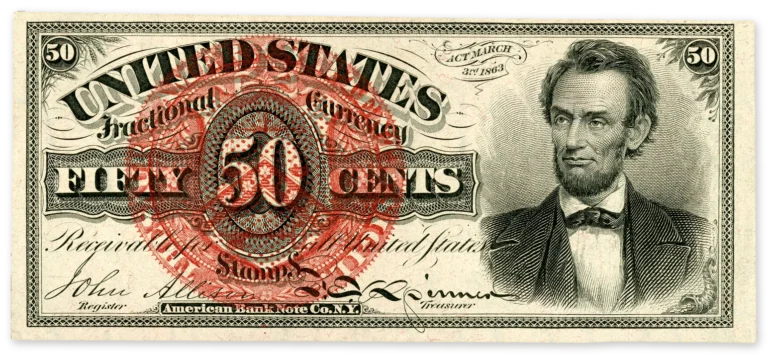
U.S. Paper Currency InformationHistory, types and how to identify U.S. notes
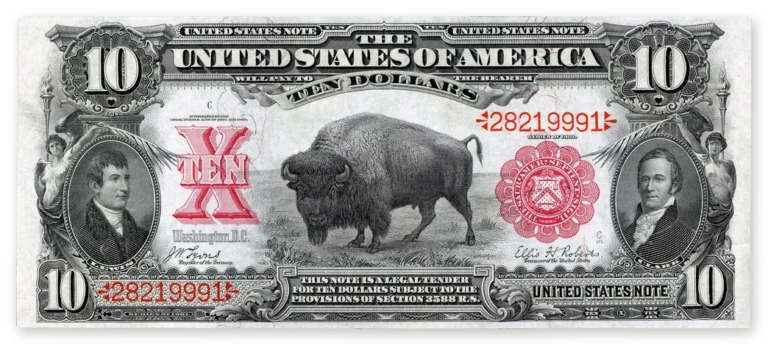
Collecting Paper MoneyNote types, grading, condition and care
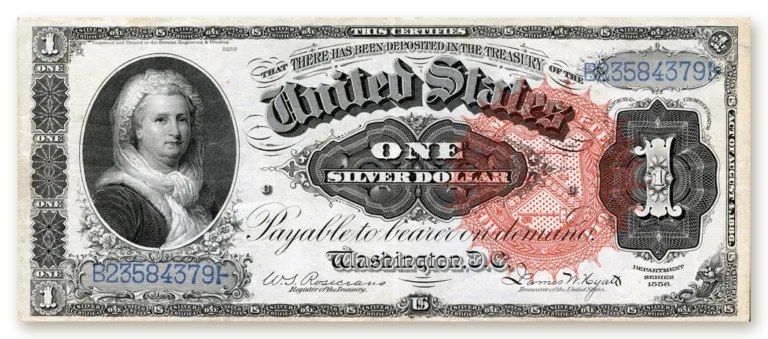
Paper Money Price GuideApproximate values for common U.S. notes
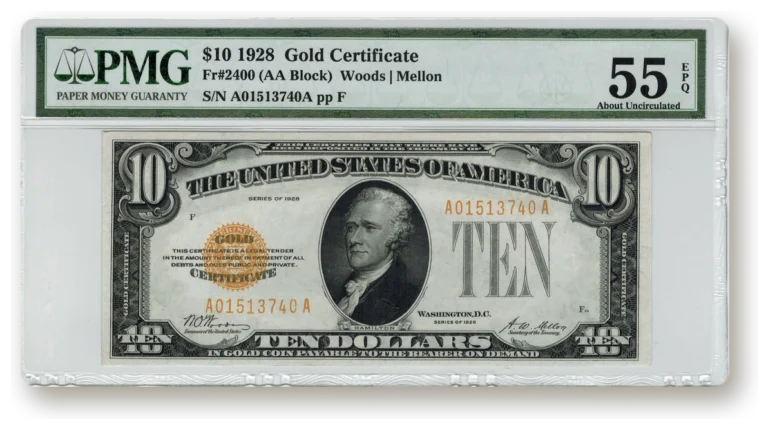
Paper Currency GradingHow PMG and PCGS Banknote grade notes
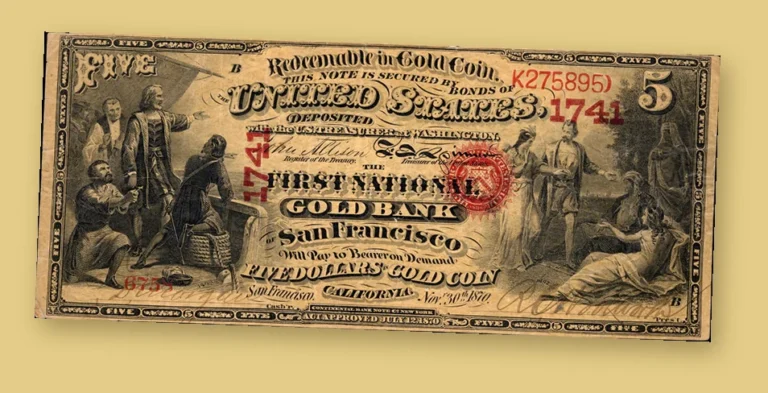
National Currency Notes GuideIdentify and value National Bank Notes
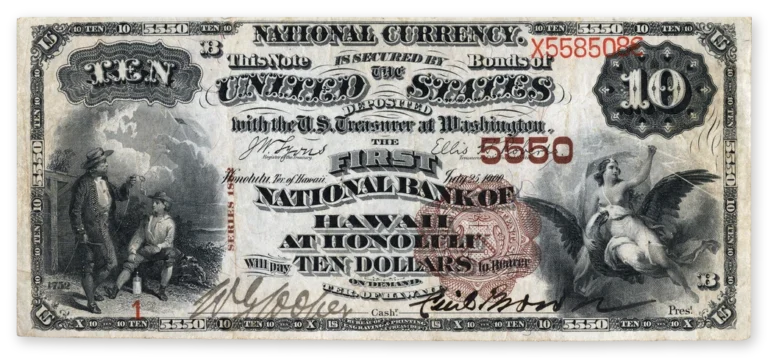
Sell National Currency NotesHow we appraise and buy National Bank NotesFind Out Your Mexican Currency Value Today
Email, Text, or Use This Form To Send Us Your Inventory List or Pictures
Email: staff@americanrarities.com Text: 720-600-4740
Professional Associations