

Leer esta página en español

Sell Mexico Gold Pesos

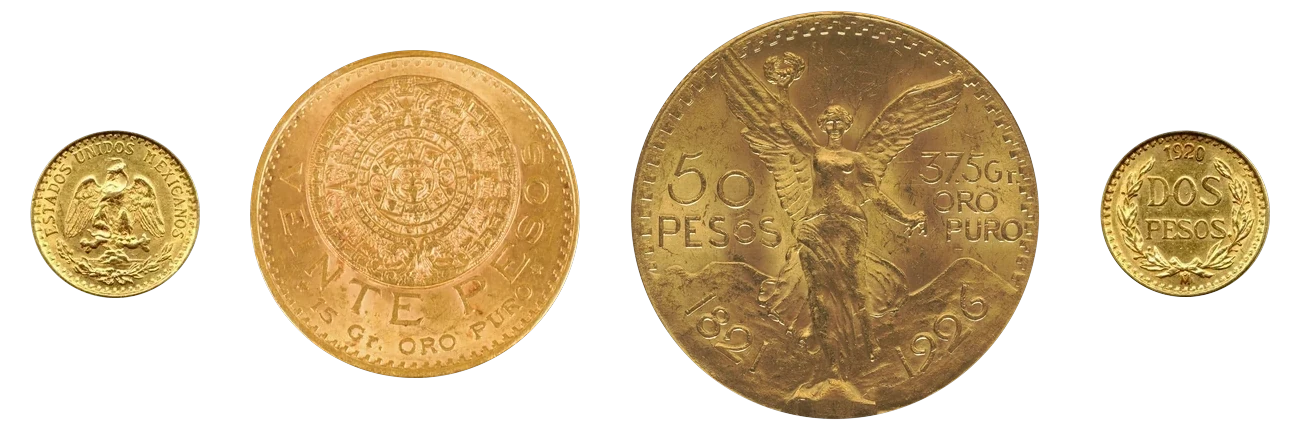
Mexican gold pesos: a 1920 2 pesos shown on both sides, a 1921 20 pesos with the Aztec calendar stone and a 1926 50 pesos Centenario with Winged Victory

Looking to sell Mexico gold pesos? Esta página también está disponible en español.

American Rarities buys Mexican gold coins of every denomination, from the tiny 2 Pesos to the 50 Pesos Centenario, whether you have one coin, a roll of restrikes or an inherited collection.

Send photos or a list by email, text or the form on this page and we will send back a free written appraisal. All appraisal requests are reviewed in the order they are received. Some appraisals take minutes, while larger, more complex collections can take a few days. Either way, you’ll get a response from us. If you accept, you are paid immediately by check, wire or ACH. There is never an obligation to sell.

This page covers Mexico’s modern gold peso series, struck to the 1905 gold standard: which coin you have, how much gold it contains, how to tell an original from a restrike, and when a coin is worth more than its gold.

On this page:

Decorative gold separator bar

The 1905 Monetary Reform and Mexico’s Gold Pesos

In 1905 Mexico put the peso on a gold standard, defining it as 0.75 grams of fine gold (see the history of the Mexican peso).

New gold coins were struck in 0.900 fine gold to match, so the gold content of every coin in the series follows from its face value: a 10 Pesos holds 7.5 grams of pure gold, a 20 Pesos 15 grams, and a 50 Pesos 37.5 grams.

The 5 and 10 Pesos came first in 1905. The 20 Pesos followed in 1917, the 2½ Pesos in 1918 and the 2 Pesos in 1919.

In 1921 Mexico added the 50 Pesos, the Centenario, to mark 100 years of independence. The Mexico City Mint kept striking gold pesos in the 1940s and, from the late 1940s on, as official restrikes for the bullion market.

If your coin is denominated in escudos or shows the old colonial or early Republic designs, it belongs to an earlier era. See our page on Mexican gold escudos instead.

Decorative gold separator bar
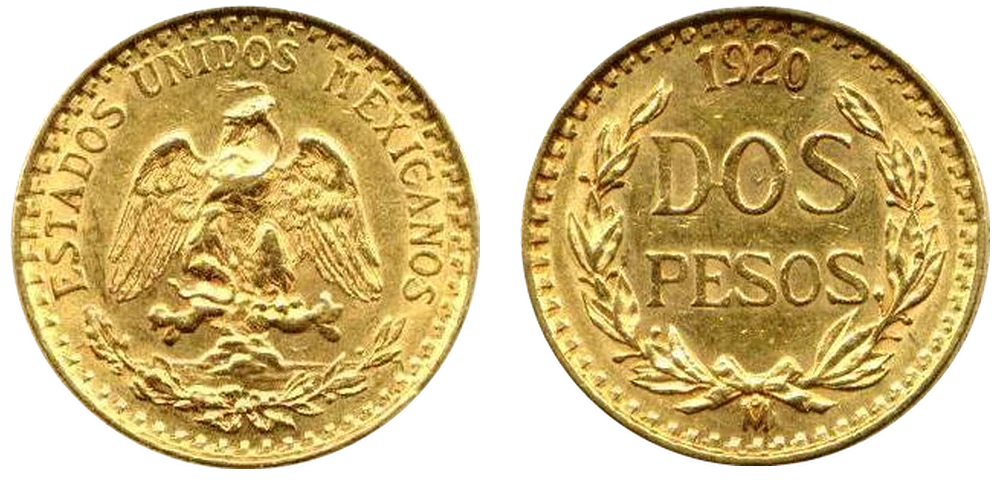
Mexico 1920 gold 2 Pesos showing the eagle and snake coat of arms and the DOS PESOS wreath side

Mexico Gold Peso Denomination Guide

All six coins are 0.900 fine gold, with the Mexican coat of arms, the eagle and snake, on one side. Use this table to identify yours:

CoinDesignOriginal datesPure gold (troy oz)Restrike date
2 PesosCoat of arms / DOS PESOS in a wreath1919–1920, 1944–19480.04821945
2½ PesosCoat of arms / Miguel Hidalgo1918–1920, 1944–19480.06031945
5 PesosCoat of arms / Miguel Hidalgo1905–1920 (some years)0.12061955
10 PesosCoat of arms / Miguel Hidalgo1905–1920 (some years)0.24111959
20 PesosCoat of arms / Aztec calendar stone1917–19210.48231959
50 Pesos (Centenario)Coat of arms / Winged Victory and volcanoes1921–1931, 1943–19471.20571947
  • 2 Pesos: the smallest coin, about the size of a fingernail. It shows DOS PESOS and the date in a wreath.
  • 2½, 5 and 10 Pesos: all three show a bust of Miguel Hidalgo, the father of Mexican independence. Check the denomination to tell them apart.
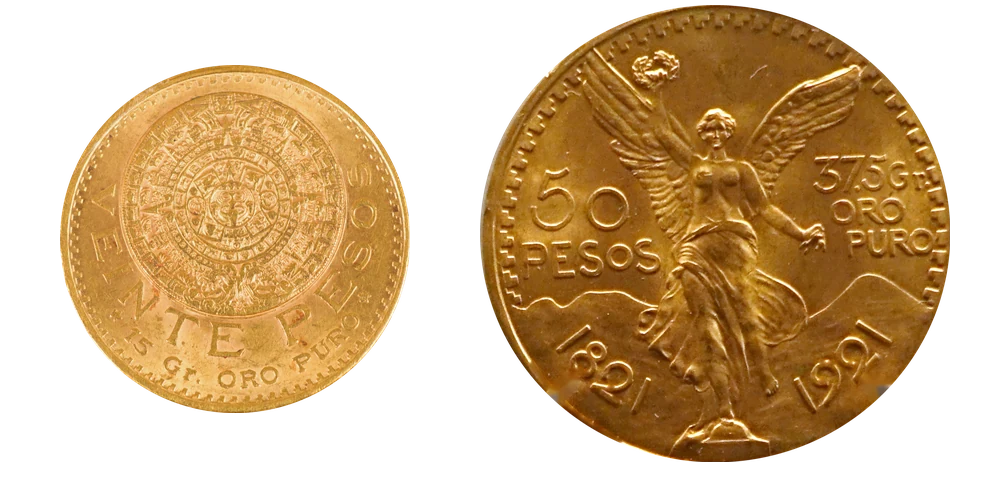
  • 20 Pesos: shows the Aztec calendar stone and is marked “15 Gr. Oro Puro”.
  • 50 Pesos Centenario: the largest coin, 37 mm across, designed by Emilio del Moral. It shows Winged Victory with the volcanoes Popocatépetl and Iztaccíhuatl and the dates 1821 and the year of issue. The 1943 coins carry “37.5 Gr. Oro Puro” with no denomination.

The Centenario’s history is covered in detail on Wikipedia and by PCGS.
Decorative gold separator bar
Mexico 1921 gold 20 Pesos Aztec calendar stone and 1921 gold 50 Pesos Centenario with Winged Victory

Original Strikes vs. Restrikes

Most Mexican gold pesos you will find today are official restrikes. From the late 1940s the Mexico City Mint struck millions of gold coins for the bullion market, keeping old dates on the dies. These are genuine government coins with full gold content, but they carry “frozen” dates:

  • 1945 on the 2 and 2½ Pesos, struck from 1951 to 1972
  • 1955 on the 5 Pesos, struck from 1955 to 1972
  • 1959 on the 10 and 20 Pesos, struck from about 1960 to 1972
  • 1947 on the 50 Pesos, struck from 1949 to 1972, again in 1996, and with a newer die in the 2000s

Some restrikes were also made in later decades for collectors. According to PCGS, restrike mintages run into the millions for the common dates, which is why these coins usually trade close to their gold value.

A coin with any other date, such as a 1906 10 Pesos, a 1918 20 Pesos or a 1928 50 Pesos, is an original strike. Original dates had smaller mintages and many saw circulation, so they are more likely to carry a collector premium, especially in high grades.

Restrikes usually look bright and nearly new, while originals often show wear.

Counterfeits of popular gold coins do exist. We test every coin with XRF analysis and digital microscopy. Read more about fake and altered coins.

Decorative gold separator bar

Bullion Value vs. Numismatic Value

Every Mexican gold peso has a floor value set by its gold content. To estimate it, multiply the coin’s pure gold weight from the table above by the current spot price of gold, which you can check on Kitco.

Spot changes all day, so any estimate is only good for the moment you make it. A dealer’s offer on bullion coins is figured from spot at the time of the offer.

Some coins are worth more than their gold:

  • Original dates with low mintages, from the 1905–1921 coins to the 1920s and 1930s Centenarios
  • High-grade coins, especially original dates in mint state
  • Certified coins graded by PCGS or NGC, which are easier to price. See selling PCGS, NGC and ANACS coins
  • Complete date or type sets, which some collectors seek out

Common-date restrikes, on the other hand, are bought and sold as bullion. We grade coins in-house for free, without slabbing, so you will know which of your coins are bullion and which deserve a closer look.

Selling other gold too? See our pages on gold and silver bullion and U.S. gold coins.

Decorative gold separator bar

Earlier Gold Pesos: The Balance Scale Series (1870–1905)

Mexico struck gold coins in pesos long before the 1905 reform. From 1870 it issued decimal gold coins of 0.875 fine gold, which collectors call the Balance Scale type, after the design they share with the silver Balance Scale peso of 1869–1873. The silver peso was dropped in 1873, but the gold coins kept the design until 1905.

Every coin shows the eagle and snake coat of arms with REPUBLICA MEXICANA and the date. The 5, 10 and 20 Pesos show a radiant Liberty cap above the scales of justice, with a sword across the scroll of law and the words LIBERTAD and LEY. The small 1 and 2½ Pesos show their value in a wreath instead.

CoinDesignDatesWeightPure gold (troy oz)
1 PesoCoat of arms / 1 PESO in a wreath1870–19051.692 g0.0476
2½ PesosCoat of arms / 2½ PESOS in a wreath1870–18934.23 g0.1190
5 PesosCoat of arms / Balance Scale1870–19058.46 g0.2380
10 PesosCoat of arms / Balance Scale1870–190516.92 g0.4760
20 PesosCoat of arms / Balance Scale1870–190533.84 g0.9520

These coins are larger and heavier than the 1905 series. A Balance Scale 20 Pesos holds almost a full ounce of gold, about twice as much as a 1917–1921 20 Pesos. Mintages were small: in 1870 the Mexico City Mint struck only 480 of the 10 Pesos. Regional mints struck them too, and the reverse carries the mint mark (such as Mo for Mexico City, Go for Guanajuato or Zs for Zacatecas) and the assayer’s initial. Value depends on date, mint and grade, not just gold content, so send us clear photos of both sides.

Date-by-date mintages for each mint are listed on Numista and in the NGC World Price Guide.

Decorative gold separator bar

How to Sell Mexico Gold Pesos in 5 Steps

Selling your Mexico gold pesos to American Rarities takes five simple steps:

Smartphone with a light camera screen showing a 1922 Mexico 50 pesos Centenario, overlapping a handwritten inventory list titled My Gold Pesos

Send Photos and/or a List

Photograph both sides of each coin with the date and denomination in focus. Email the pictures to staff@americanrarities.com, text them to 720-600-4740, or upload them with the free appraisal form below.

A simple list works too, with or without photos: for example a 1922 50 pesos Centenario, a 1930 50 pesos or a 1906 10 pesos Hidalgo. If your coins are certified by PCGS, NGC or ANACS, include the cert numbers. Please don’t clean your coins.

American Rarities written appraisal and offer sheet listing sample Mexican gold pesos, with a small Eschenbach 5X folding loupe at the lower left

Free Appraisal and Written Offer

A numismatist checks each coin’s denomination, date, whether it is an original strike or a restrike, and its condition. All appraisal requests are reviewed in the order they are received. Some appraisals take minutes, while larger, more complex collections can take a few days. Either way, you’ll get a response from us.

If you want to sell, you get a written offer with no obligation. Common-date restrikes are valued on their gold content, while original dates and high-grade coins can be worth more. We also give a free grading opinion without slabbing, and IRS-compliant appraisals are available for estates.

Two locked, addressed cartons on a rolling cart, marked insured, with packing windows showing a 1930 Mexico 50 pesos Centenario and a 1906 10 pesos Hidalgo

Ship Fully Insured (paid by us)

Pack your gold pesos securely in a locked carton addressed to American Rarities. Shipping is fully insured at our expense, with no deductible. We do not provide shipping materials.

For larger holdings, see selling a large coin collection. If you decline our offer, we return your items fully insured.

A buyer examining a 1930 Mexico 50 pesos Centenario with a loupe, seated across from a seller, with a 1906 10 pesos and a 1920 2½ pesos on the table

Meet in Person

Prefer to hand your coins over in person? A buyer from our nationwide buying network can visit you at home, or we can meet you at your bank, to look over your gold pesos with you.

Meeting in person works well for estates, rolls of restrikes and collections you would rather not ship.
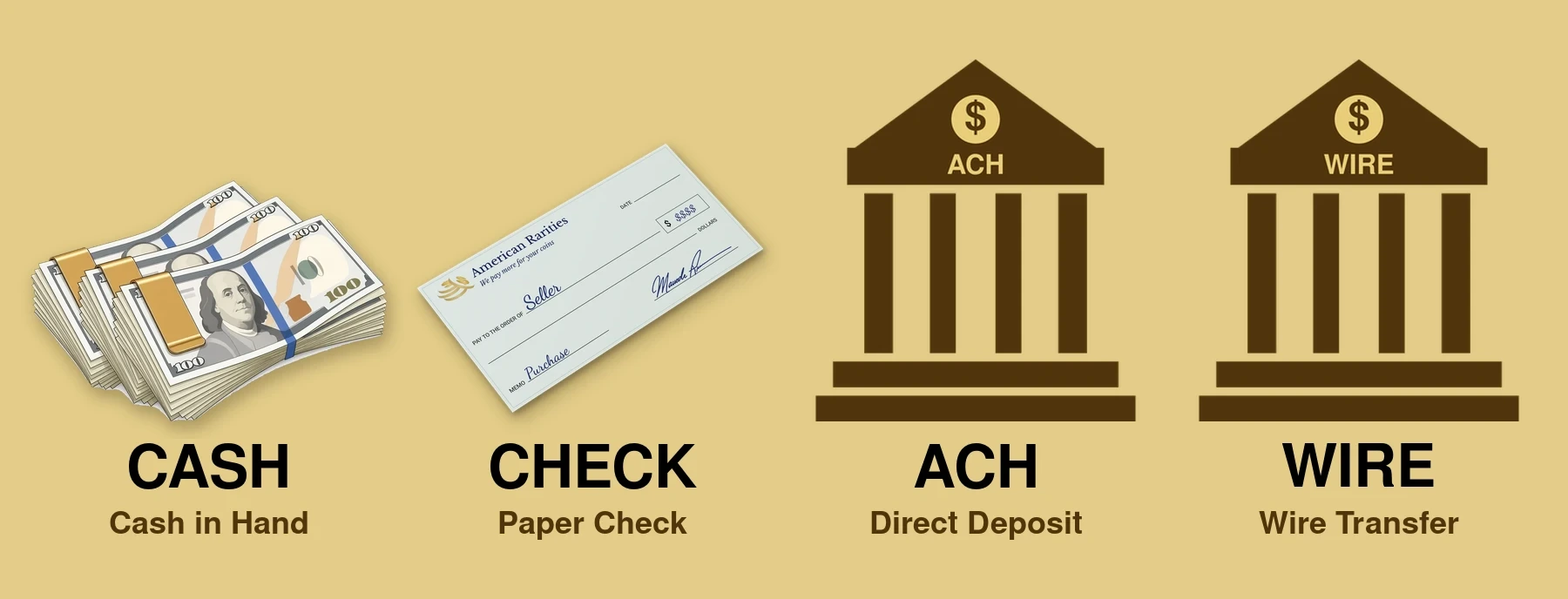
Four ways to get paid for your coins: stacks of $100 bills labeled Cash, an American Rarities check labeled Check, and two bank buildings labeled ACH and Wire

Get Paid (cash, check, ACH or wire)

Once your coins arrive and we confirm them, we pay you immediately by cash, check, ACH or wire, whichever you prefer.

Why Sell Your Mexican Gold to American Rarities

  • Founded in 1990, with more than 30 years in the rare coin business and over $400 million in coins purchased
  • Hundreds of years of combined experience on our team, with buyers in California, Colorado and Arizona, plus Minnesota, Texas, Florida, Pennsylvania, Wyoming and New Jersey
  • Life Members of the American Numismatic Association and an A+ rating from the Better Business Bureau
  • PCGS and NGC authorized dealer and ANACS submission center
  • 4.7 stars from 86 Google reviews
  • Free in-house grading, XRF testing and digital microscopy

Read what sellers say in our customer testimonials, or meet our rare coin experts.

Decorative gold separator bar

Mexico Gold Pesos: Quick Answers

How much gold is in a 50 Pesos Centenario?

37.5 grams of pure gold, or 1.2057 troy ounces. The coin weighs 41.67 grams because it is 90% gold, with copper making up the rest.

To estimate a common-date Centenario’s gold value, multiply 1.2057 by the current spot price of gold. Original dates from 1921 to 1931 and high-grade coins can be worth more than their gold.

How can I tell if my Mexican gold coin is a restrike?

Check the date. Coins dated 1945 (2 and 2½ Pesos), 1955 (5 Pesos), 1959 (10 and 20 Pesos) and 1947 (50 Pesos) are almost always official restrikes, made in large numbers for the bullion market.

A coin with any other date, such as a 1906 10 Pesos or a 1928 50 Pesos, is an original strike. Restrikes usually look bright and nearly new, while originals often show wear.

Are Mexican gold restrikes real gold?

Yes. The Mexico City Mint made them to the same 0.900 fine standard as the originals, with full gold content, and they usually trade close to gold value. They are genuine government coins, not copies. Counterfeits of popular gold coins do exist, though, so we test every coin with XRF analysis and digital microscopy before making a final offer.

Is it legal to sell Mexican gold coins in the U.S.?

Yes. There is no restriction on owning or selling Mexican gold pesos in the United States. Under IRS reporting rules, dealers file Form 1099-B when someone sells 25 or more 50 Pesos coins in one transaction.

Smaller sales are not reported by the dealer, but any gain on gold is still taxable to you, so keep your purchase records and ask your tax adviser.

Decorative gold separator bar

Find Out Your Mexico Gold Pesos Value Today

Email, Text, or Use This Form To Send Us Your Inventory List or Pictures


Upload files of inventory lists and front and back photos of your items.

    We can help build your inventory list. Use the Collection List Maker to photograph your items and we'll build the inventory list for you.

    Decorative gold separator bar

    Professional Associations

    Professional association and grading-service logos including ANA Life Member, PMG, PCGS, NGC, ANACS, CAC, CCE and currency-grading organizations