

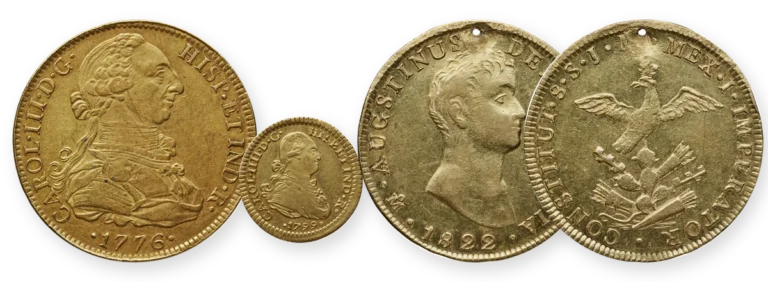
Mexico gold escudos are the gold coins of New Spain and the early Mexican Republic, struck at the Mexico City mint from 1679 and at a network of Republic-era branch mints until 1873. Esta página también está disponible en español.
They range from the tiny 1/2 escudo to the 8 escudos, the big gold “onza” or doubloon of eight that traveled the world’s trade routes.
American Rarities has been buying gold coins since 1990, with more than $400 million purchased.
Whether you have a single hammered cob, a set of Spanish king portrait doubloons, or Republic Hand on Book 8 escudos, you get a free, no-obligation appraisal. All appraisal requests are reviewed in the order they are received. Some appraisals take minutes, while larger, more complex collections can take a few days. Either way, you’ll get a response from us. Immediate payment by check, wire, or ACH when you accept an offer.
Gold Escudo Denominations: 1/2 to 8 Escudos
Mexico’s gold escudos followed the Spanish American standard: one escudo weighed about 3.383 grams, and the larger coins are multiples of it. The gold was 22 karats (11/12, or .917 fine), later reduced to 21 karats (.875 fine), according to the Mexican peso history.
- 1/2 escudo: about 1.69 grams, the smallest gold coin of the system.
- 1 escudo: about 3.38 grams, worth roughly 16 silver reales.
- 2 escudos: the classic doubloon, or pistole.
- 4 escudos: half the weight of the 8 escudos.
- 8 escudos: about 27 grams, the onza or doubloon of eight, and the most widely collected size.
Three Eras of Mexico Gold Escudos
Hand-struck cobs (1679 to the early 1730s)
The Mexico City mint, founded in 1535, struck only silver and copper for well over a century.
Gold coinage was authorized in 1675 and began in December 1679. The first gold escudos were irregular, hand-hammered cobs in 1, 2, 4, and 8 escudos, showing a cross on one side and the crowned Spanish arms on the other.
Milled portrait doubloons (from 1732)
In 1732 the mint moved to machine-struck, round coins with a protective edge. The gold now carried the king’s portrait, from Philip V through Ferdinand VI, Charles III, Charles IV, and Ferdinand VII, with the Mo mint mark and the initials of the mint assayers.
These are the coins most people picture when they hear “Spanish doubloon”. Coins of the 1810–1821 War of Independence are covered on our Mexican War of Independence coins page.
Empire and early Republic (1822–1873)
After independence, Mexico City struck 8 escudos for Emperor Agustín I Iturbide in 1822 and 1823 during the First Mexican Empire, followed by the Republic’s short-lived 1823 “hookneck” eagle 8 escudos.
From 1824 the Republic used the design collectors know as Hand on Book (the silver 8 reales of the same years are the Cap and Rays design): a facing eagle with REPUBLICA MEXICANA on one side, and on the other a hand holding a staff topped by a liberty cap over an open book marked LEY, surrounded by rays and the motto LA LIBERTAD EN LA LEY.
The PCGS population report for the 1824–1873 8 escudos lists the many dates and mints of this type. The later 1870–1873 peso-denominated gold and silver coins are the Balance Scale type. For Mexico’s later decimal gold coins, see Sell Mexico Gold Pesos.
What Makes a Mexico Gold Escudo Valuable?
- Era and type: cobs, portrait doubloons, Iturbide Empire issues, and Republic Hand on Book escudos each have their own collector market.
- Mint and assayer: Republic escudos were struck at Mexico City (Mo) and at branch mints including Guadalajara (Ga), Guanajuato (Go), Durango (Do), Chihuahua (Ca), Guadalupe y Calvo (GC), Culiacán (C), Zacatecas (Zs), Hermosillo (Ho), Álamos (A), Oaxaca, and the Estado de México mint (EoMo). Some mint and date combinations are far scarcer than others.
- Denomination and date: rare dates and short-lived types carry premiums well above gold content.
- Condition: a sharp, original coin is worth much more than one that is worn, holed, bent, cleaned, or saltwater-damaged.
- Authenticity: gold escudos are often counterfeited. We test with XRF and digital microscopy, and offer free in-house grading without slabbing. Certified coins from NGC or PCGS are welcome too.
Values move with gold prices and the collector market. If you want a reference point, use current NGC or PCGS guide values with their as-of date, or ask us for a free appraisal of your own coins.
Why Sell Your Gold Escudos to American Rarities?
- Experience: founded in 1990, with hundreds of years of combined experience across our nationwide buying network.
- Trusted reputation: an A+ rating with the BBB, a 4.7-star Google rating, and Life Members of the ANA.
- Industry credentials: a PCGS and NGC authorized dealer and an ANACS submission center.
- Estates and donations: IRS-compliant appraisals and home visits for larger collections.
- Fast payment: immediate payment by check, wire, or ACH once you accept.
We also buy U.S. gold coins and foreign coins of every kind, so a mixed collection can be appraised all at once.
How the Selling Process Works
Selling your Mexico gold escudos to American Rarities takes four simple steps:

Send Photos and/or a List
Photograph both sides of each escudo, with the date, the mint mark (Mo, Go, Ga and others) and the assayer initials in focus. Email the pictures to staff@americanrarities.com, text them to 720-600-4740, or upload them with the free appraisal form below.
A simple list is a fine start too, with or without photos: for example an 1810 Ferdinand VII 8 escudos, a 1714 Mexico City cob 2 escudos, or an 1825 Republic ½ escudo. Please don’t clean your coins.

Free Appraisal and Written Offer
A numismatist who knows colonial and Republic gold checks each coin’s type, mint, assayer, date and condition. All appraisal requests are reviewed in the order they are received. Some appraisals take minutes, while larger, more complex collections can take a few days. Either way, you’ll get a response from us.
If you want to sell, you get a written offer with no obligation. We also give a free grading opinion without slabbing, and certified PCGS, NGC or ANACS escudos are welcome.

Ship or Meet
Ship fully insured (paid by us), with no deductible, in a carton addressed to American Rarities. We do not provide shipping materials.
Prefer to meet? A buyer from our nationwide buying network can visit you at home, or we can meet you at your bank, to look over your escudos in person. If you decline, we return your items fully insured.
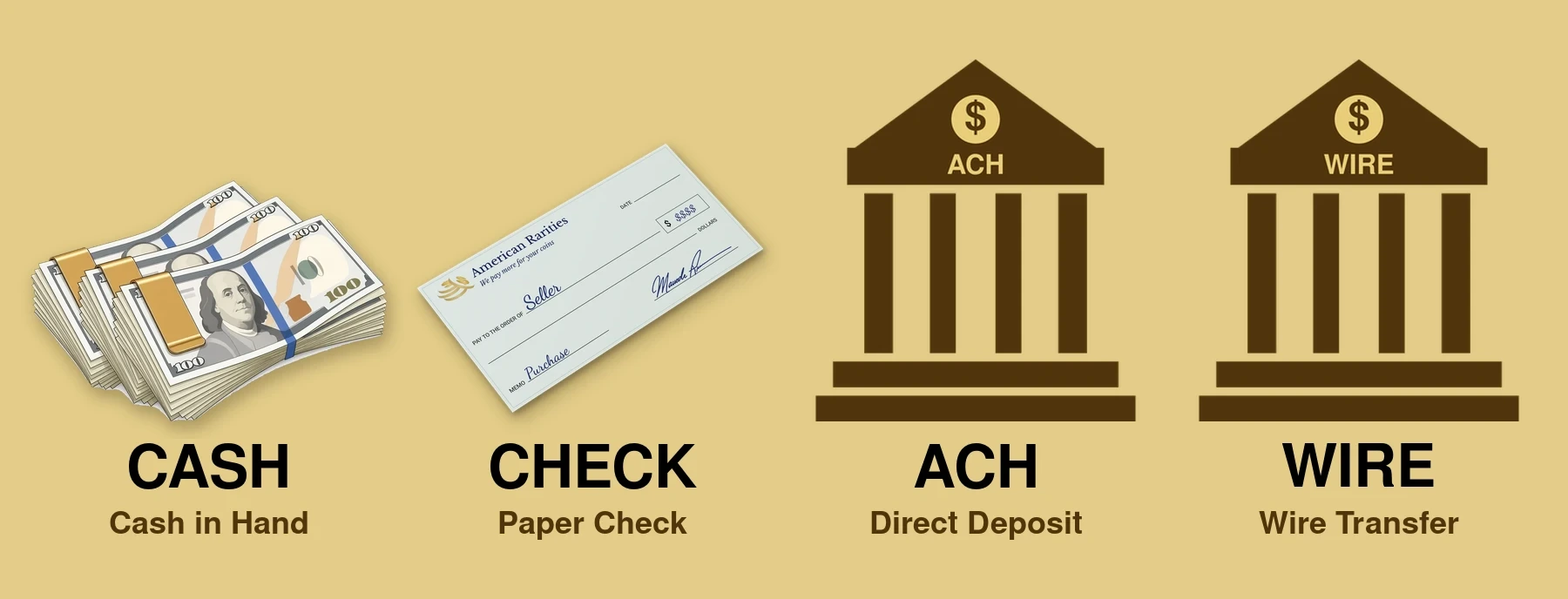
Get Paid (cash, check, ACH or wire)
Once your escudos arrive and we confirm them, we pay you immediately by cash, check, ACH or wire, whichever you prefer.

Ready to Sell Your Mexico Gold Escudos?
Send us photos of your gold escudos for a free, no-obligation appraisal. Please don’t clean your coins; cleaning can sharply reduce their value.
Selling other Mexican coins or currency? See Mexico gold pesos, Caballito pesos, Mexican War of Independence coins, Morelos SUD copper coins, Mexican Revolutionary coinage, and Mexican paper money.
Mexico Gold Escudos: Quick Answers
What is the difference between a cob and a milled escudo?
Cobs, struck from 1679 to the early 1730s, were hand-hammered and irregular, with a cross on one side and the crowned Spanish arms on the other.
From 1732 Mexico City struck round, machine-made coins with a protected edge and, on the gold, the king’s portrait. Both are collected, and cobs with a clear date and assayer mark are especially sought after.
What is a Hand on Book 8 escudos?
It is the Mexican Republic’s gold 8 escudos of 1824 to 1873, with a facing eagle on one side and a hand holding a liberty cap over an open book, surrounded by rays, on the other.
It was struck at Mexico City and many branch mints, so value depends heavily on the mint and date combination, as well as condition. Some combinations are common, while others are rare.
How do I know which mint struck my escudo?
Look for the mint mark near the date or in the legend. Mo is Mexico City; Republic branch mints used marks such as Ga for Guadalajara, Go for Guanajuato, Do for Durango, Ca for Chihuahua, Zs for Zacatecas and Ho for Hermosillo.
The letters beside the mint mark are the assayers’ initials. Send us a close-up photo and we will identify it for free.
How much gold is in an 8 escudos?
An 8 escudos weighs about 27 grams and contains roughly 0.76 to 0.80 troy ounces of pure gold, depending on whether it was struck at 22 karats or the later 21-karat standard.
Smaller denominations are fractions of that: a 4 escudos holds half, a 2 escudos a quarter. Most escudos sell well above their gold value because collectors want them.
How can I tell if a gold doubloon is real?
Weight and size are the first checks, but they are not enough, because gold escudos are often counterfeited and some fakes are made of real gold.
Look for crisp, consistent lettering and an edge that matches the type, and be wary of coins with soft details or cast-looking surfaces. We test every coin with XRF analysis and digital microscopy, and PCGS or NGC certification adds confidence. Never clean a coin to inspect it.
Find Out Your Mexico Gold Escudos Value Today
Email, Text, or Use This Form To Send Us Your Inventory List or Pictures
Email: staff@americanrarities.com Text: 720-600-4740
Professional Associations
