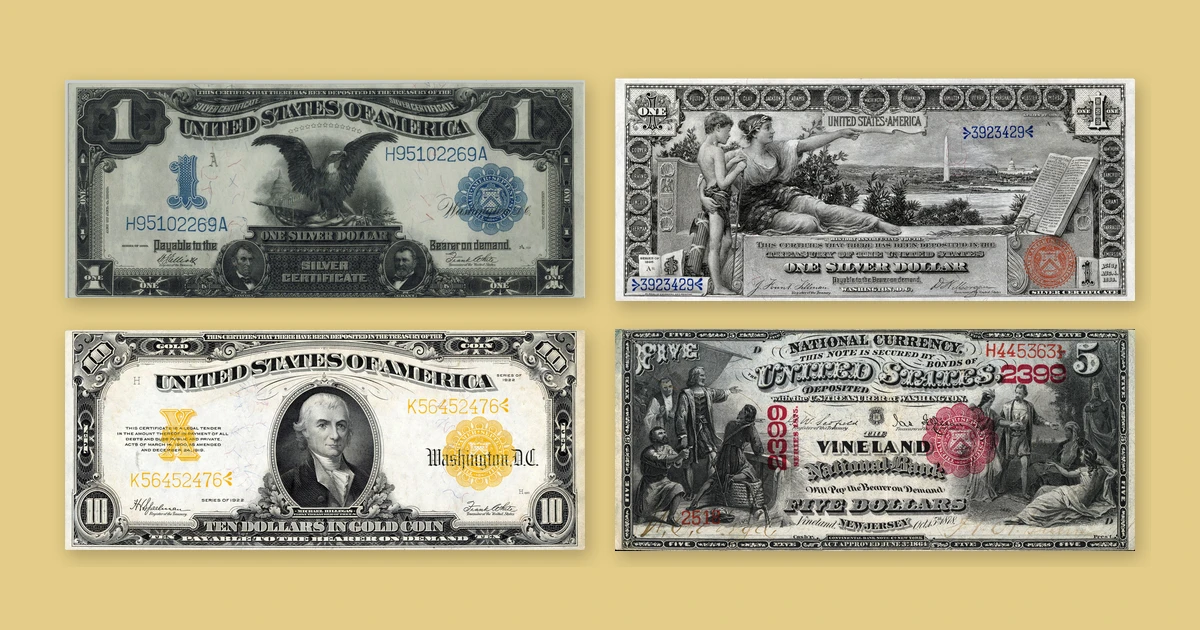
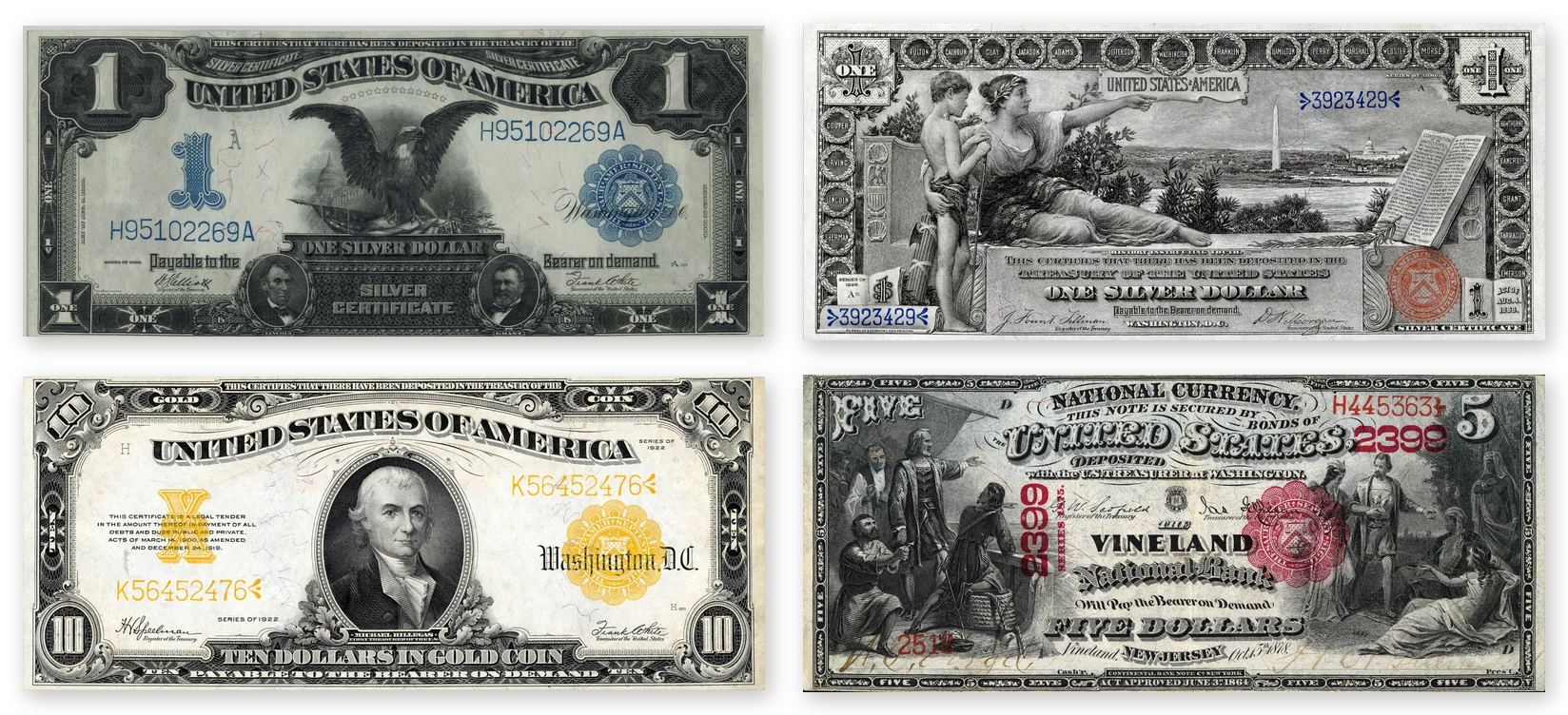

An 1899 Black Eagle $1, an 1896 Educational $1, a 1922 $10 gold certificate and an 1875 $5 National Bank Note on a gold background
How to Sell Paper Currency, a guide from American Rarities. 1899 $1 Black Eagle silver certificate: photo by Bruxton via Wikimedia Commons, CC0 (public domain). 1896 $1 Educational silver certificate: National Numismatic Collection, National Museum of American History (Smithsonian), image by Godot13 via Wikimedia Commons, licensed CC BY-SA 4.0 (public-domain note design). 1922 $10 gold certificate: National Numismatic Collection, National Museum of American History (Smithsonian), image by Godot13 via Wikimedia Commons, licensed CC BY-SA 4.0 (public-domain note design). 1875 $5 National Bank Note, Vineland National Bank, New Jersey: image by Godot13 via Wikimedia Commons, licensed CC BY-SA 3.0 (public-domain note design). Backgrounds removed and notes arranged by American Rarities.

How to Sell Paper Currency: A Step-by-Step Guide to Selling Old Paper Money

  • Post published:
  • Post category:Articles
Four large-size U.S. notes shown at the same scale: an 1899 $1 Black Eagle silver certificate, an 1896 $1 Educational silver certificate, a 1922 $10 gold certificate and an 1875 $5 National Bank Note

Old Paper Money: Where to Begin

Maybe you found a stack of big old bills in a family Bible, a grandparent saved a few silver certificates in an envelope, or an estate turned up an album of notes nobody has looked at in years. Old paper money is easy to overlook and easy to damage, and its value can range from a little over face to many times face, depending on the type of note, its serial number and, above all, its condition. Knowing how to sell paper currency the right way helps you avoid the buyers who count on sellers not knowing what they have.

Founded in 1990, American Rarities has purchased more than $400 million in rare coins, paper currency and collectibles. This guide walks through the five steps we recommend before you sell old currency: identifying what you have, checking serial numbers and errors, protecting condition, understanding grading and spotting counterfeits and replicas. At the end, you will find how to get a free appraisal. If you have coins too, our guides on how to sell gold coins, how to sell silver dollars, how to sell inherited coins, how to sell proof and mint sets and how to sell a coin collection complete the series.

Decorative gold separator bar

Step 1: Know What Kind of Paper Money You Have

The first question is simply what type of note you are holding. Each type has its own collector market, and some are worth far more than others.
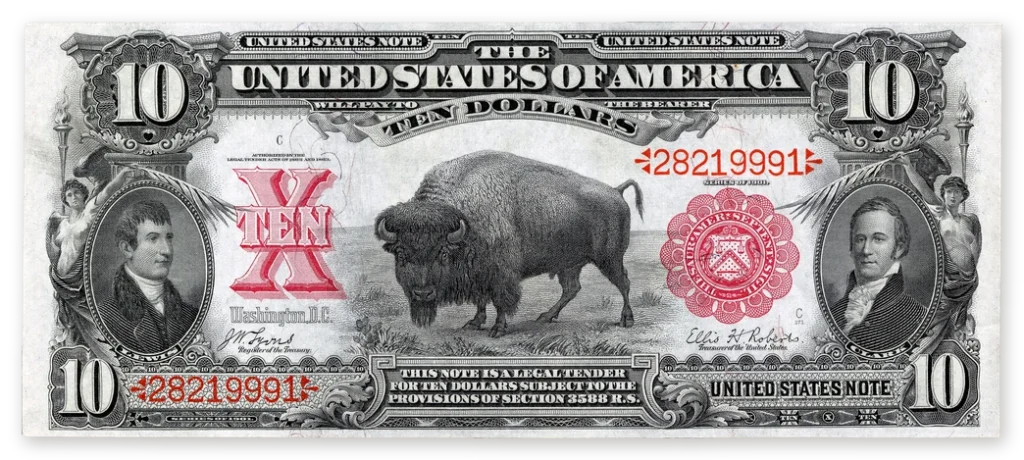
A Series 1901 $10 Legal Tender large-size note with an American bison at center between portraits of Lewis and Clark

Large-size notes. Before 1929, U.S. paper money was noticeably larger than today’s bills, roughly 7.4 by 3.1 inches. Collectors often call them “horse blankets.” Designs like the 1901 $10 “Bison” note shown here, the 1896 Educational series and the 1899 Black Eagle silver certificate are among the most popular notes in American collecting.
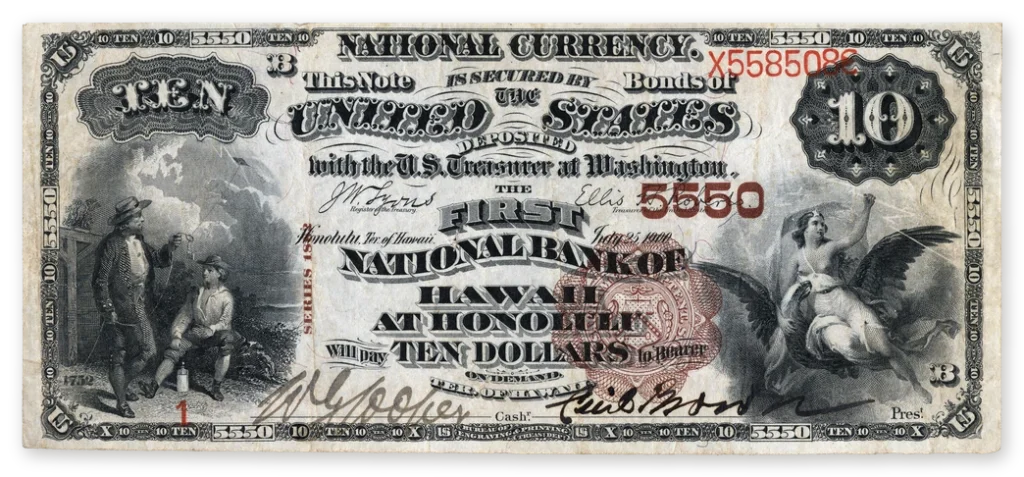
A Series 1882 $10 Brown Back National Bank Note from the First National Bank of Honolulu, charter 5550, serial number 1

National Bank Notes. From 1863 to 1935, thousands of local banks issued their own notes, each printed with the bank’s name, town and charter number, like this 1882 $10 from the First National Bank of Honolulu. Notes from small towns, rare states and territories and early series can be in strong demand. Our comprehensive guide to National Currency notes explains more, and you can sell National Currency notes to us directly.
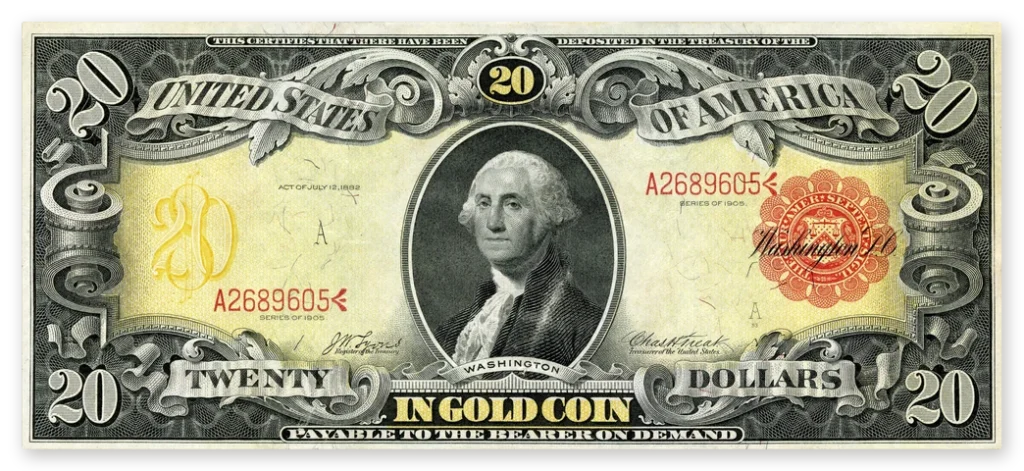
A Series 1905 $20 gold certificate with George Washington and gold and red coloring, known as the Technicolor note

Gold certificates. Notes with a gold seal or bright orange-gold back, once redeemable in gold coin, are legal to own and collect today. The 1905 $20 shown here is nicknamed the “Technicolor” note for its gold tint and red seal.
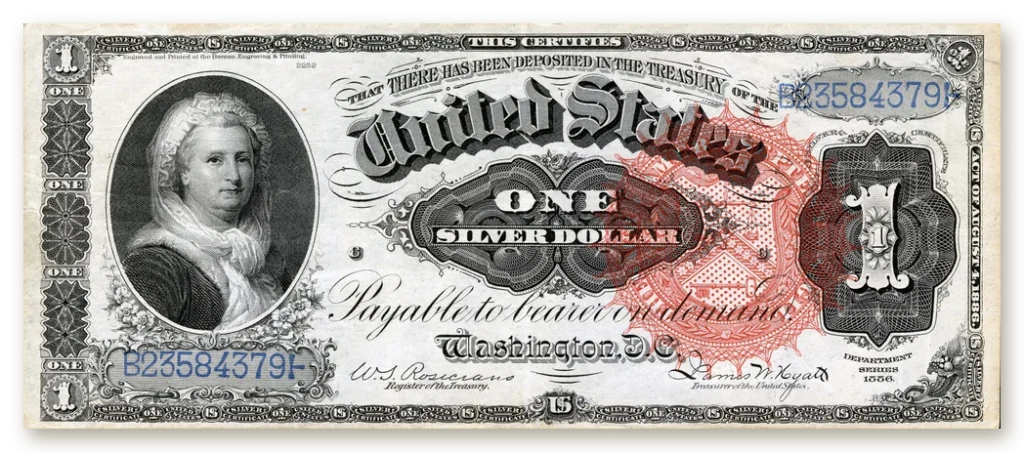
Face of a Series 1886 one dollar silver certificate large-size note with a portrait of Martha Washington

Silver certificates. Large-size issues, like the 1886 $1 with Martha Washington shown here, and small-size notes with blue seals. Most common small-size notes from the 1930s through the 1950s trade close to face value unless they are crisp uncirculated, star notes or unusual varieties.
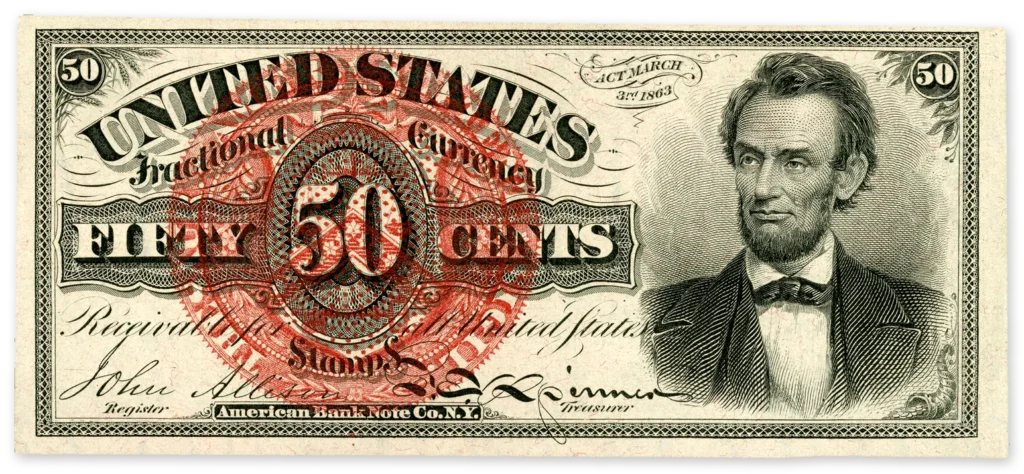
A Fourth Issue 50-cent U.S. Fractional currency note with Abraham Lincoln's portrait and a red Treasury seal

Fractional currency. Small notes worth 3 to 50 cents, issued from 1862 to 1876 when coins were hoarded during and after the Civil War. The Fourth Issue 50-cent note with Abraham Lincoln shown here is one of the best-known designs.
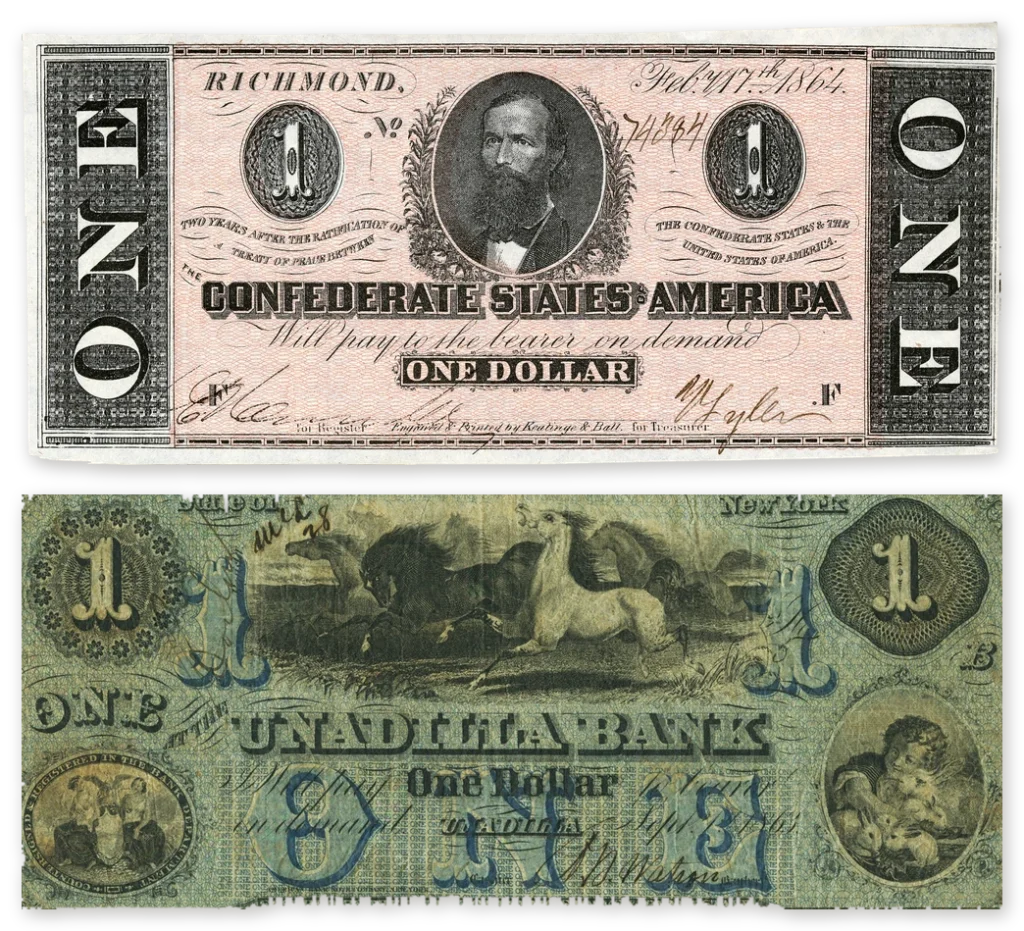
An 1864 $1 Confederate States of America note above a $1 obsolete bank note from the Unadilla Bank of New York

Confederate and obsolete notes. Notes issued by the Confederate States, by individual states and by private banks before 1866, like the 1864 Confederate $1 and the Unadilla Bank of New York $1 shown here. Genuine notes are collected widely, but replicas are common, as Step 5 explains.

For a broader overview, see our U.S. paper currency information page and our guide to collecting paper money.

Decorative gold separator bar

Step 2: Check Serial Numbers, Seals, Signatures and Errors

Two notes of the same type and series can be worth very different amounts because of small details printed on their faces. Before you sell, look closely at:
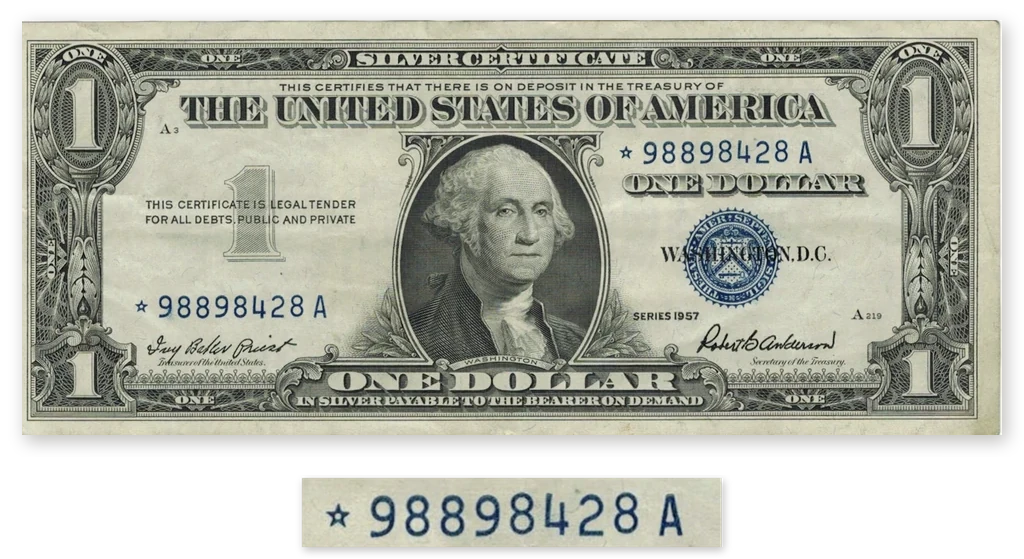
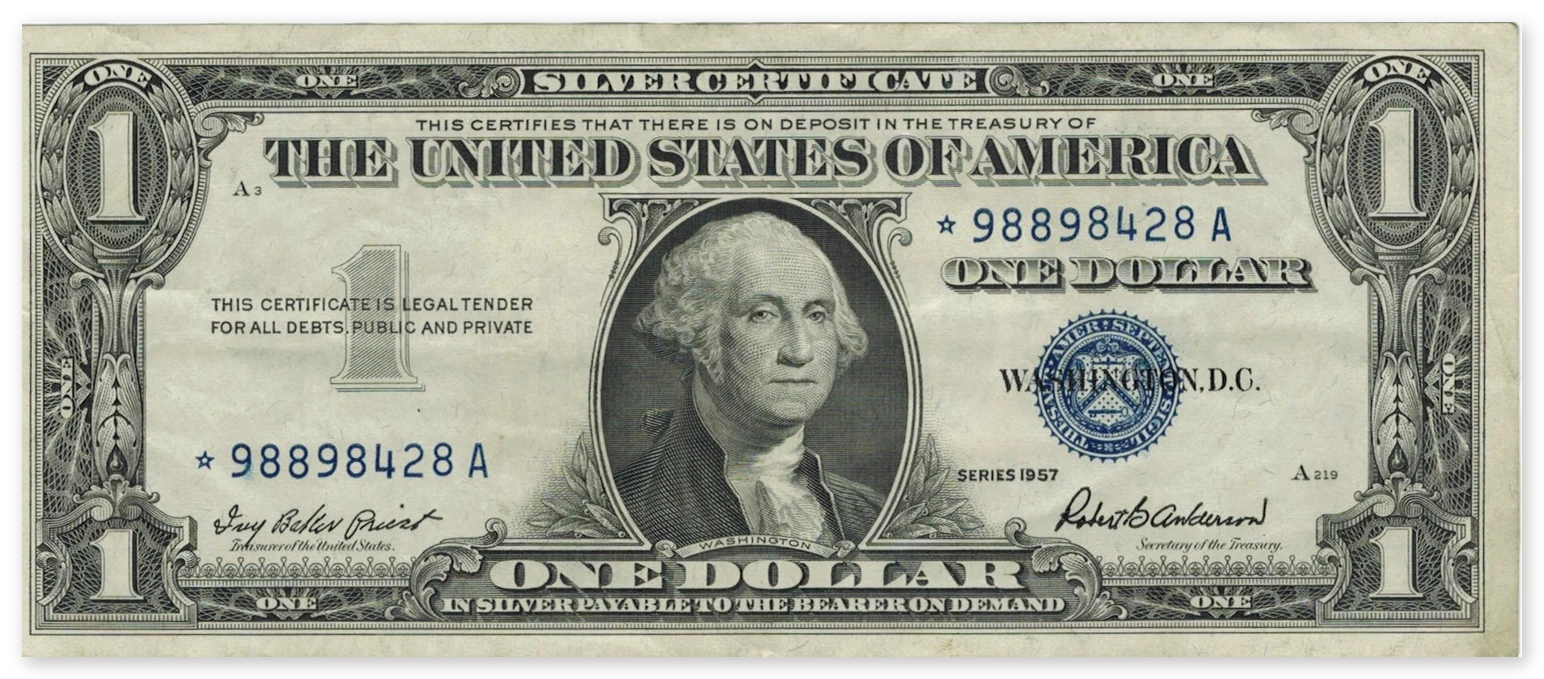
A Series 1957 $1 silver certificate star note with George Washington and a blue seal, above a small close-up of the star before its serial numberA Series 1957 $1 silver certificate star note with a star before each serial number and a blue seal

Star notes. A star printed before or after the serial number marks a replacement note, printed to replace a sheet damaged during production. Star notes were made in much smaller numbers, and older ones can bring a premium. The 1957 $1 silver certificate shown here has a star before its serial number.
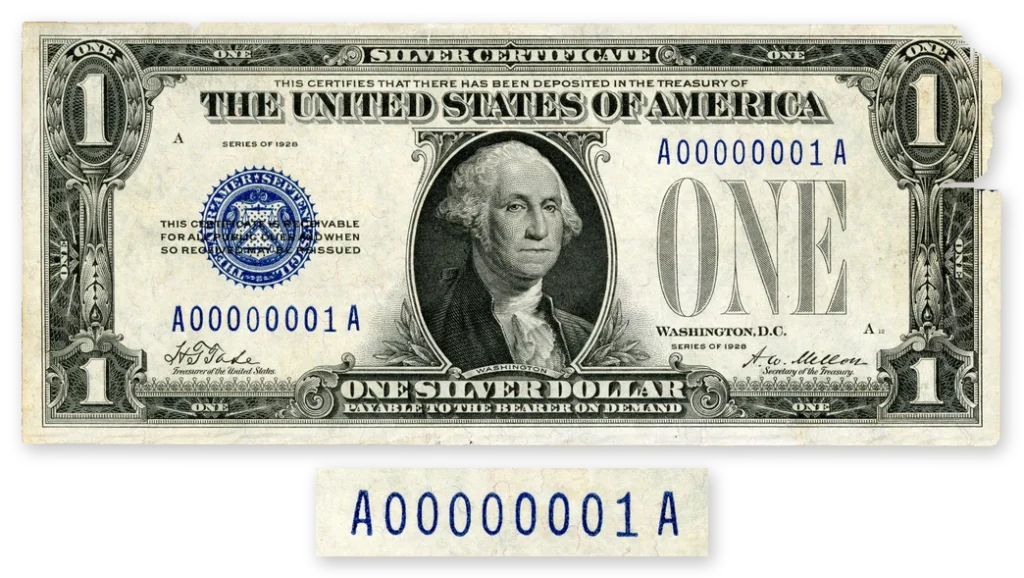
A Series 1928 $1 silver certificate with serial number A00000001A, above a small close-up of the serial number

Fancy serial numbers. Very low numbers like 00000001, solids such as 77777777, ladders such as 12345678, radars that read the same in both directions and repeaters can all attract collector interest. The 1928 $1 silver certificate shown here carries serial number A00000001A, the very first note of its run.

Seal colors and signatures. Blue, red, gold, brown and green seals identify different kinds of notes, and the Treasury signature combination helps pin down the exact variety. Some combinations are far scarcer than others.
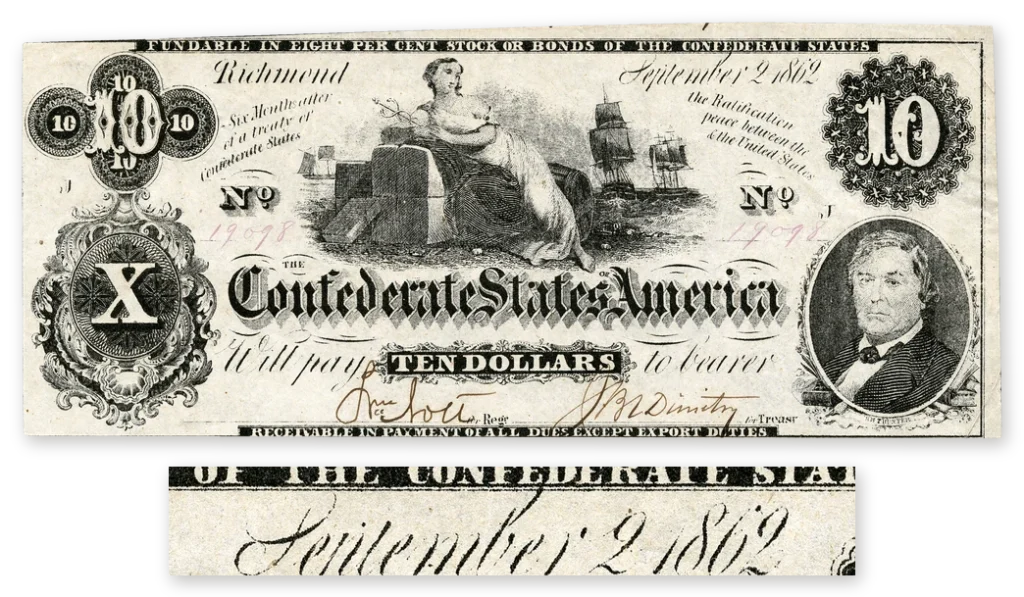
An 1861 $10 Confederate note dated September 2, 1862 in error, above an enlarged close-up of the date

Printing errors. Inverted backs, misaligned or missing printing, mismatched serial numbers, extra paper folded into the print and cutting errors are all collectible. Like error coins, genuine printing errors should be examined by a professional. Errors go back a long way: this 1861 Confederate $10 was printed with the year 1862 in its date by mistake.

National Bank details. The bank’s town, state and charter number can matter more than the denomination.

Notes that stay together can matter too. Consecutive serial numbers, original packs and uncut sheets are often worth more kept intact, so do not break them up before an appraisal.

Decorative gold separator bar

Step 3: Protect the Condition: No Cleaning, Pressing or Taping

Condition drives the value of paper money more than almost anything else. A crisp note with original paper and sharp corners can be worth many times more than the same note with folds, stains or repairs. The most common mistakes are made with good intentions:

  • Do not clean or wash notes. Erasing, washing or bleaching removes the original surface and leaves damage that experienced buyers and graders spot right away.
  • Do not press, iron or flatten. Pressing a note to hide folds is a well-known form of alteration. It removes the natural texture, called embossing, and graders treat it as a problem.
  • Do not tape or glue tears. Tape and glue stain the paper over time and are difficult to remove. Leave tears and missing pieces as they are.
  • Do not trim the edges or write on the note. Even pencil marks can be a problem.

Handle notes by the edges with clean, dry hands, and store them flat in archival-safe currency sleeves, away from heat, moisture and sunlight. Leave notes in albums or holders they are already in, and keep any envelopes, wrappers or family notes that came with them. Our article on mistakes to avoid when selling rare coins covers many of the same pitfalls.

Decorative gold separator bar

Step 4: Understand Grading With PMG and PCGS Banknote
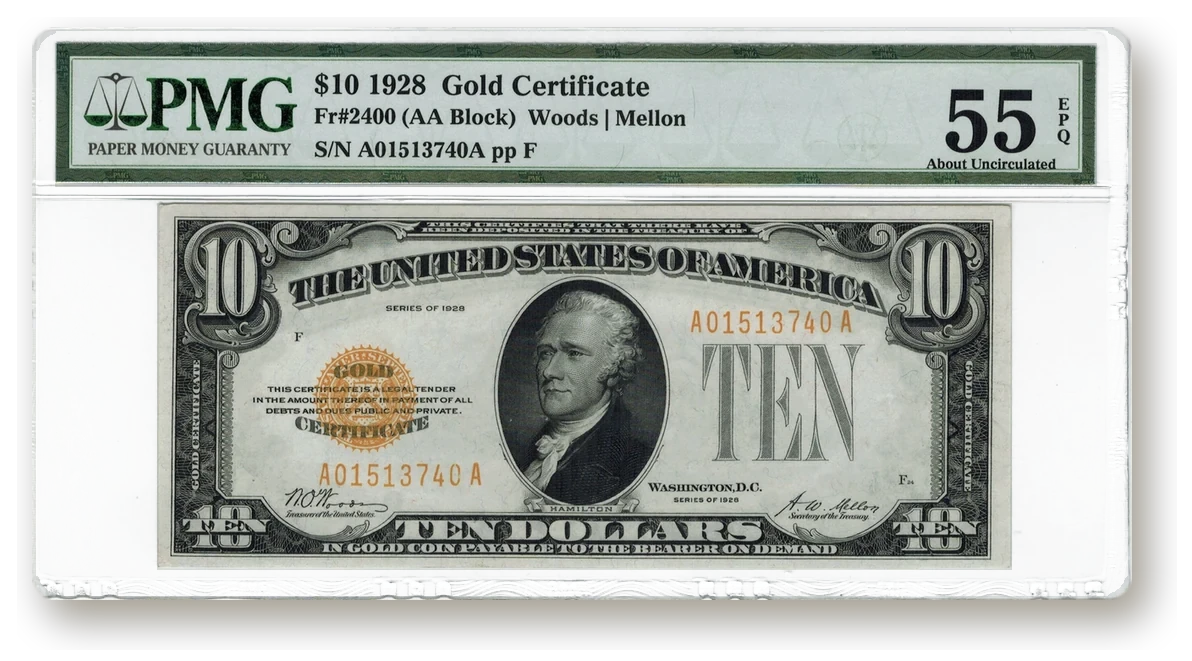
A 1928 ten dollar gold certificate sealed in a clear PMG paper money holder with its grading label above the note

Paper money is graded on a 70-point scale, from heavily worn notes at the low end to Gem Uncirculated notes at 65 and above. The two leading third-party services for U.S. currency are PMG (Paper Money Guaranty) and PCGS Banknote. They authenticate the note, assign a grade and seal it in a protective holder with a label.

Labels also flag notes with original, undoctored paper. PMG uses the EPQ designation, for Exceptional Paper Quality, and PCGS Banknote uses PPQ, for Premium Paper Quality. Notes that have been pressed, repaired or otherwise altered are noted on the label, which is one more reason never to try to improve a note at home.

Is Grading Worth It?

Grading costs money and takes time, so it makes sense only for notes where the grade has a real effect on value, such as better large-size notes, scarce National Bank Notes, high-grade star notes and major errors. Most circulated small-size notes are not worth grading. If your notes are already graded, leave them in their holders. Our page on rare coin and paper currency grading explains more, and we can tell you during a free appraisal which notes, if any, are worth submitting.

Decorative gold separator bar

Step 5: Watch for Counterfeits and Replicas
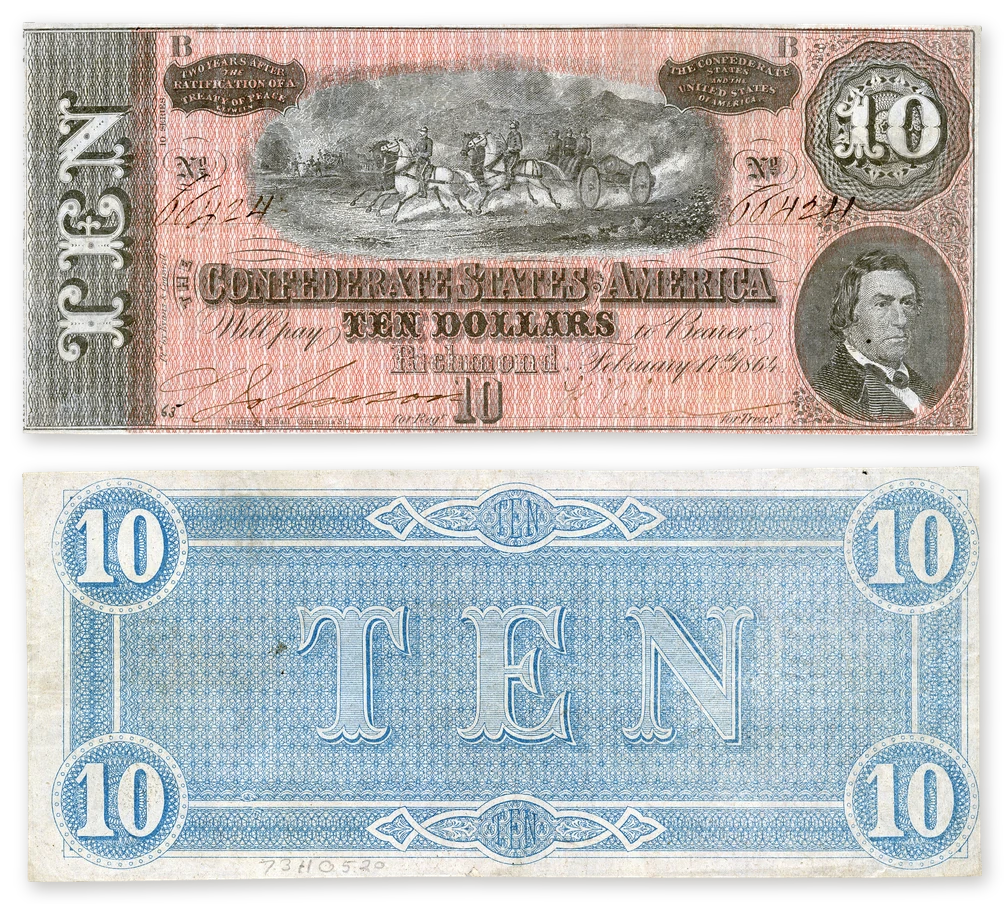
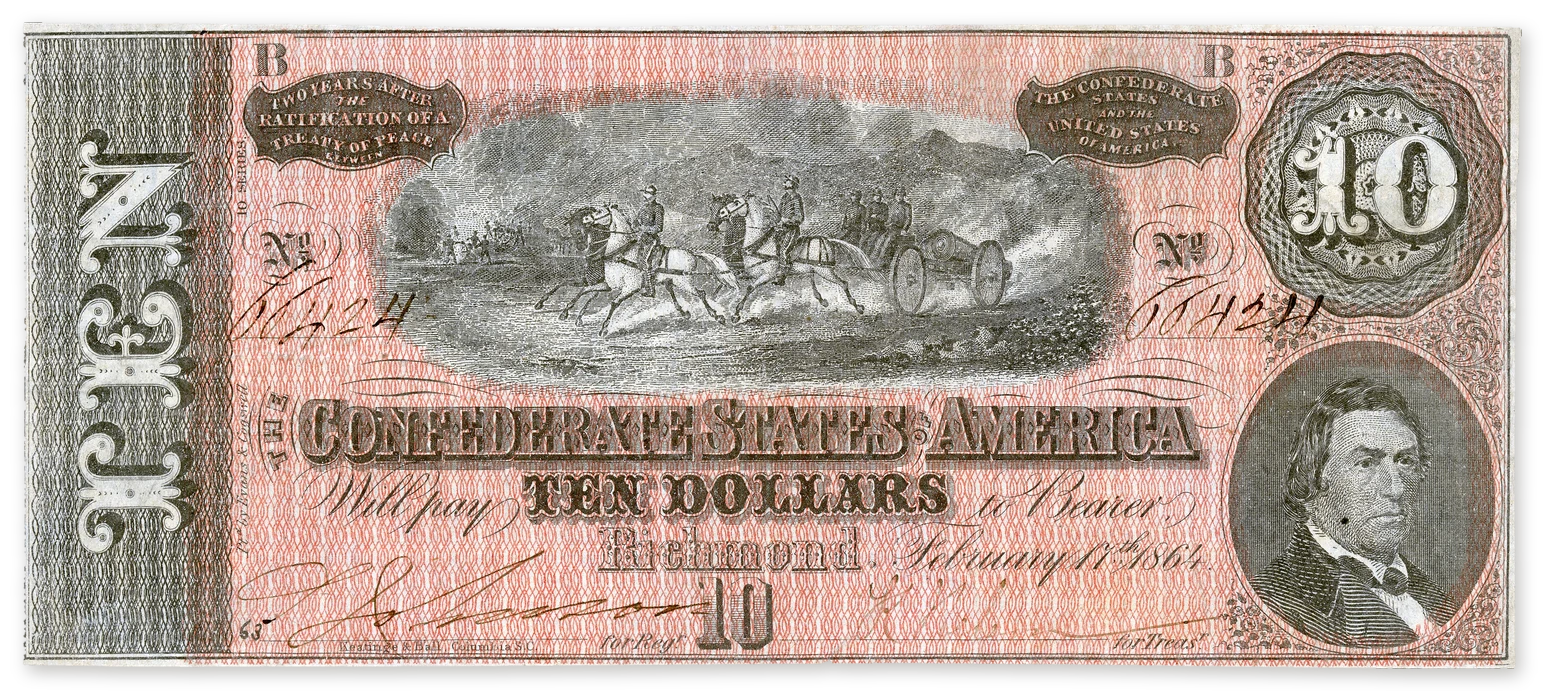
Front and back of a genuine 1864 Confederate States of America $10 note, type T-68, with a horse-drawn artillery vignette and R.M.T. Hunter, and its blue backA genuine 1864 Confederate States of America $10 note, type T-68, with a horse-drawn artillery vignette and R.M.T. Hunter

Replica notes are everywhere. Souvenir copies of Confederate notes and early U.S. currency have been sold in gift shops and inserted in books and magazines for decades, and many end up in family collections. Contemporary counterfeits made when the notes circulated also exist and are collected in their own right, but they are valued very differently from genuine notes.

Signs that a note may be a replica include:

  • The word “copy” or “facsimile” printed on the front or back, sometimes very small
  • Stiff, glossy or brown “parchment” paper, or paper that looks artificially aged
  • Blurry, flat printing without the fine, raised detail of an engraved note
  • A size that does not match genuine notes of the same type
  • A blank back on a note that should have a printed back

Confederate notes are especially tricky because some genuine issues, like the 1864 $10 shown here, are fairly common while others are scarce, and replicas of both are widespread. If you are unsure, do not guess. Send us photos, and we will tell you what you have. Our page on counterfeit and altered coins explains how we authenticate, and our Pinterest board of fake U.S. rare coins shows how convincing copies can look.

Any $100,000 Bill You Find Is a Replica
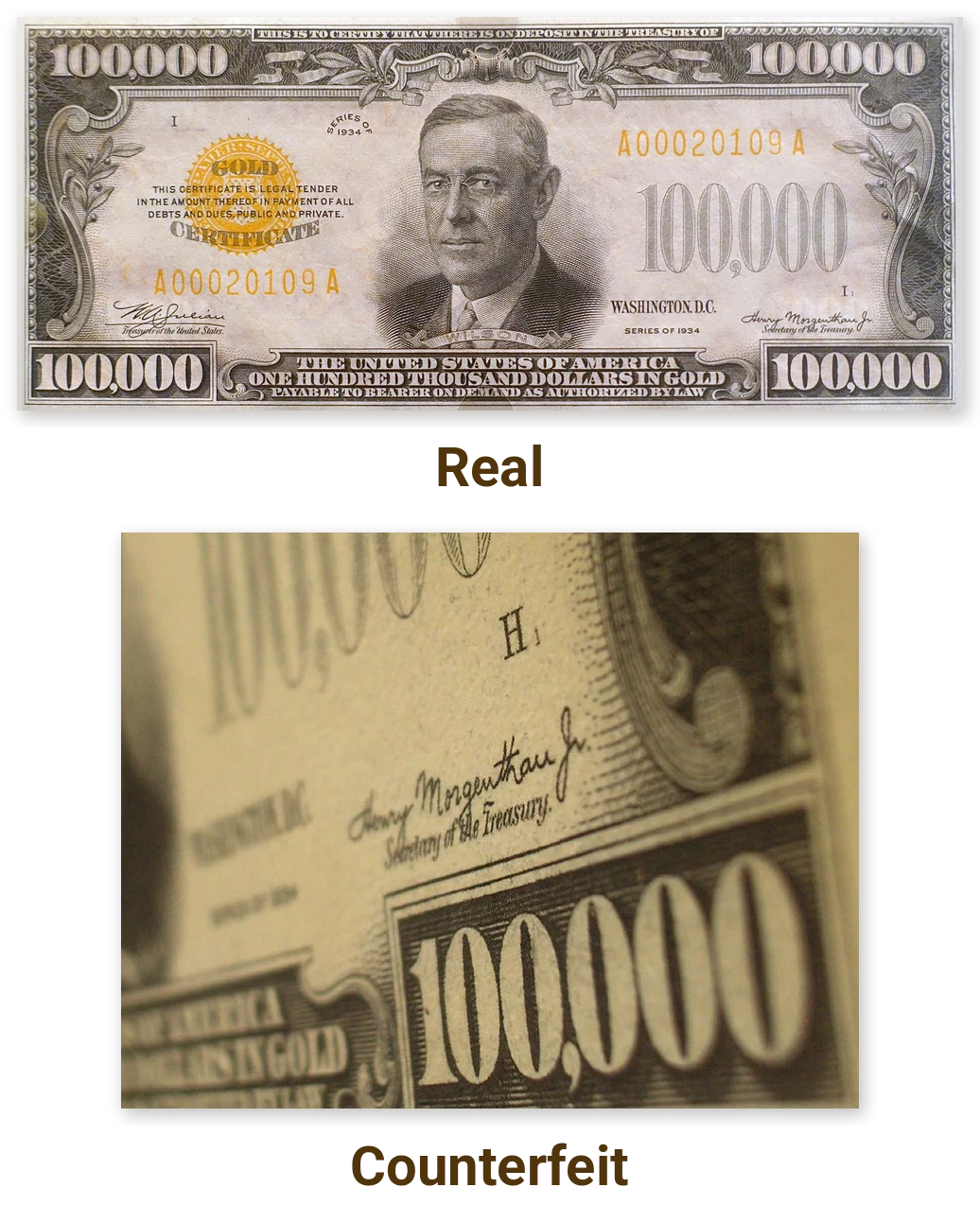
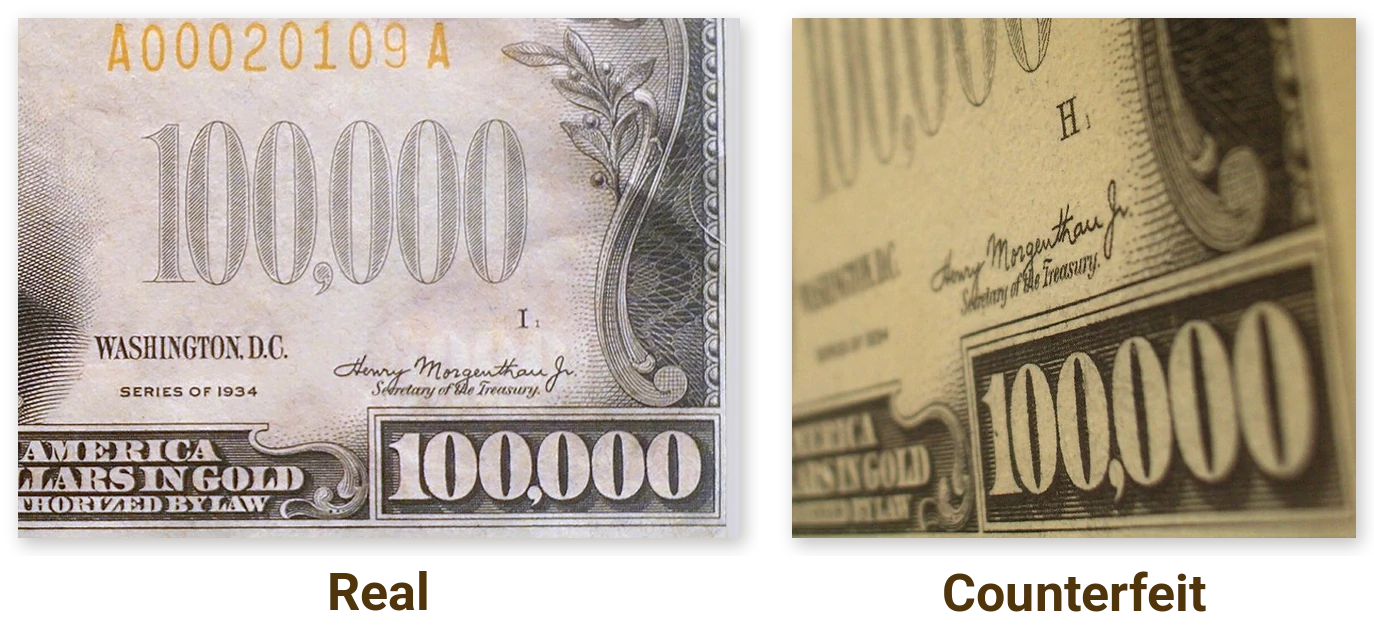
A real Series 1934 $100,000 gold certificate with Woodrow Wilson and gold serial numbers, labeled Real, above a close-up of a one-color printed copy labeled CounterfeitSide-by-side close-ups of the lower right corner of a real 1934 $100,000 gold certificate, labeled Real, and a printed copy, labeled Counterfeit

The largest note the United States ever printed is the Series 1934 $100,000 gold certificate with Woodrow Wilson. The real note shown here is in the Smithsonian’s National Numismatic Collection. These notes were used only for transfers between the Federal Reserve Banks and the Treasury. They were never released to the public, and private collectors cannot legally own one. Any $100,000 note found in a collection or offered for sale is a counterfeit or replica.

Copies are usually easy to spot next to a real note. A genuine $100,000 note has sharp engraving and a seal and serial numbers printed in gold. The counterfeit shown here is printed in one dark ink on yellowed paper, with softer detail and no gold at all.

Decorative gold separator bar

Ready to Sell Your Paper Currency?

Whether you have a single silver certificate or a lifetime collection of large-size and National Bank Notes, the steps are the same: identify what you have, check the details, protect the condition, understand grading, rule out replicas and work with a buyer who pays for everything your notes are worth. We have bought paper money from collectors, families and estates since 1990, and we would be glad to help you. Collectors building a collection can also visit our paper money collector page.

How to Get a Free Appraisal

1

Send Photos and/or a List

Smartphone camera with a light screen photographing the front and back of a large-size 1923 $1 silver certificate, over a handwritten list of paper money to sell

Photograph the front and back of each note, flat and in good light, with the whole note in the frame and the serial numbers readable. For a large group, an inventory list with a few sample photos is enough to start. Text them to 720-600-4740, email staff@americanrarities.com or use the form further down this page. Our tips on what photos to take can help.

2

Get Your Free Written Offer

Sample American Rarities written appraisal and offer for U.S. paper money, listing silver certificates, a red seal $2 note, a gold certificate, a Federal Reserve Note and a National Bank Note, with an Eschenbach 5X loupe

We send you a free, no-obligation written offer that lists each note or group with its grade and our price, like this sample (the figures are for illustration only). All appraisal requests are reviewed in the order they are received. Some appraisals take minutes, while larger, more complex collections can take a few days. Either way, you’ll get a response from us. You are welcome to compare our offer with others.

3

Ship Your Notes or Meet in Person

A box sealed with red padlock tape addressed to American Rarities, or our buyer meeting an older couple with paper money at their kitchen table

Pack your notes flat in sleeves between stiff cardboard, seal them in a sturdy box and ship them to us fully insured at our expense. For larger collections, we can meet you in person, for example at your bank. If you decline our offer, we return your items fully insured.

4

Get Paid

A banded stack of $100 bills, an American Rarities check, and two bank icons labeled ACH and Wire, showing the ways we pay

When you accept our offer, we pay you immediately by cash, check, ACH or wire, whichever you prefer. There is never a fee for our appraisal.

American Rarities holds a 4.7-star Google rating and an A+ rating with the BBB, we are ANA Life Members, and we are an authorized PCGS, NGC and ANACS dealer. Learn more on our page to sell paper currency.
Decorative gold separator bar

How to Sell Paper Currency: Frequently Asked Questions

Is my old paper money worth more than face value?

Often, yes. Large-size notes from before 1929, National Bank Notes, gold certificates, Fractional currency, star notes and notes with fancy serial numbers or printing errors are frequently worth well above face value. Common small-size notes in circulated condition usually trade close to face. Every note should be looked at individually, because condition can change the value many times over.

Can I sell Federal Reserve Notes for more than face value?

Most circulated Federal Reserve Notes are worth only face value, but some bring more. Look for star notes, fancy serial numbers such as solids, ladders and radars, printing errors, older series in crisp uncirculated condition, and $500 and $1,000 notes, which were last printed in 1945 and are sought by collectors. Uncut sheets and consecutive runs are also worth more kept together.

Is it legal to sell gold certificates?

Yes. Gold certificates, with their gold seals and orange-gold backs, have been legal to own and collect since 1964, and you can sell them freely. They can no longer be redeemed for gold, but collectors pay well above face value for many of them, especially large-size notes such as the 1905 $20 Technicolor and crisp examples of any series.

Where is the best place to sell paper money?

An experienced currency buyer who prices each note separately and pays right away is usually the simplest and safest choice. Pawn shops and general buyers often make one low offer for everything, while online marketplaces and auctions add fees, shipping risk and waiting. To start with us, photograph the front and back of each note flat, in good light, with serial numbers readable.

Should I clean, flatten or repair old bills before selling?

No. Washing, pressing, ironing, taping or trimming a note lowers its value, and graders mark altered notes on the label. Leave notes exactly as they are and store them flat in currency sleeves, away from heat, moisture and sunlight. Keep any envelopes, wrappers or family notes that came with them, since they can help tell a note’s story.

Should I get my notes graded by PMG or PCGS Banknote?

Only if the grade makes a real difference in value, such as better large-size notes, scarce National Bank Notes, high-grade star notes and major errors. Most circulated small-size notes are not worth the cost. We can tell you during a free appraisal which notes, if any, are worth grading, so you do not pay fees that will not come back to you.

How do you pay when I sell my paper currency?

When you accept our offer, we pay you immediately by cash, check, ACH or wire, whichever you prefer. Mail-in is fully insured at our expense, and if you decline, we return your items fully insured. Send photos by text to 720-600-4740, by email to staff@americanrarities.com or with the form on this page.

Decorative gold separator bar

Paper Money Guides

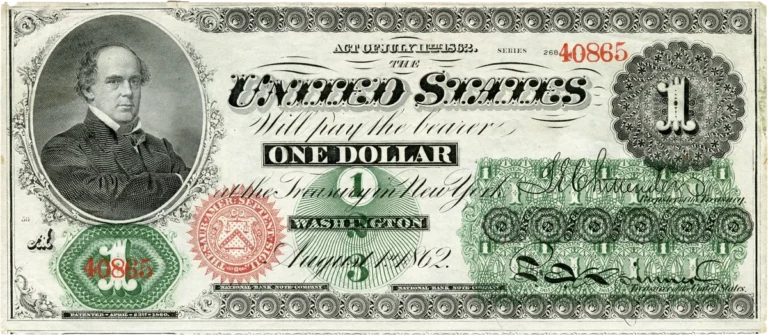
1862 one dollar Legal Tender United States Note with a portrait of Treasury Secretary Salmon P. Chase at leftSell Your U.S. Paper CurrencyFree appraisal and a cash offer for your notes
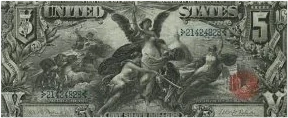
Series 1896 five dollar Educational Series Silver Certificate with the allegory Electricity Presenting Light to the WorldU.S. Paper Currency InformationHistory, types and how to identify U.S. notes
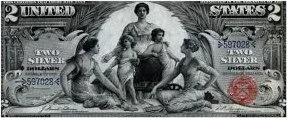
Series 1896 two dollar Educational Series Silver Certificate with the allegory Science Presenting Steam and Electricity to Commerce and ManufactureCollecting Paper MoneyNote types, grading, condition and care
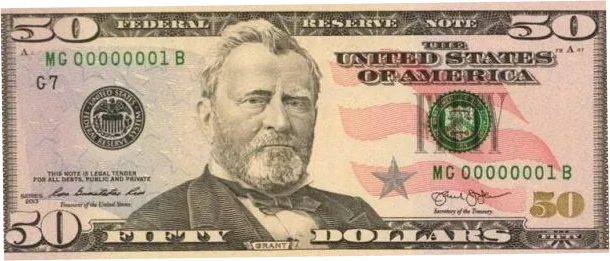
Fifty dollar Federal Reserve Note with Ulysses S. Grant and the fancy low serial number MG 00000001 BPaper Money Price GuideApproximate values for common U.S. notes
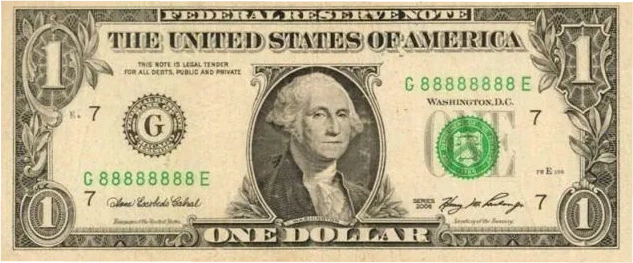
One dollar Federal Reserve Note with George Washington and the solid fancy serial number G 88888888 EPaper Currency GradingHow PMG and PCGS Banknote grade notes
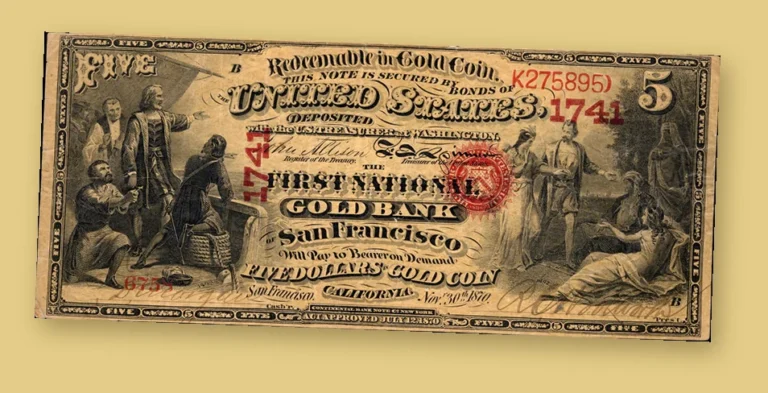
$5 National Gold Bank Note on yellow-tinted paper, First National Gold Bank of San Francisco, charter 1741National Currency Notes GuideIdentify and value National Bank Notes
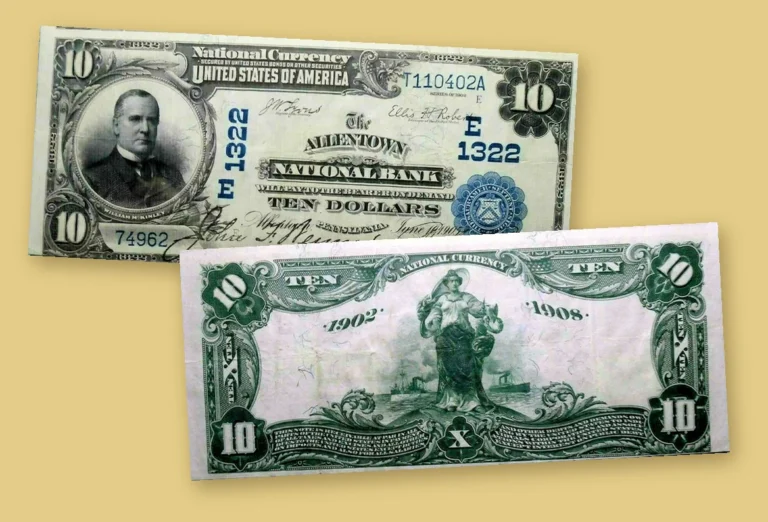
Third Charter Series 1902 Date Back $10 National Bank Note, Allentown National Bank charter 1322, with 1902-1908 dated backSell National Currency NotesHow we appraise and buy National Bank Notes
Mexican Revolution banknote: Gobierno Provisional de México 20 pesos of 1914 with an eagle vignetteSell Mexican Paper MoneyBank, Revolution and Banco de México notes
Decorative gold separator bar

Free Paper Currency Appraisal and Offer

Email, Text, or Use This Form To Send Us Your Inventory List or Pictures


Upload files of inventory lists and front and back photos of your items.

    We can help build your inventory list. Use the Collection List Maker to photograph your items and we'll build the inventory list for you.

    Decorative gold separator bar