
U.S. Silver Dollar Information
Everything you need to know about the types of silver dollars
that have been struck in the United States.
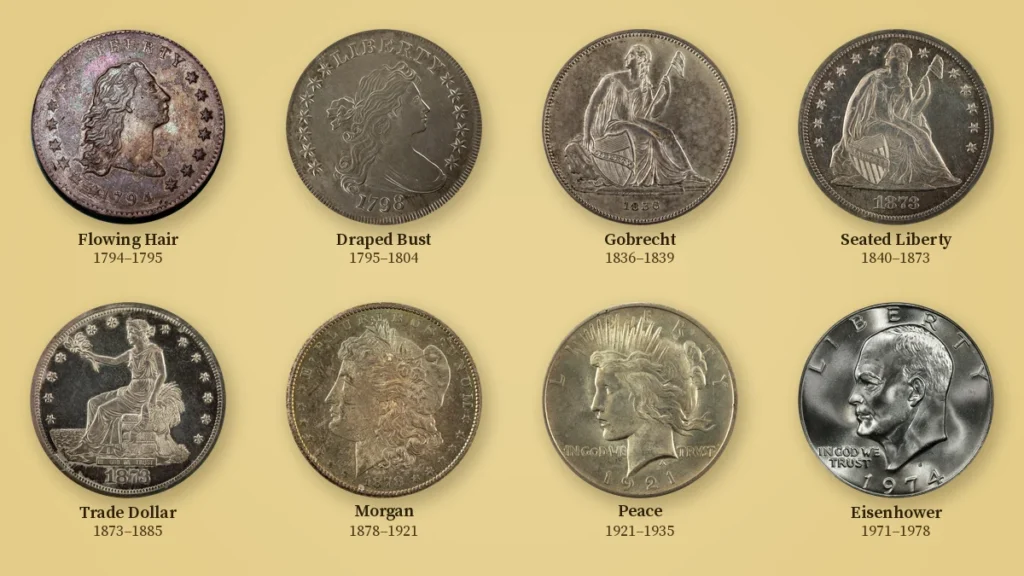
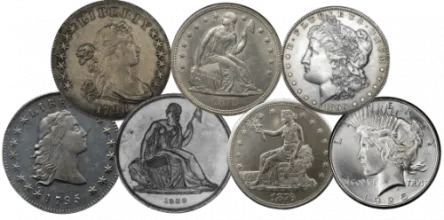
U.S. silver dollar types, 1794 to 1978. Photos: Smithsonian National Museum of American History, National Numismatic Collection (public domain); 1974-S Eisenhower dollar photo public domain.
The United States has struck silver dollars since 1794, and each design tells part of the nation’s story, from the first Flowing Hair dollars made in Philadelphia to the Morgan dollars of the silver mining boom and the Peace dollar that marked the end of World War I. This guide covers the major U.S. silver dollar types, a short history of the series, who designed each coin, which mints struck it and where to find the mint mark.
If you have silver dollars to sell, see how to sell your silver dollars to American Rarities, or learn how we value bags of 90% silver dollars. American Rarities has bought and appraised U.S. silver dollars since 1990. For a free, no-obligation appraisal, use the form on this page or text 720-600-4740.
Have silver dollars to sell? Sell your silver dollars to American Rarities for a free written offer.
U.S. Silver Dollar Types
| Flowing Hair Silver Dollars | 1794-1795 |
| Draped Bust Silver Dollars | 1795-1804 |
| Gobrecht Silver Dollars | 1836-1839 |
| Seated Silver Dollars | 1840-1873 |
| Trade Silver Dollars | 1873-1885 |
| Morgan Silver Dollars | 1878-1921 |
| Peace Silver Dollars | 1921-1935 |

A Short History of the U.S. Silver Dollar
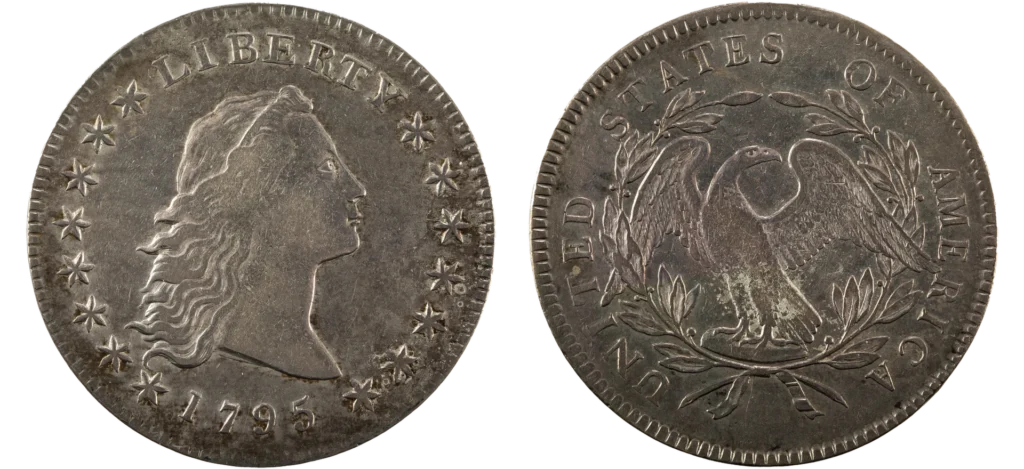
1792 to 1804: the first dollars. The Coinage Act of 1792 created the U.S. Mint and made the silver dollar the basic unit of American money. The Mint delivered its first 1,758 silver dollars, the Flowing Hair design, in October 1794. The Draped Bust design followed in 1795. Many of the new dollars were exported, and in 1804 production of silver dollars stopped.
The 1804 dollar. No silver dollars dated 1804 were struck in 1804. The famous 1804 dollars were made in the 1830s for presentation sets given as diplomatic gifts, and more were struck later for collectors. Only 15 are known.
1836 to 1873: Gobrecht and Seated Liberty dollars. Silver dollar coinage resumed with Christian Gobrecht’s dollars of 1836 to 1839, struck in small numbers. His Seated Liberty design went into regular production in 1840, and the motto IN GOD WE TRUST was added to the reverse in 1866. Seated dollars were struck at Philadelphia, New Orleans, San Francisco and, from 1870, Carson City.
1873: the Trade dollar. The Coinage Act of 1873 ended the standard silver dollar and created the Trade dollar, a slightly heavier coin made for commerce in Asia. It lost its legal tender status in 1876, coinage for circulation ended in 1878, and later dates were struck only as proofs.
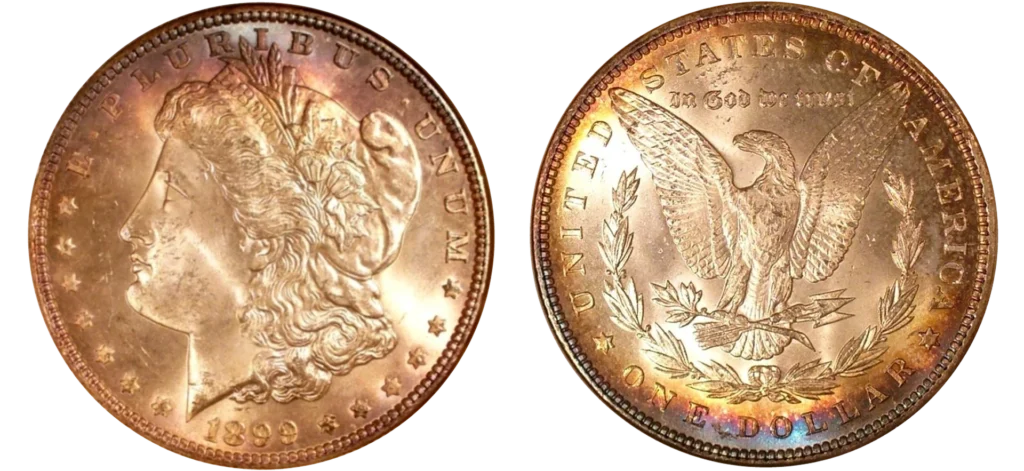
1878 to 1921: the Morgan dollar. The Bland-Allison Act of 1878 required the Treasury to buy silver and coin it into dollars, and George T. Morgan’s design was struck from 1878 to 1904. In 1918 the Pittman Act sent more than 270 million silver dollars to the melting pot. Morgan dollars were struck again in 1921 to replace them.
1921 to 1935: the Peace dollar. Anthony de Francisci’s Peace dollar, issued from December 1921 to celebrate the peace after World War I, was the last U.S. silver dollar struck for circulation. Coinage ended in 1935. In 1965 the Denver Mint struck more than 316,000 Peace dollars dated 1964, but they were never released and all were reported melted.
Treasury releases and GSA sales. Millions of old silver dollars sat in Treasury vaults for decades. When the Treasury paid them out in the early 1960s, long-rare dates turned up by the bag. The Treasury kept back about 2.9 million Carson City dollars, which the General Services Administration sold to the public in the 1970s and 1980, many in special GSA holders.
1971 to today. The Eisenhower dollar of 1971 to 1978 returned the large dollar coin, but the coins made for circulation are copper-nickel clad. Only the San Francisco collector versions sold by the Mint are 40% silver. For the 100th anniversary of the Peace dollar and the last Morgan dollars, the U.S. Mint issued .999 fine silver Morgan and Peace dollars for collectors in 2021, and has issued them again since 2023.
Who Designed Each U.S. Silver Dollar and Where It Was Struck
The table below lists who designed each U.S. silver dollar and which mints struck it. You can see more examples in the Smithsonian’s National Numismatic Collection and in PCGS CoinFacts.
| Type | Years struck | Designer | Mints |
|---|---|---|---|
| Flowing Hair | 1794-1795 | Robert Scot | Philadelphia |
| Draped Bust | 1795-1803 (1804 dollars struck later) | Robert Scot, from a portrait attributed to Gilbert Stuart | Philadelphia |
| Gobrecht | 1836-1839 | Christian Gobrecht, from drawings by Thomas Sully and Titian Peale | Philadelphia |
| Seated Liberty | 1840-1873 | Christian Gobrecht | Philadelphia, New Orleans (O), San Francisco (S), Carson City (CC) |
| Trade | 1873-1885 | William Barber | Philadelphia, Carson City (CC), San Francisco (S) |
| Morgan | 1878-1904, 1921 | George T. Morgan | Philadelphia, New Orleans (O), San Francisco (S), Carson City (CC), Denver (D, 1921 only) |
| Peace | 1921-1928, 1934-1935 | Anthony de Francisci | Philadelphia, Denver (D), San Francisco (S) |
| Eisenhower | 1971-1978 | Frank Gasparro | Philadelphia, Denver (D), San Francisco (S) |
Proof Silver Dollars
Silver dollar collectors are wild about proof silver dollars. These coins have very low mintages (typically less than 1,000 pieces). They are specially struck on polished planchets, and unlike their business-strike counterparts, they sport beautiful high-luster mirror surfaces. Typically, the only proof US silver dollars available to coin collectors are proof Seated Liberty dollars, proof Trade dollars and proof Morgan dollars. While the majority of these coins were struck in Philadelphia, a small number were struck at branch mints, i.e. New Orleans, San Francisco, Denver, and even Carson City. Assessing the value of silver dollars in proof condition requires expert knowledge.
U.S. Branch Mint Silver Dollars
Nothing seems to cause more confusion than the relative importance of the different U.S. branch mints. While there are some generalities that can be applied, the truth is that mint mark importance and value of silver dollars varies from coin to coin. This relative importance is based on the scarcity and quality of the particular coin in question.
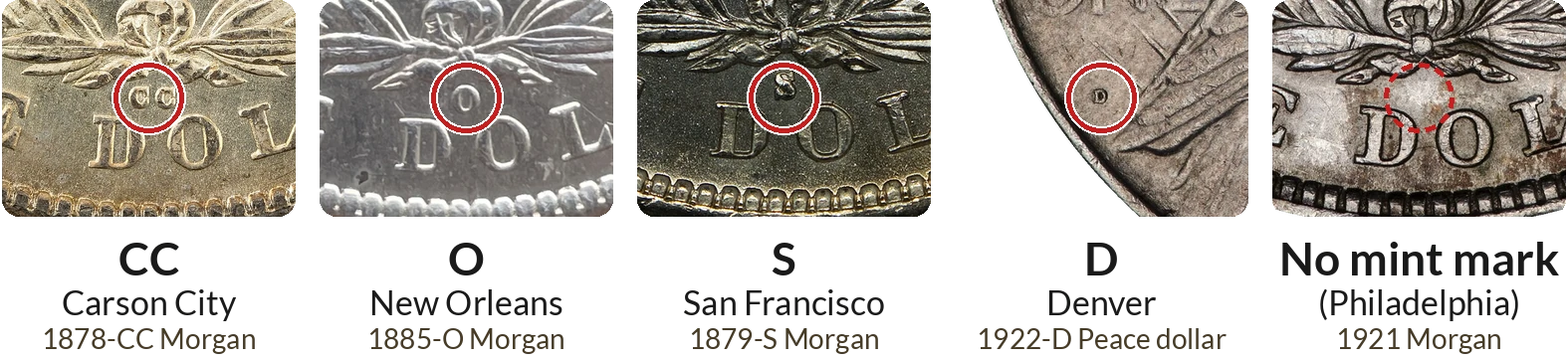
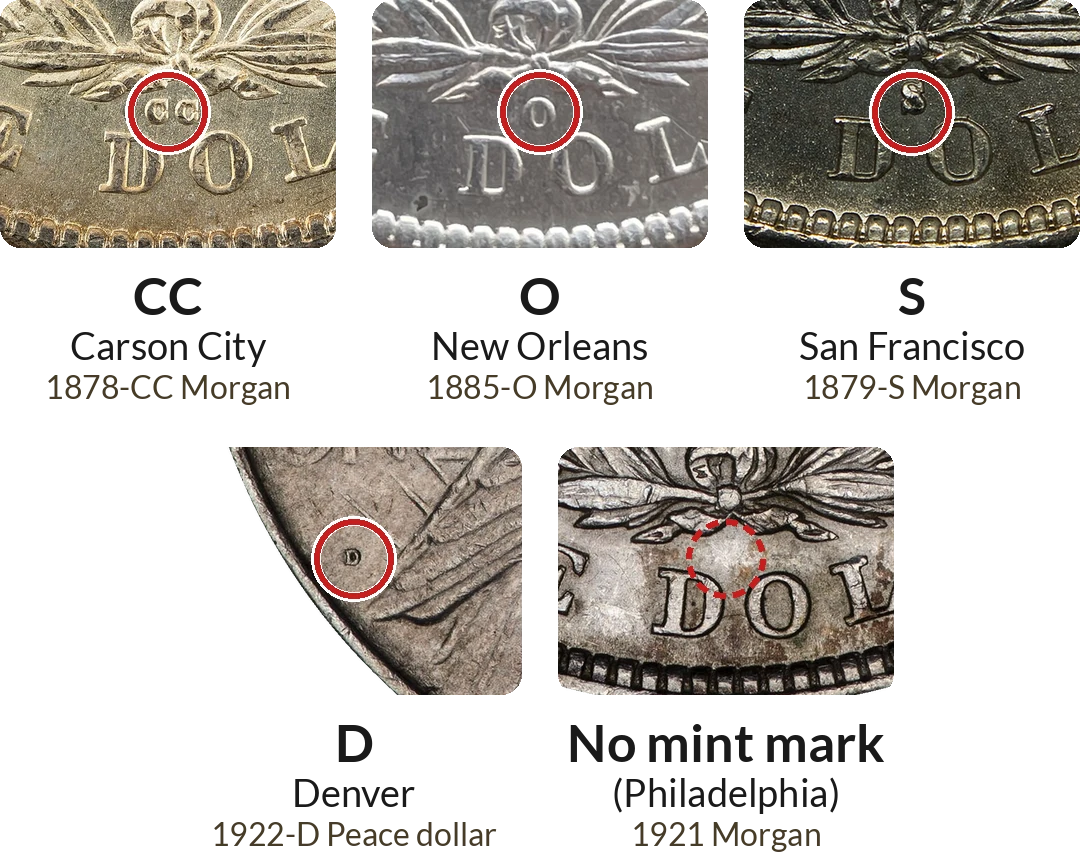
Above you can see examples of the five possible mint mark variations found on US silver dollars. The CC, O, S and Philadelphia examples are Morgan silver dollars; the D is shown on a 1922-D Peace dollar, because Morgan dollars carry the D mint mark only in 1921. Silver dollar values can vary due to mint mark. The first mint mark shown is from the iconic Carson City Mint. We put this one first because, even in the lowest grades, it tends to add extra value. The last picture is of a Philadelphia-struck Morgan dollar – as you can see, there is no mint mark in this case.
Please see our page U.S. Silver Dollar Values if you have interest in selling your U.S. Silver Dollar coins.
Where to Find the Mint Mark on Each Silver Dollar Type
Silver dollars struck at Philadelphia before 1980 carry no mint mark. Branch mint coins carry a small letter: CC for Carson City, O for New Orleans, S for San Francisco and D for Denver. Where it appears depends on the type:
- Flowing Hair, Draped Bust and Gobrecht dollars: no mint mark, since all were struck in Philadelphia.
- Seated Liberty dollars: on the reverse, below the eagle and above the denomination.
- Trade dollars: on the reverse, below the eagle and just above the word DOLLAR.
- Morgan dollars: on the reverse, below the wreath and above the letters DO in DOLLAR, as shown in the close-ups above.
- Peace dollars: on the reverse, at the lower left, below the word ONE and near the tip of the eagle’s wing.
- Eisenhower dollars: on the obverse, below the portrait and above the date.
A magnifier helps with worn coins. For more on how mints and dates are recorded, see the NGC Coin Explorer or the American Numismatic Association.
Quick Answers: U.S. Silver Dollar History
Which U.S. silver dollars actually contain silver?
Every U.S. silver dollar dated 1794 to 1935, including Flowing Hair, Draped Bust, Gobrecht, Seated Liberty, Trade, Morgan and Peace dollars, is about 90% silver. Eisenhower dollars made for circulation from 1971 to 1978 are copper-nickel clad and contain no silver; only the San Francisco collector versions sold by the Mint are 40% silver. Later dollar coins such as the Susan B. Anthony and Sacagawea dollars contain no silver, while the Mint's modern collector Morgan and Peace dollars are .999 fine silver.
Why were so many U.S. silver dollars melted?
Whenever the silver in a dollar was worth more than a dollar, coins were exported or melted, which happened to many early and Seated Liberty dollars. The biggest melt came under the Pittman Act of 1918, when more than 270 million silver dollars were melted, largely to supply silver to Britain. The 1964-dated Peace dollars struck in 1965 were also melted. That is why some dates with large mintages are scarce today.
Were the 1804 silver dollars really made in 1804?
No. The Mint's records list silver dollars struck in 1804, but they were dated 1803 or earlier. The first 1804-dated dollars were struck in the 1830s for presentation sets sent as diplomatic gifts, and more were struck later for collectors. Only 15 are known, and they rank among the most famous American coins.
Ready for an offer? Get a free offer on your silver dollars from our buyers.
Ready to start your no-obligation appraisal?
Email: staff@americanrarities.com | Text: 720-600-4740
Fill out the secure form below.
Professional Associations
