
Selling or Appraising an Inherited Foreign Coin Collection

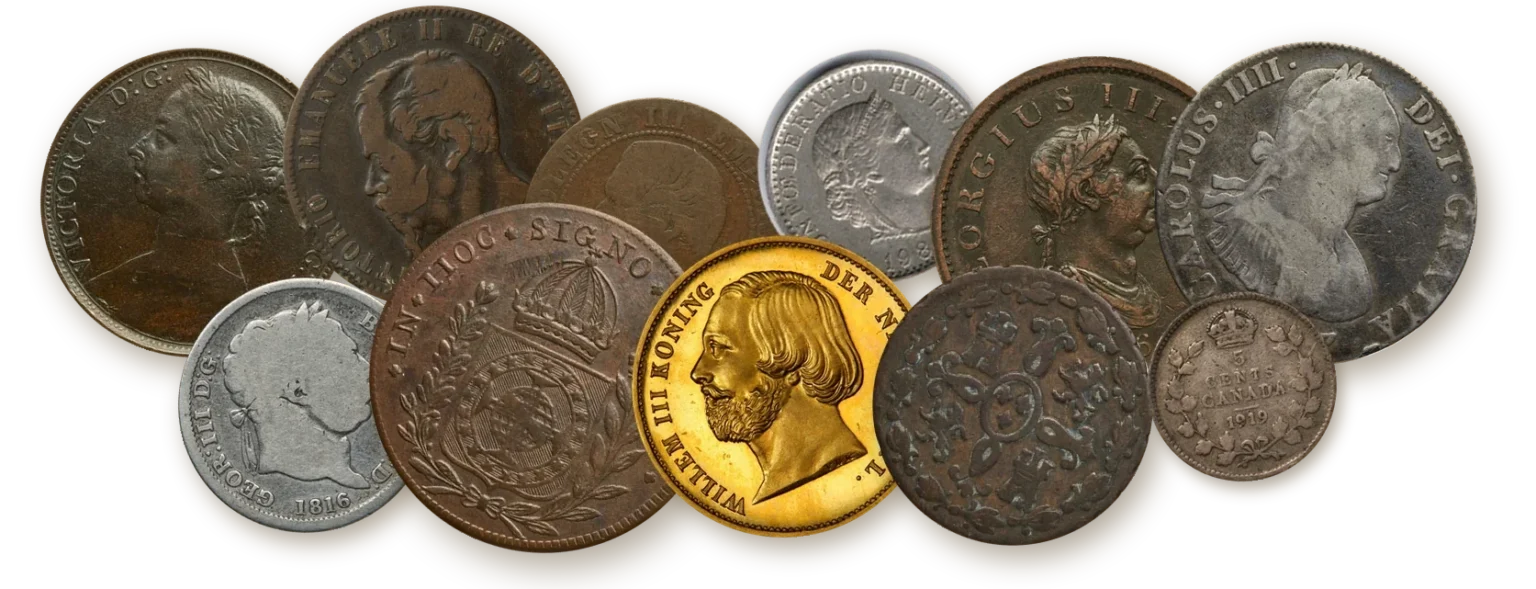
A loose accumulation of British pennies and a George III shilling, French and Italian copper coins, a Swiss coin, a Brazil 40 reis, a Spain 2 maravedis, a Canada 5 cents, a Mexico 4 reales and a Netherlands gold coin

Foreign coin collections often arrive all at once: a parent’s coin albums, a grandparent’s cigar box of travel coins, or a lifetime collection organized by country. If you have inherited or accumulated world coins, it can be hard to know where to begin, what is worth something and what is not.

This guide explains how to sort a foreign coin collection, what is likely to be valuable, why sets should be kept together, and how we handle large collections and estates. American Rarities has appraised and bought coin collections since 1990, and our appraisals are free.
Step 1: Sort the Collection

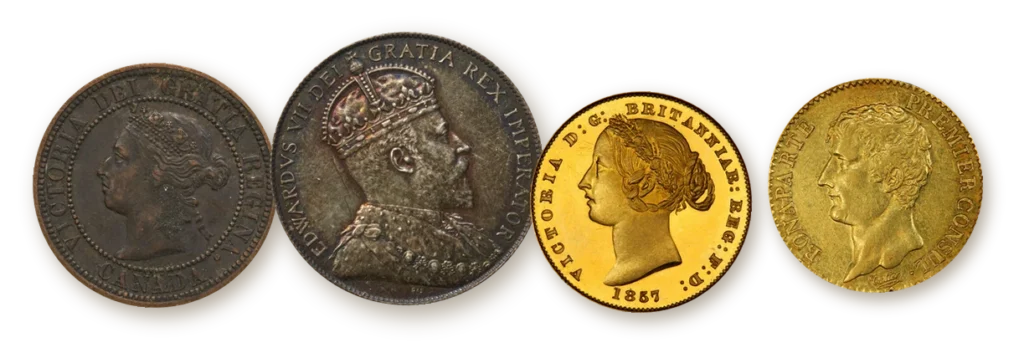
Sorting world coins by metal: an 1882 Canada copper large cent, a 1908 Canada silver 50 cents, an 1857 Australia gold sovereign and a French 20 francs gold coin of Napoleon as First Consul

You do not need to identify every coin. A simple first sort tells us a lot:

  • Gold. Yellow, heavy for their size and usually small. Set these aside first.
  • Silver. Older European, Latin American and Asian coins, crowns and thalers, and pre-1967 Canadian coins are often silver.
  • Sets and holders. Proof sets, mint sets, albums and coins in certified holders.
  • Old or unusual coins. Hand-struck coins, ancient coins and anything dated before 1900.
  • Everything else. Modern copper, nickel and base metal circulating coins.

Please do not clean any coins. Cleaning can remove much of a coin’s value.

Step 2: What Is Likely Valuable and What Is Common

Most circulated foreign coins from the 20th century, such as modern pennies, centimes, pfennigs and yen, were struck in huge numbers and are worth little each. Large lots of them are usually valued by the pound or by country. The value in a typical collection tends to come from:

Our foreign coins value guide explains these factors country by country, and our US and foreign rare coin values guide helps if the collection mixes US and world coins. For the US coins, see our coin value finder, coin collectors price guide and coin and paper money price guide. Numista is a useful neutral catalog for identifying world coins.

Step 3: Keep Sets Together

Four French gold coins in a row: a 1643 half Louis d or, a 1727 half Louis d or, a 1709 Louis d or and a 1788 Louis d or

A collector may have spent decades assembling a run of coins, like the French Louis d’or gold coins shown here, dated from 1643 to 1788. A complete or themed set is often worth more together than the same coins sold one by one. Keep proof and mint sets in their original packaging, leave coins in their albums and holders, and keep any notes, receipts or inventory lists the collector made. They help us understand what the collection is and where it came from.


Large Collections, Home Visits and Estates

For larger collections we offer home visits nationwide, so you do not have to pack or move anything. Smaller collections can be sent by mail-in, which is fully covered with no deductible, with free or discounted shipping on selected collections. See also selling a large coin collection and coin collection appraisals.

For estates, we provide IRS-compliant appraisals; see IRS-compliant numismatic appraisals. Our in-house grading is free, and we test coins with XRF and examine them under digital microscopy. We are a PCGS and NGC authorized dealer and an ANACS submission center, Life Members of the American Numismatic Association, with an A+ rating from the Better Business Bureau and a 4.7 rating on Google from 86 reviews.

If you decide to sell, we pay immediately by company check, wire or ACH once we agree on a price. Our foreign coin buyers page explains the selling process. To get started, email us at staff@americanrarities.com, text photos to 720-600-4740 or use the form below.

Foreign Coin Collections: Quick Answers

How do I sort an inherited foreign coin collection?

Separate gold and silver from base-metal coins, then set aside coins in holders, sets and albums and anything old or unusual. Do not clean them.

Are most foreign coins in a collection valuable?

Most 20th-century circulated world coins are common. The value usually lies in the gold and silver, older coins in good condition, proofs, sets and scarce dates.

Should I keep coin sets together?

Yes. Proof sets, mint sets and organized collections are often worth more together than as loose coins.

Decorative gold separator bar

Free Appraisal for Your Coins and Coin Collections

Email, Text, or Use This Form To Send Us Your Inventory List or Pictures


Upload clear photos of fronts and backs and we'll reply with a free appraisal.


    Professional Associations

    American Rarities professional association logos