Silver Proof Set Values

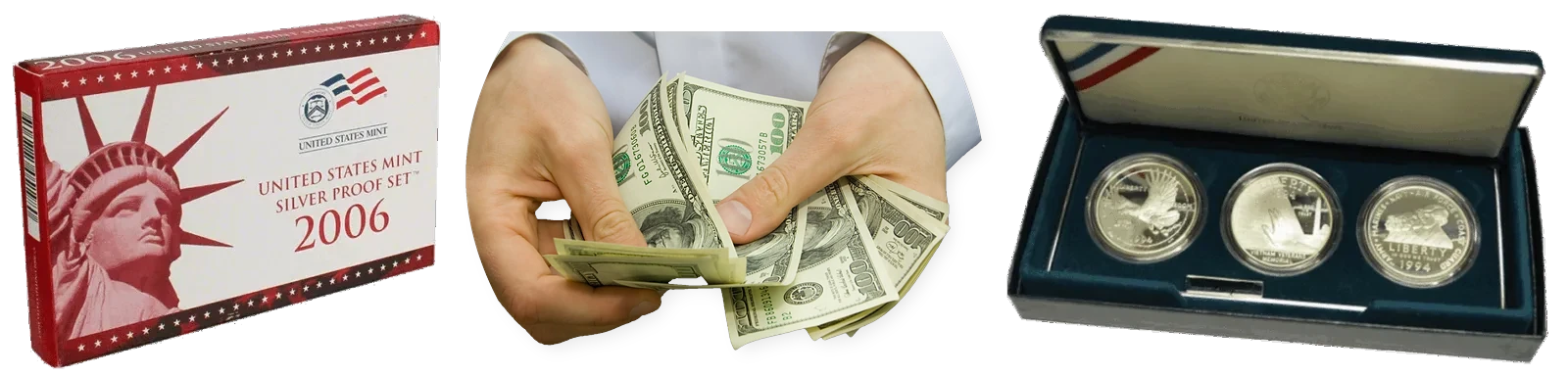
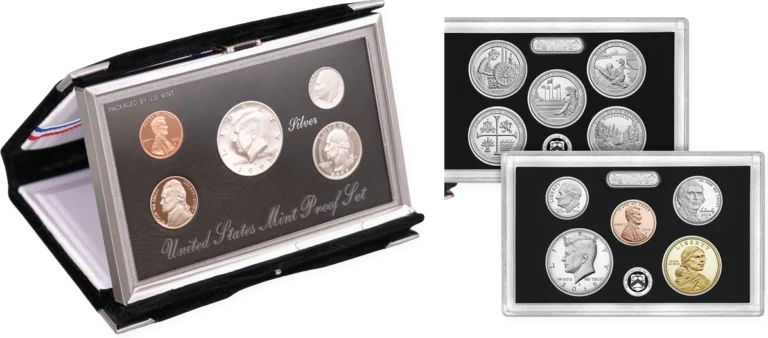
1995 Premier silver proof set and 2019 silver proof set. Premier packaging derived from Karl Thomas Moore, CC BY-SA 4.0; 2019 set photo by the United States Mint, public domain, via Wikimedia Commons.

Proof sets are annual sets of U.S. coins struck by the United States Mint with specially polished dies and planchets, giving them mirror-like fields and frosted designs. A silver proof set is a set in which some or all of the coins are struck in silver instead of copper-nickel clad, so part of its value comes from the precious metal it contains.
Silver proof set values depend on three things: how much silver the coins contain, the year and how many sets were made, and the condition and completeness of the set. This guide shows the silver content of the main types of U.S. silver proof sets, how that translates into melt value, and what adds a collector premium on top. For a free, no-obligation offer on your sets, use the form on this page or text 720-600-4740.
Always Paying More For Your Silver Proof Sets
Silver proof sets are one of the most common things we see in inherited collections, often still in their original Mint boxes. Because we buy them every day, we know which years carry a collector premium and which trade closer to their silver value, and we pay accordingly. We buy single sets, runs of consecutive years and whole collections, along with the rest of your silver coins and bullion. If you also have clad proof sets, uncirculated mint sets or commemoratives, see how to sell proof sets, mint sets and commemorative coins. Our step-by-step guide on how to sell proof and mint sets covers both silver and clad sets.
How Silver Proof Set Values Are Figured
Every silver proof set has a floor value set by its silver content. On top of that, collectors pay a premium for sets that are scarce, popular or in exceptional condition. The table below shows the silver content of each major type of U.S. silver proof set and its melt value at a stated silver price.
| Set Type | Silver coins in the set | Silver content (troy oz) | Melt value at $54/oz |
|---|---|---|---|
| 1950–1964 proof sets | 90% silver dime, quarter and half dollar (cent and nickel are not silver) | 0.6149 | $33.20 |
| 1968–1970 proof sets | 40% silver Kennedy half dollar only | 0.1479 | $7.99 |
| 1976-S Bicentennial 3-piece silver proof set | 40% silver quarter, half dollar and Eisenhower dollar | 0.5381 | $29.06 |
| 1992–1998 silver proof sets (including Premier sets) | 90% silver dime, quarter and half dollar | 0.6149 | $33.20 |
| 1999–2008 and 2010–2018 silver proof sets | 90% silver dime, five quarters and half dollar | 1.3383 | $72.27 |
| 2019 silver proof set | 99.9% fine silver dime, five quarters and half dollar | 1.5076 | $81.41 |
Silver content is calculated from the Mint’s standard weights and fineness for each coin (for example, 2.5 g of 90% silver for a dime, 6.25 g for a quarter and 12.5 g for a half dollar; 2.537 g, 6.343 g and 12.685 g of 99.9% silver for the 2019 coins). Melt value is shown at an example silver price of $54 per troy ounce, about where silver traded in late October 2026. Silver prices change every day, so multiply the silver content by today’s price for a current figure. These are not offers or retail prices.
What moves a set above its melt value:
- Year and mintage: low-mintage years, especially the early 1950s sets, usually sell well above silver value.
- Original packaging: sets in their original Mint box or envelope with the certificate of authenticity are easier to sell than loose lenses.
- Condition: spotted, hazy or heavily toned coins, and cracked or yellowed lenses, can lower the value. Attractive toning on the older flat-pack sets can sometimes add to it.
- Varieties and errors: certain sets contain rare varieties, such as coins missing their S mint mark, which can be worth far more than a normal set.
- Graded coins: individual coins graded PR69 or PR70 Deep Cameo by a service such as NGC can be worth more than the set they came from.
A Short History of U.S. Proof Sets


The U.S. Mint has struck proof coins for collectors since the 1800s. It began selling proof coins to the public again in 1936, paused during and after World War II from 1943 to 1949, and has sold complete proof sets each year since 1950, apart from 1965 to 1967, when it issued Special Mint Sets instead. Since 1968 proof sets have been struck at the San Francisco Mint and carry an S mint mark. You can read more about how proof coins are made and the return of the proof set in 1936.
Because silver was removed from circulating dimes and quarters in 1965, proof sets from 1968 on are copper-nickel clad, except for the 40% silver half dollar in the 1968 to 1970 sets. The Mint added a separate 40% silver Bicentennial set in 1976 and began offering a 90% silver proof set alongside the clad set in 1992. For what clad and silver proof sets of every year are worth today, see our guide to US Mint proof set value.
What’s the Value of a 1950–1964 Silver Proof Set?
Every proof set made from 1950 through 1964 is a silver proof set: the dime, quarter and half dollar are 90% silver, giving each set 0.6149 troy ounces of silver. The cent is bronze and the nickel is copper-nickel. Sets from 1950 to early 1955 came in small boxes with each coin in its own cellophane sleeve; from 1955 to 1964 they were sold in flat plastic packs inside a mailing envelope. Early-1950s sets had much smaller mintages and usually command strong premiums, while late-1950s and early-1960s sets often trade closer to silver value. The 1964 set is the last with a 90% silver Kennedy half dollar. See also our guide to 90% silver coins.
What’s the Value of a 1976 Bicentennial Silver Proof Set?
For the nation’s 200th birthday, the Mint issued the quarter, half dollar and dollar with special dual-dated 1776–1976 Bicentennial designs. Alongside the regular clad proof set, it sold a three-piece 40% silver proof set from San Francisco containing the Drummer Boy Washington quarter, the Independence Hall Kennedy half dollar and the Liberty Bell and Moon Eisenhower dollar. Each set contains 0.5381 troy ounces of silver, about $29.06 in melt value at $54 silver. Because millions were made, most sets trade near their silver value, with a modest premium for sets in the original box with the certificate. The regular six-coin 1976 proof set is clad and contains no silver.
What’s the Value of a 1992–1998 Silver or Premier Proof Set?
In 1992, the Mint’s 200th anniversary year, it began offering a silver proof set alongside the clad set. The 1992 to 1998 silver proof sets contain a Lincoln cent, Jefferson nickel and a 90% silver Roosevelt dime, Washington quarter and Kennedy half dollar, a total of 0.6149 troy ounces of silver, or about $33.20 at $54 silver.
The same years also saw Premier silver proof sets, with the same coins in a deluxe velvet-lined folding case like the 1995 set pictured at the top of this page. Premier sets have the same silver content as the standard silver sets, and collectors often pay a little more for the packaging. Lower-mintage years can carry higher premiums than the more common years.
What’s the Value of a 1999 Silver Proof Set?
The 1999 silver proof set was the first to include the 50 State Quarters: Delaware, Pennsylvania, New Jersey, Georgia and Connecticut. It holds nine coins: the Lincoln cent and Jefferson nickel, which are not silver, plus the 90% silver Roosevelt dime, the five state quarters and the Kennedy half dollar. That is 1.3383 troy ounces of silver, about $72.27 in melt value at $54 silver.
The Mint also sold a clad nine-coin proof set and a clad five-coin quarters set in 1999; neither contains any silver. The 1999 silver set is one of the more sought-after modern silver sets, so it usually brings more than its silver value. Later silver sets follow the same pattern with five quarters a year, except 2009, which has six quarters for the District of Columbia and U.S. territories. From 2000 the sets also include a dollar coin, which is not silver.
2019 and Later: 99.9% Fine Silver Proof Sets
In 2019 the Mint switched the silver coins in its silver proof sets from 90% to 99.9% fine silver. The 2019 silver proof set contains a 99.9% silver dime, five America the Beautiful quarters and a Kennedy half dollar, plus a cent, nickel and Native American dollar that are not silver, and each set came with a bonus 2019-W reverse proof Lincoln cent. Its silver content is about 1.5076 troy ounces, roughly $81.41 at $54 silver. Later silver proof sets also use 99.9% silver, though the number of quarters and the set contents vary from year to year.
Prestige Sets and Commemorative Coins


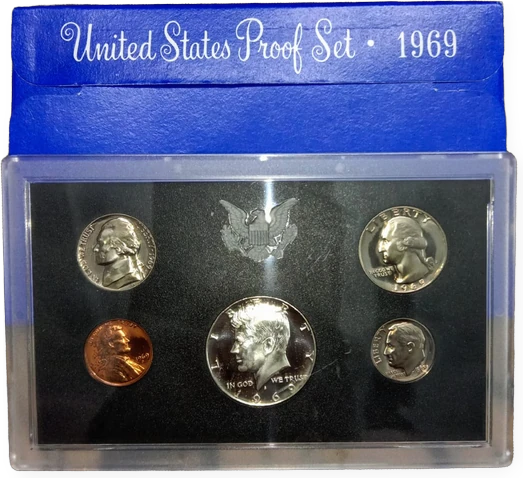
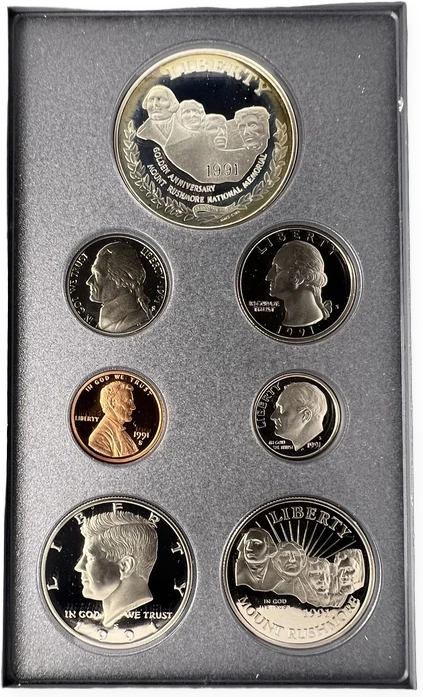
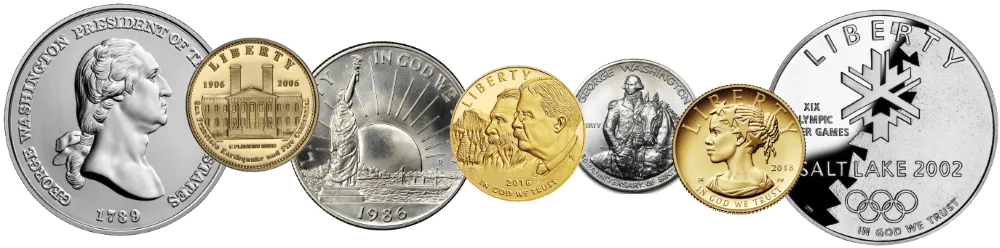
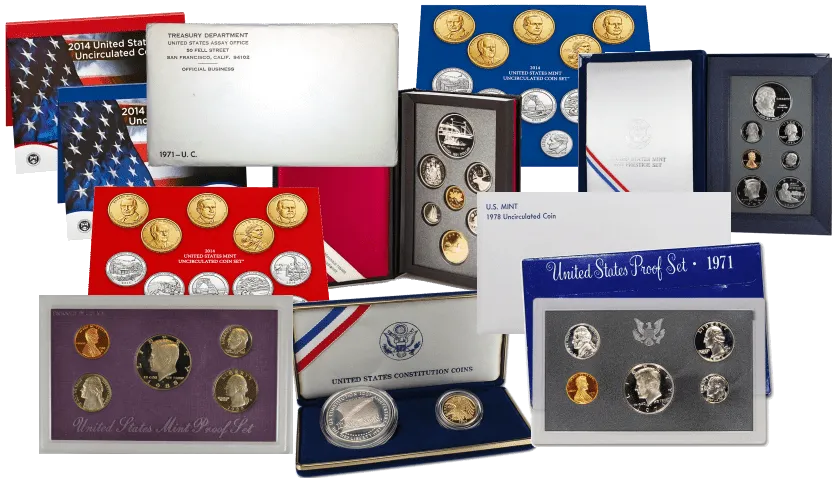
Some sets contain more silver or gold than a standard proof set. From 1983 to 1997 the Mint sold Prestige proof sets, which add one or two commemorative coins, usually a silver dollar, to the year’s proof set. Commemorative coins like those shown above were also sold on their own, in proof and uncirculated versions, and their value depends on the coin, its metal and its mintage. Learn more about U.S. and foreign mint sets, proof sets and commemorative coins, or see our guide to U.S. proof set values for clad sets. See also coin proof sets value and commemorative coins value.
How to Sell Your Silver Proof Sets in 4 Steps
Send Photos and/or a List


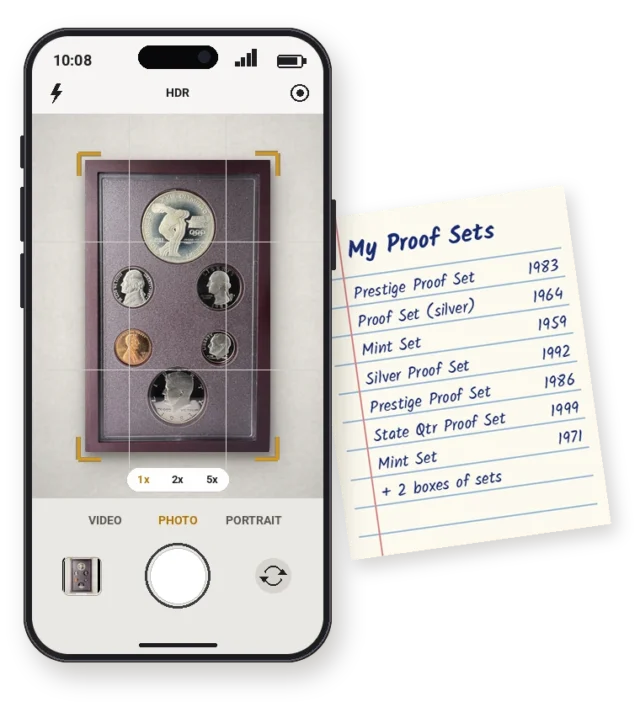
Text photos of your silver proof sets to 720-600-4740, email staff@americanrarities.com, or use the form on this page. A simple list of years, types and quantities works too — for example a 1964 proof set, a 1976 three-piece silver set or a 1999 silver proof set.
Free Appraisal and Written Offer
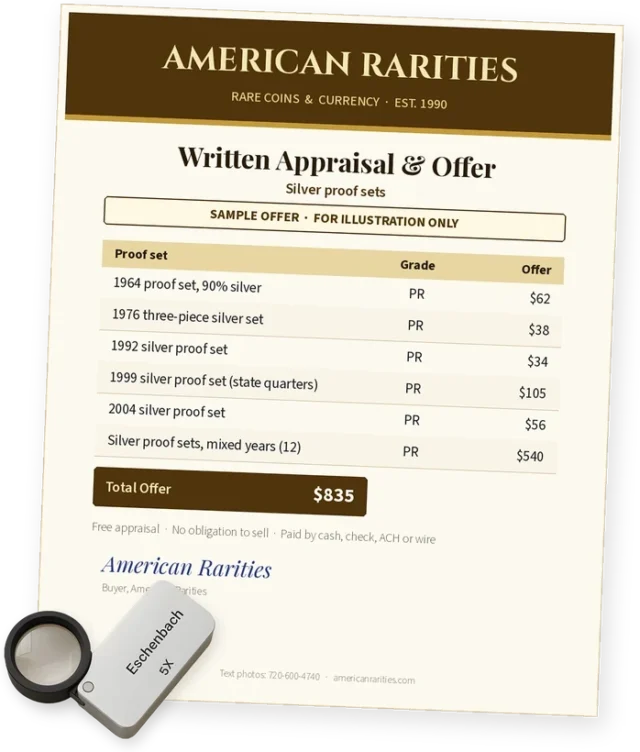
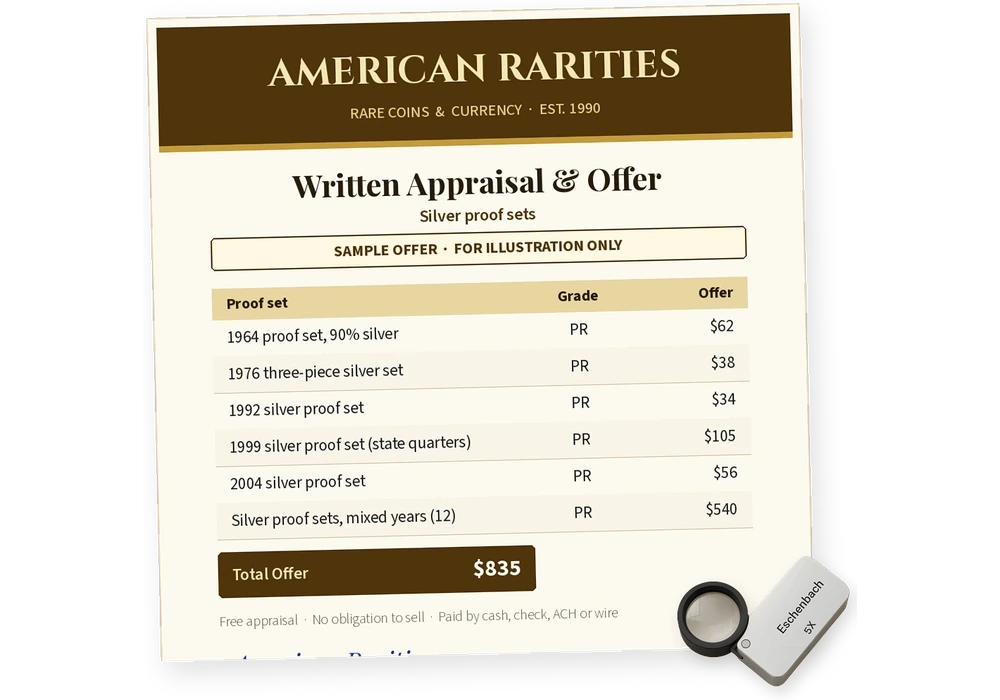
A specialist reviews your list against current silver prices and collector demand for each year, then sends a free, no-obligation written offer. All appraisal requests are reviewed in the order they are received. Some appraisals take minutes, while larger, more complex collections can take a few days. Either way, you’ll get a response from us.
Ship Fully Insured (Paid by Us)
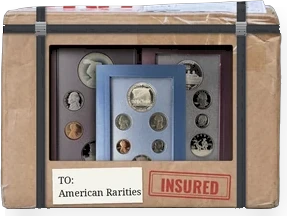
Leave the coins in their original lenses and boxes, pack them snugly in your own sturdy carton so nothing can shift, and ship them to us fully insured. We pay for the insured shipping; we do not provide shipping materials. If you decline our offer, we return your items fully insured.
Get Paid
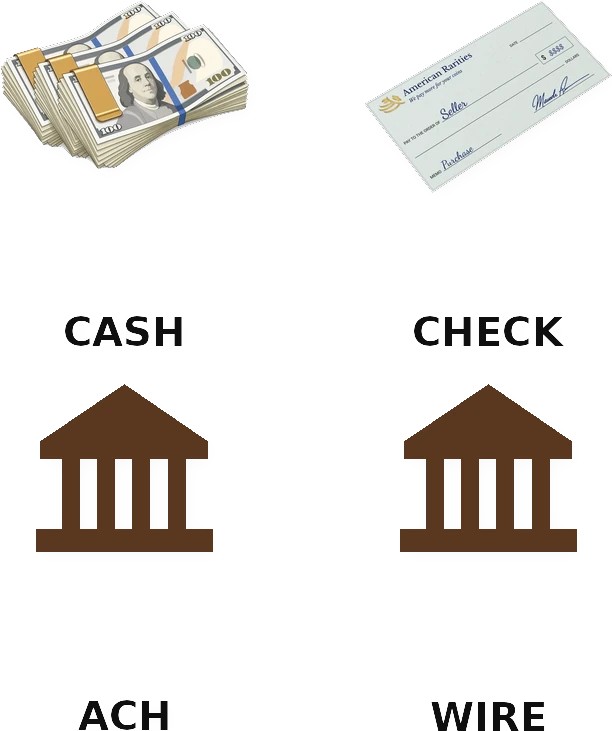
When you accept our offer, we pay you immediately by cash, check, ACH or wire — whichever you prefer.
What Is My Silver Proof Set Worth?
The easiest way to find out what your silver proof sets are worth is to have them appraised by us. We have appraised silver proof sets for decades and offer it as a completely free service. After you send us your collection information by text or with the form below, we will get you a free written appraisal and offer to purchase. All appraisal requests are reviewed in the order they are received. Some appraisals take minutes, while larger, more complex collections can take a few days. Either way, you’ll get a response from us. If circumstances permit, we may even send one of our rare coin buyers to your home for a physical appraisal, payable on the spot, totally free of charge.
There is no obligation to sell, so feel free to use us as a resource. Should you choose to sell, we will insure the full value of your shipment and pay you by company check, wire transfer or ACH deposit as soon as your coins arrive.
Silver Proof Sets: Quick Answers
Is a silver proof set worth more than its silver content?
Usually, though not always by much. Every set has a floor set by its silver content, but common sets made in large numbers often sell near melt value, while scarce years, sets in top condition and sets with rare varieties can sell for well above it. Complete original packaging also matters, since buyers pay less for sets missing their box or certificate.
How much is a 1992 silver proof set worth?
A 1992 silver proof set is worth at least its silver value, plus a modest collector premium. Its 90% silver dime, quarter and half dollar contain about 0.61 troy ounces of pure silver, and the cent and nickel are not silver. Sets from 1992 to 1998 have the same silver content, so their value moves with the silver price, with premiums for lower-mintage years, the Premier versions and coins that could grade PR69 or PR70.
How much is a 1976 Bicentennial silver proof set worth?
A 1976 three-piece silver proof set is valued mainly for its silver. The quarter, half dollar and dollar are 40% silver and together contain about 0.54 troy ounces of pure silver, so the set’s melt value is about 0.54 times the spot price. Millions were made, so most sell near or modestly above melt. Sets in the original Mint lens and envelope with bright, untoned coins bring the most.
Should I take the coins out of the lens or clean them?
No. Opening the lens exposes the coins to fingerprints and air, and cleaning a proof coin leaves hairlines that permanently lower its value. Keep each set sealed in its original lens, box and envelope with the certificate. Store sets flat in a cool, dry place away from heat and humidity, which can cause haze or spots inside the lens.
How can I tell a silver proof set from a clad set?
For 1992 and later sets, the box and certificate say “Silver Proof Set.” The 1976 three-piece silver set is a single lens with just a quarter, half dollar and dollar. Every proof set from 1950 to 1964 is silver, and sets from 1968 to 1970 have a 40% silver half dollar. Silver proof coins show no copper stripe on the edge. If you are not sure, send us a photo.
Free Silver Proof Set Appraisal - Free Silver Proof Set Values
Email, Text, or Use This Form To Send Us Your Inventory List or Pictures
Email: staff@americanrarities.com Text: 720-600-4740
Professional Associations