US Proof Set Values

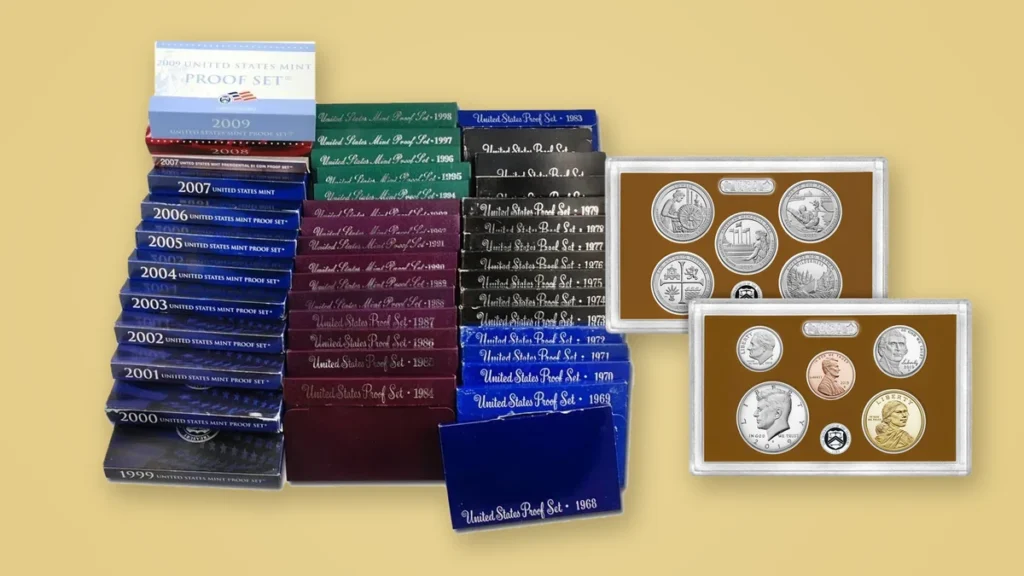
Stack of U.S. proof sets from 1968 to 2009 in original government packaging beside an open 2019 U.S. Mint Proof Set on a gold background

U.S. proof sets from 1968 to 2009 in original packaging, beside a 2019 Proof Set. 2019 set photo: United States Mint (public domain).

This page looks at US proof set values by era: how proof sets changed from the first modern sets of 1936 to today, and which years, errors and varieties collectors watch for. If you want to know what affects the price of a set and how to check it yourself, see our guide to US Mint proof set value. Before you sell, read our step-by-step guide on how to sell proof and mint sets.

US proof sets are that year’s current circulating coins that are specially struck in “proof condition” by the U.S. Mint for coin collectors. Because they’re relatively inexpensive, they’re an accessible way for beginner numismatists to get started in the hobby.

If your collection includes U.S. Mint Sets, or U.S. Commemorative Coin Sets see our page on selling them.

What Determines US Proof Set Values

Some factors determining US proof set values include:

  • The grading service – many US proof set coins are graded by rare coin grading services like ANACS, NGC, and PCGS.
  • The grade of the coins – Let’s face it, quality can matter. Proof coins in the very highest of grades could be valued significantly higher.
  • The year of issue – Modern US proof sets have been minted since 1936. Generally speaking, US proof set values are higher the closer they are to 1936. However, throughout the series there are special instances of various sets going for hundreds or even thousands of dollars more than normal.

No one else can help you better ferret out those valuable coins than us.

For those interested, here is a link to a deeper dive into Proof Sets, Mint Sets, and Commemorative Sets.

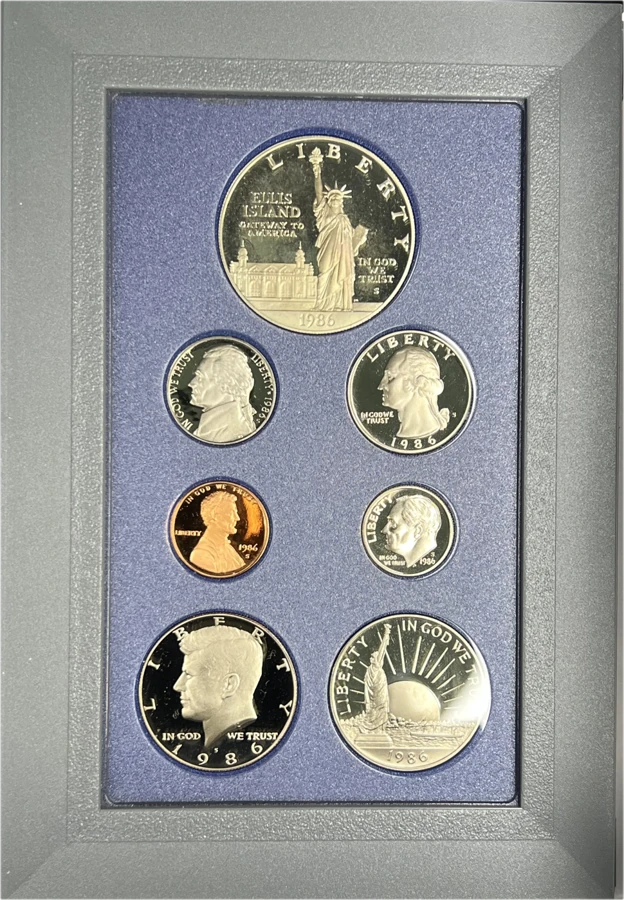
1986 U.S. Mint Prestige Proof Set in its case with the Statue of Liberty commemorative half dollar and silver dollar and the regular proof coins
1986 Prestige Proof Set with Statue of Liberty commemoratives
Decorative gold separator bar

US Proof Sets by Era

Where a proof set was struck, how it was packaged and which coins it holds all depend on its era. Knowing the era helps you judge whether a set is complete and original.

EraWhere struckPackagingWhat to look for
1936 to 1942Philadelphia, no mintmarkCoins sold one by one in tissue or cellophane, so sets were put together by collectorsThe lowest mintages of any modern proof sets; 1942 sets can include both the regular and the wartime silver nickel
1943 to 1949No proof coins were made during and after World War II.
1950 to 1964Philadelphia, no mintmarkSmall cardboard box until 1955, then flat plastic packs in an envelope90% silver dime, quarter and half dollar; Cameo coins; 1955 box sets; 1960 Large Date and Small Date cents
1965 to 1967No proof sets. Special Mint Sets were sold instead.
1968 to dateSan Francisco, S mintmark (some later coins from West Point, W mintmark)Hard plastic lens in a box or sleeveNo-S errors, Type 2 mintmark varieties, silver proof sets from 1992, and special bonus coins

Silver proof sets have their own guide: silver proof set values. You can look up mintages and details for individual proof coins at PCGS CoinFacts.

Decorative gold separator bar

Scarce Proof Sets and Errors to Look For

Most proof sets are common, but a few years and errors stand out. These are some of the sets collectors look for:

  • 1936 to 1942 proof coins and sets. Made in small numbers, with 1936 the lowest-mintage year.
  • Early 1950s proof sets. Mintages were far lower than in later decades, and coins with strong Cameo contrast are especially wanted.
  • No-S proof errors. A few proof coins were struck without their S mintmark, including the 1968, 1970, 1975 and 1983 dimes, the 1971 nickel and the 1990 cent. These are rare and are found in otherwise normal sets.
  • 1979 and 1981 Type 2 sets. A clearer, redesigned S mintmark was used on some coins partway through these years.
  • 1999 silver proof set. The first silver set with the 50 State Quarters, and a popular year with collectors.
  • 2019 proof set with the 2019-W cent. The Mint added a West Point proof cent to that year’s proof set as a bonus coin.

If you think one of your sets has an error or variety, see our guide to error coins and variety coins, or use the form below for a free appraisal.

Decorative gold separator bar

What is My US Proof Set Worth?

There’s an easy process for finding out your US proof set values. All you need to do is provide us with a simple inventory list, or pictures, as well as contact information. If you decide to send us pictures, here are instructions on how to take the best coin pictures.

From there, we’ll get you a written appraisal value and offer to purchase, (within a few hours in many cases). If circumstances permit, we may even send our coin buyer to your house for a physical appraisal that would be payable on the spot, totally free of charge.

Always Paying More For Your US Proof Sets

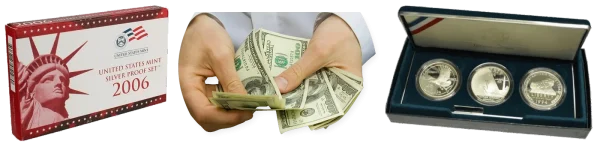
2006 U.S. Mint silver proof set and a 1994 commemorative silver set beside hands in white shirt sleeves counting cash

Why Sell U.S. Proof Sets To Us?

When it comes to figuring U.S. Proof Set Values, there’s a number of advantages to dealing with us 

These include:

  • Decades of experience — We’ve been in the numismatics business for over 30 years and have the extensive knowledge and resources that allow us to confidently make Top Dollar Offers to buy from folks like yourself.
  • Reputability — Check out our Google Reviews. An A+ rating from the Better Business Administration. This means if you deal with us, you can trust that you are dealing with one of the most reputable coin dealers around.
  • Fewer Expenses— If you decide to ship to us, your shipment is fully covered with no deductible, and we offer free or discounted shipping on selected collections.
  • Less aggravation — If you come to us you’re not going to have to travel around just to haggle with greedy coin shop owners or otherwise, deal with anonymous buyers online. Not only will we offer to buy your entire collection, we’ll make you that offer writing. Best of all, if you choose to sell with us, payment is promptly made upon our receipt of your US Proof Set collection.

Don’t wait any longer to find out if you have a valuable collection! Fill out the form below to get started today!

Decorative gold separator bar
Quick Answers: US Proof Sets by Year

Why are there no US proof sets from 1943 to 1949?

The U.S. Mint stopped making proof coins in 1942 because of World War II and did not start again until 1950. Proof sets were also skipped from 1965 to 1967, when Special Mint Sets were sold instead.

What is a No-S proof coin?

Since 1968 US proof coins have been struck in San Francisco and carry an S mintmark. A No-S proof is a coin that was struck without that mintmark by mistake. Known examples include the 1968, 1970, 1975 and 1983 dimes, the 1971 nickel and the 1990 cent, and all of them are rare.

How can I tell what year my proof set is from?

The year is on each coin and is usually printed on the box, sleeve or envelope. Packaging also helps: sets from 1950 to 1955 came in small boxes, sets from 1955 to 1964 in flat plastic packs, and sets from 1968 on in hard plastic lenses.
Decorative gold separator bar

Free Proof Set Appraisals - Free Proof Set Values

Email, Text, or Use This Form To Send Us Your Inventory List or Pictures

Email: staff@americanrarities.com | Text: 720-600-4740


Upload clear photos of fronts and backs and we'll reply with a free appraisal.

    Decorative gold separator bar

    Professional Associations

    American Rarities professional association logos