
Sell Collector Coins

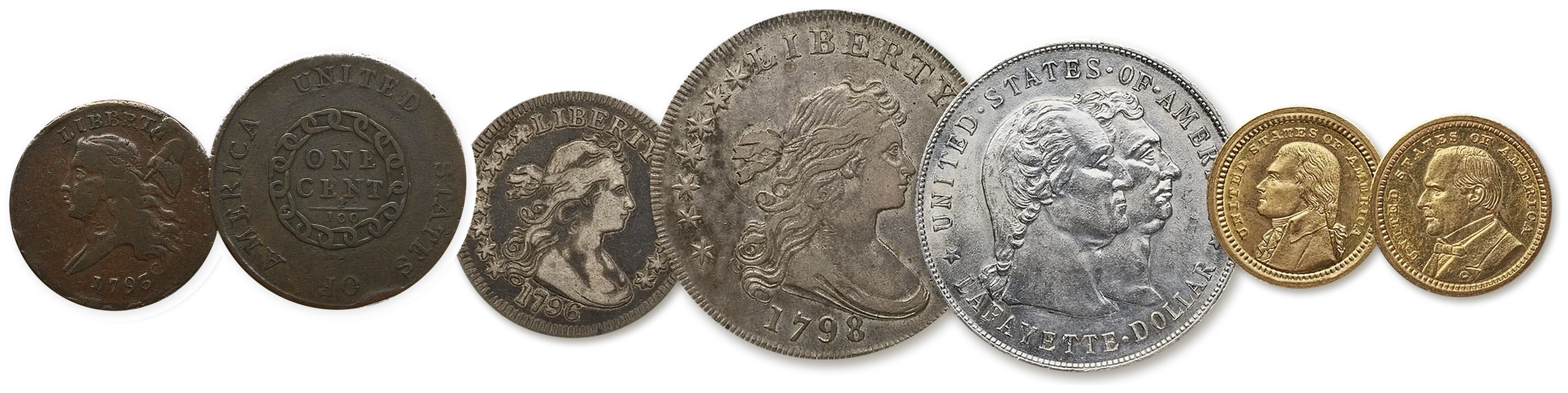
Row of collector coins: 1793 Liberty Cap half cent, 1793 Chain cent, 1796 Draped Bust quarter, 1798 Draped Bust dollar, 1900 Lafayette dollar and two 1903 Louisiana Purchase gold dollars

If you want to sell collector coins, the most important thing is to deal with a buyer who pays for what makes them collectible: rarity, date and mint mark, variety, grade and eye appeal, not just the silver or gold they contain. American Rarities has bought rare and collector coins since 1990, and in more than 30 years we have purchased over $400 million in coins, bullion and currency.

Whether you have an early American type set, a run of commemorative half dollars, a complete date set in albums or a few certified key dates, we will appraise every coin for free and make a written offer with no obligation. Email photos or a list to staff@americanrarities.com, text them to 720-600-4740, or use the form on this page.

What Counts as a Collector Coin?

A collector coin, or numismatic coin, is worth more than its metal because collectors want it. Common examples include:

  • Early American coins such as half cents, large cents and Draped Bust or Capped Bust silver from the first decades of the United States Mint.
  • Type coins from short-lived series, such as two-cent pieces, three-cent silver and nickel pieces, twenty-cent pieces, Seated Liberty silver and $3 gold.
  • Key dates and varieties in popular series such as Indian Head and Lincoln cents, Buffalo nickels, Mercury dimes, Standing Liberty quarters, Walking Liberty halves and Morgan and Peace dollars.
  • Commemoratives, including the classic commemoratives of 1892 to 1954 such as the 1900 Lafayette dollar and 1903 Louisiana Purchase gold dollars, and modern U.S. Mint commemoratives.
  • Complete sets and albums, proof and mint sets, and pre-1933 U.S. gold.
  • Certified coins graded by PCGS or NGC, including high-grade registry-quality pieces.

Not sure what you have? Our coin value finder explains how to identify a coin and what drives its value, and a free online coin appraisal gets you an expert answer from photos.

Decorative gold separator bar

How We Value Collector Coins

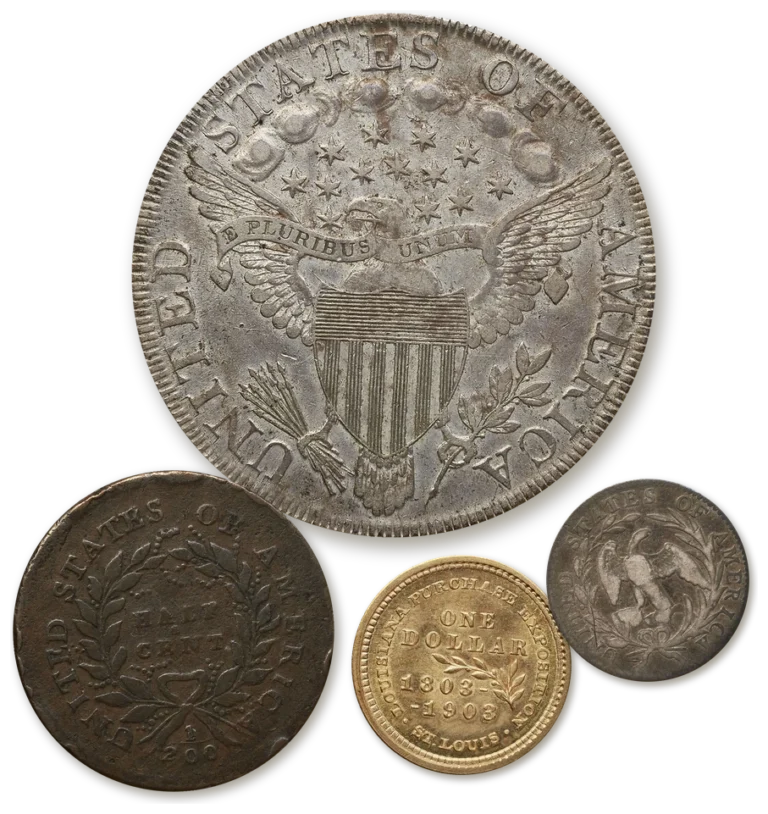
Reverses of collector coins: a 1798 Heraldic Eagle silver dollar, a 1793 half cent wreath, a 1903 Louisiana Purchase gold dollar and a 1796 small eagle dime

Two coins with the same date can be worth very different amounts. When we appraise a collector coin, we look at:

  • Rarity: mintage, survival rate and how many exist in each grade, using population data from grading services such as PCGS and NGC.
  • Grade: where the coin falls on the Sheldon 1-70 grading scale. We offer free in-house grading without slabbing, so you do not have to pay to certify coins before selling.
  • Eye appeal and originality: natural toning, strike and surfaces. Cleaned, polished or damaged coins are worth less, which is why you should never clean a coin before selling it.
  • Authenticity: we use XRF metal analysis and digital microscopy to confirm valuable coins.
  • Demand: what collectors are paying now, checked against recent auction records and dealer markets, with the metal value as a floor for silver and gold coins.

Why collectors and families sell to American Rarities

  • Experience: founded in 1990, with hundreds of years of combined numismatic experience on our team.
  • Reputation: A+ rating from the Better Business Bureau, Life Members of the American Numismatic Association, a PCGS and NGC authorized dealer and ANACS submission center, and a 4.7 rating from 86 Google reviews.
  • We buy whole collections: we make an offer on the entire collection, so you are not left with the coins nobody else wanted after a buyer picks out the best ones. Selling a big holding? See our guide to selling a large coin collection.
  • A nationwide buying network: with a presence in California, Colorado, Arizona, Minnesota, Texas, Florida, Pennsylvania, Wyoming and New Jersey, our buyers can visit you at home to review a significant collection in person.

Sadly, not every buyer is trustworthy. State consumer agencies such as the Minnesota Attorney General have published warnings about coin dealer scams, so check any buyer’s credentials before you sell.
Decorative gold separator bar
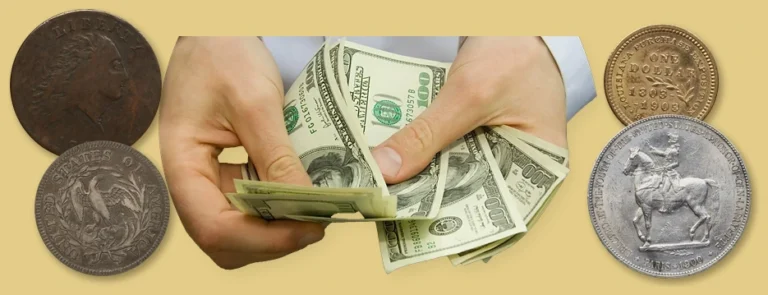
Hands in white shirt sleeves counting cash between a 1793 large cent, a 1796 quarter, a 1903 Louisiana Purchase gold dollar and a 1900 Lafayette dollar

How to Sell Collector Coins in 4 Easy Steps

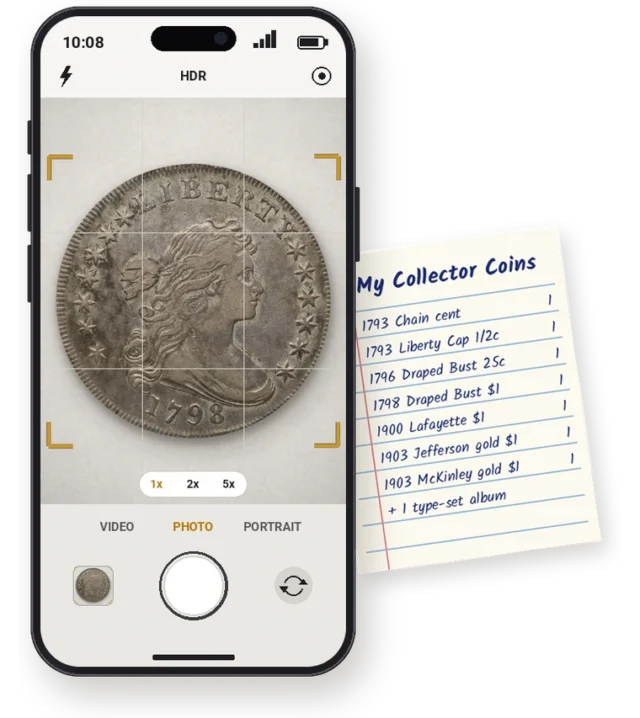
  1. Smartphone with a light camera screen showing a 1798 Draped Bust silver dollar, overlapping a handwritten inventory list of collector coins
    Tell us what you have. Email, text or use the form to send photos of the front and back of your best coins, an inventory list, or both. For albums and sets, a few photos of each page is a fine start. Include any PCGS or NGC certification numbers.
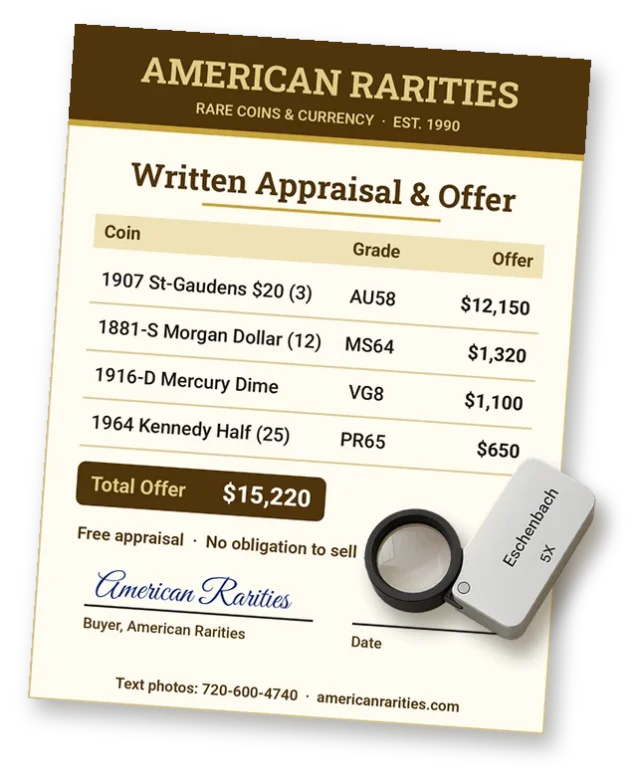
  2. American Rarities written appraisal and offer sheet with an Eschenbach 5X folding loupe resting on the page
    Get a free written appraisal. A numismatist reviews your coins. All appraisal requests are reviewed in the order they are received. Some appraisals take minutes, while larger, more complex collections can take a few days. Either way, you’ll get a response from us. with an appraisal and, if you want to sell, a written offer There is no obligation.
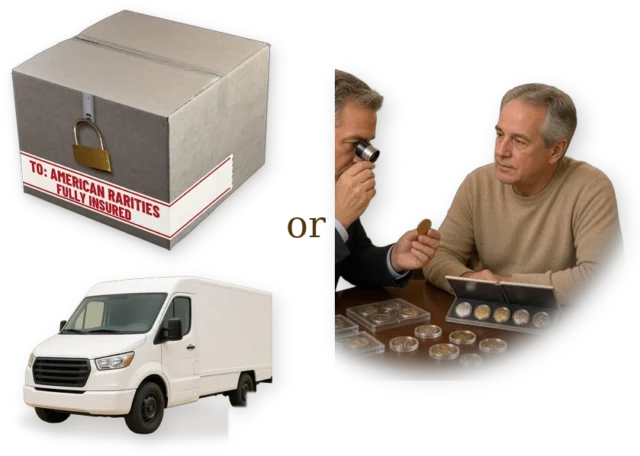
  3. A padlocked American Rarities shipping carton and a delivery van, or a buyer meeting a customer in person to look at collector coins
    Choose how to deliver. Ship with our insured mail-in service with no deductible (free or discounted shipping on selected collections), or have a buyer from our nationwide buying network visit you at home.
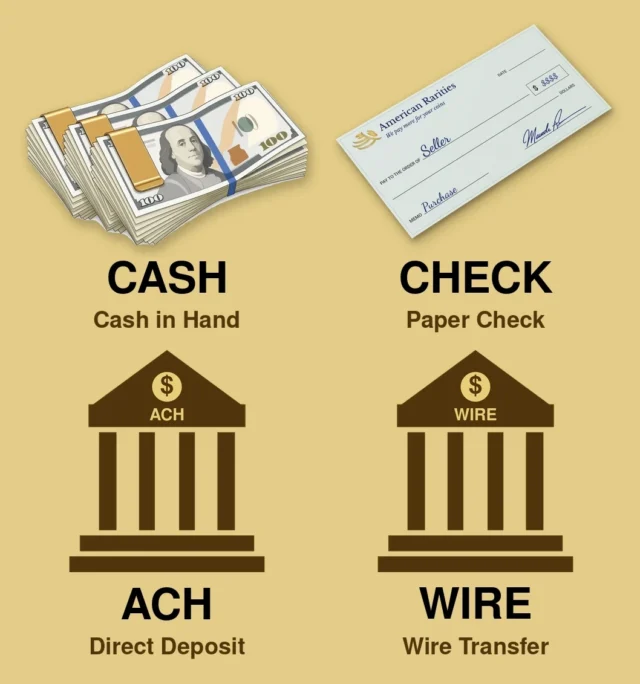
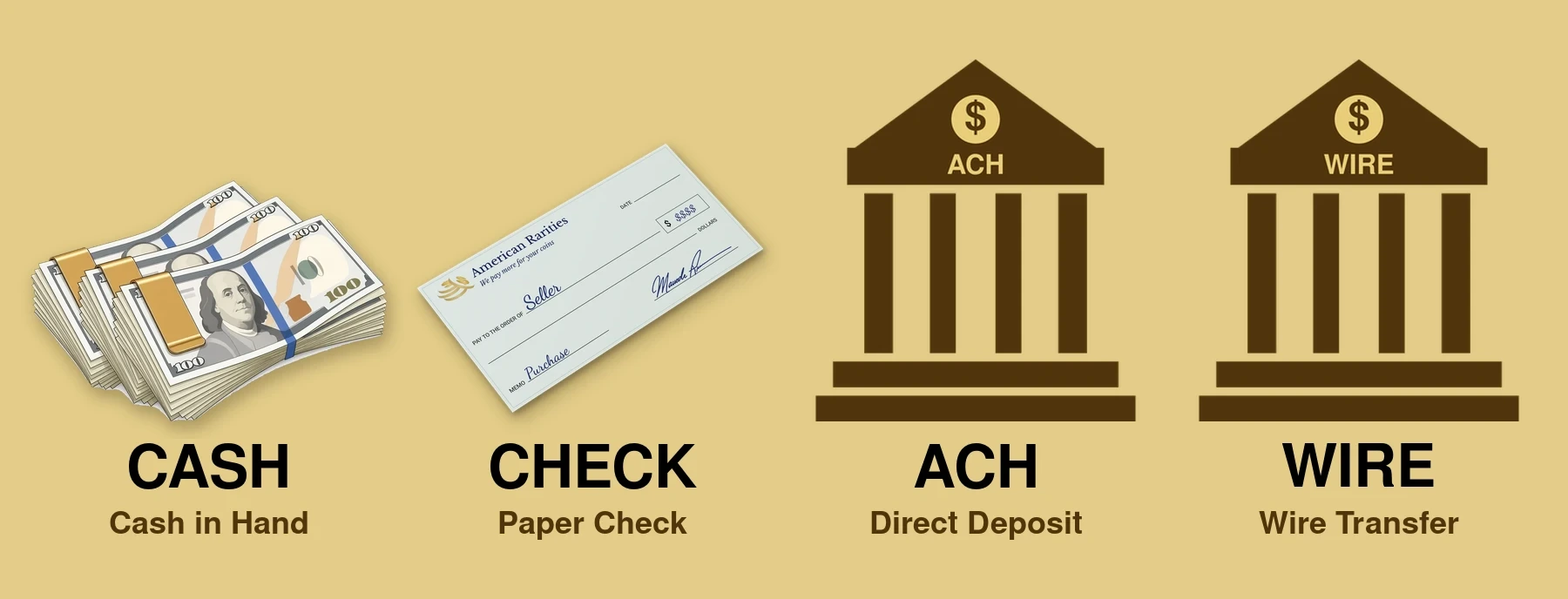
  4. Four ways to get paid: cash, check, ACH and wire, stacked two by two
    Get paid immediately. Once we confirm your coins, we pay immediately by cash, check, ACH or wire.

Tips before you sell: do not clean or polish anything, leave certified coins in their holders and keep coins in their original albums, folders or Mint packaging. Keep any receipts or old inventory lists, since they help us identify varieties. Settling an estate? We also prepare IRS-compliant appraisals.

Related guides: sell rare U.S. coins, sell my rare coins, sell a single rare coin, coin collection buyers and sell coins online for cash.

Decorative gold separator bar

Selling Collector Coins: Quick Answers

What is the difference between a collector coin and a bullion coin?

A bullion coin is valued mainly for its silver or gold, and its price moves with the spot price. A collector coin, or numismatic coin, is worth more than its metal because of its rarity, date, mint mark, variety, grade and demand. Some coins are both: a common Morgan dollar trades near silver value, while a scarce date or high grade is valued as a collectible. We appraise every coin as a collectible first.

What kinds of collector coins do you buy?

We buy U.S. and world collector coins of every kind: early copper and silver, key dates and varieties, type coins, commemoratives, proof and mint sets, pre-1933 gold and certified coins in PCGS, NGC and ANACS holders. We also buy the common coins that come with a collection, so you do not have to split it up. Send photos or a list and we will appraise everything for free.

How do I sell a coin collection that is in albums?

Leave the coins in their albums and photograph each page, front and back if the album allows. Removing coins risks scratches and fingerprints, and some collectors value original albums. Incomplete sets are fine; we price every coin that is there. Old cardboard albums can tone coins over time, sometimes attractively, so do not try to clean them. A list of which albums you have, with the series and years, is a helpful start.

What is a type set, and are type coins valuable?

A type set contains one example of each coin design rather than every date, and type coins are often valuable. Short-lived series such as two-cent pieces, three-cent silver and nickel pieces, twenty-cent pieces and $3 gold, plus early Bust and Seated Liberty silver, are scarce in any date. Value depends mostly on grade, eye appeal and originality, since collectors want the nicest example they can afford of each design.

Do I have to send my collector coins in the mail?

No. You can use our insured mail-in service, fully insured at our expense, or for significant collections a buyer can visit you at home or meet you at your bank. Either way, you start with photos or a list and get a free written offer before anything moves. If you decline, we return mailed items fully insured.

Decorative gold separator bar

Free Appraisal for Your Coins and Coin Collections

Email, Text, or Use This Form To Send Us Your Inventory List or Pictures


Upload files of inventory lists and front and back photos of your items.

    We can help build your inventory list. Use the Collection List Maker to photograph your items and we'll build the inventory list for you.

    Decorative gold separator bar

    Professional Associations

    Professional association and grading-service logos including ANA Life Member, PMG, PCGS, NGC, ANACS, CAC, CCE and currency-grading organizations