A Beginner’s First Steps for Selling Old Coins

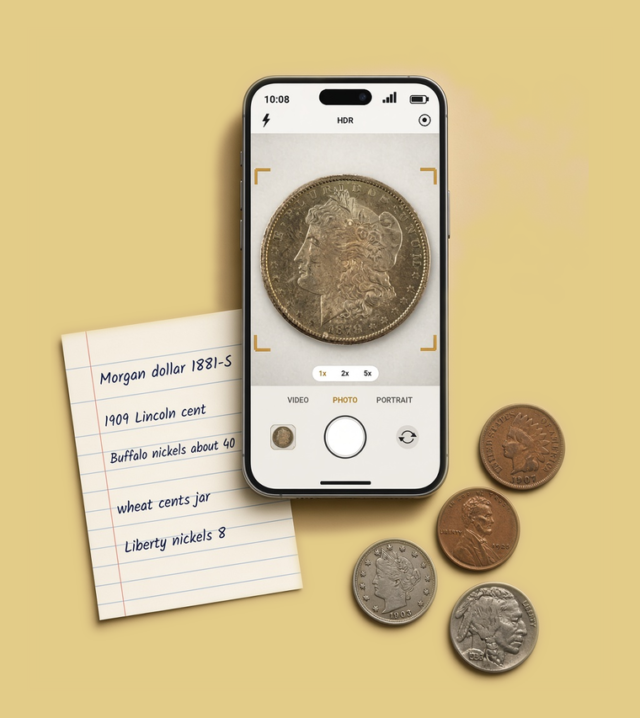
Found a jar of old coins, a drawer of change from a grandparent or a small box you don’t recognize? You don’t need to know anything about coins to take the right first steps. This page shows you what to leave alone, how to photograph what you have and how to ask for a free opinion before deciding anything.
American Rarities has bought old coins since 1990. We look at small groups of coins every day, and there is no obligation to sell.
Step 1: Leave the Coins as They Are
- Do not clean, rub, polish or dip any coin. Cleaning leaves fine scratches and can sharply lower value.
- Handle coins by the edges, not the faces, so skin oils don’t leave marks.
- Leave coins in their holders, envelopes, rolls or albums.
- Keep groups together. If coins were stored together, keep them that way.
Step 2: Sort Gently, Without Guessing
You can separate coins by what you can plainly see: pennies, nickels, dimes, quarters, half dollars, dollars, gold-colored coins and coins from other countries. Don’t assume a coin is valuable because it is old, or worthless because it is worn. Some coins from the 1900s were made by the millions, and some worn coins are still scarce. If you are not sure, leave it unsorted.
Step 3: Make a Simple List and Photos

- Take a clear photo of the front and back of any coin you are unsure about, in good light, without a flash glare.
- For a jar or roll, a photo of the group spread out on a table is fine.
- Write down rough counts: for example, “about 200 pennies, 30 dimes, 4 large silver-colored coins.”
- Keep the photos to coins only. You don’t need to show your home or post them publicly.
Step 4: A Plain-Language First Look
| What you see | What it might be |
|---|---|
| Ordinary-looking modern change | Often face value, but worth a quick check for older dates. |
| Older silver-colored dimes, quarters, halves or dollars | Older U.S. silver coins can be worth more than face value. See 90% silver coin values. |
| Coins from other countries | Values vary widely; an expert can sort them quickly. |
| Anything unusual or very old | Could be ordinary or could be scarce. Let an expert review it. |
Simple home tests, like ringing a coin, scratching it or trying a magnet, cannot prove a coin is genuine, so please skip them. To identify an unfamiliar coin yourself, use our guide to identify an unfamiliar coin. Think you have a key date? See selling a suspected key date.
Step 5: Ask for a Free Opinion
Text your photos to 720-600-4740, email staff@americanrarities.com or use the form below. All appraisal requests are reviewed in the order they are received. Some appraisals take minutes, while larger, more complex collections can take a few days. Either way, you’ll get a response from us. A photo opinion is a first look, not a final authenticated value; if a coin looks important, we will tell you what the next step is.
If you decide to sell, you can ship fully insured at our expense, and we pay immediately by cash, check, ACH or wire once you accept. Found a whole album collection rather than a jar? Read about handling a full inherited collection, or choose your next step.
Selling Old Coins: Quick Answers
Is a coin valuable just because it is 100 years old?
Not always. Many early-1900s coins, such as common Indian Head and wheat cents, were made by the millions and are worth only a little. Rarity, metal, condition and demand matter more than age. Silver and gold content, a scarce date or mint mark, or unusually good condition is what usually makes an old coin worth more.
Should I clean old coins before selling?
No. Cleaning can sharply lower a coin’s value, because it leaves fine scratches and removes the original surface that collectors pay for. Leave them as they are, handle them by the edges and keep them in their holders, envelopes, rolls or albums. Dirt and dark toning are normal on old coins.
Do you look at small groups of coins?
Yes. Send photos of a jar, a drawer or a handful of coins and we will give you a free opinion. One group photo of common coins, plus front and back photos of anything that looks old, silver, gold or unusual, is enough to start. There is no obligation to sell.
Do you buy ancient coins?
Yes. We buy ancient Greek and Roman coins along with U.S. and world coins. Ancient coins are widely copied, and many sold to travelers are modern replicas, so authenticity is the first question. Send clear photos of both sides and the edge, and we will tell you what you have before you decide anything.
Can a magnet or ring test tell me if a coin is real?
No. Those tests cannot prove a coin is genuine. A magnet can flag some steel or iron fakes, since genuine gold and silver coins are not magnetic, but many counterfeits are made of non-magnetic metals. Expert review, with weight, metal testing and magnification, is the reliable way to know.

Free Appraisal for Your Coins and Coin Collections
Email, Text, or Use This Form To Send Us Your Inventory List or Pictures
Email: staff@americanrarities.com Text: 720-600-4740
First steps for a jar of old coins
Leave coins as they are.
What rubbing and dipping do.
A beginner path from jar to offer.
Ten steps to a realistic range.
When old coins are worth more than melt.
Professional Associations