
The Silver “Golden Rule” (1916–1970)
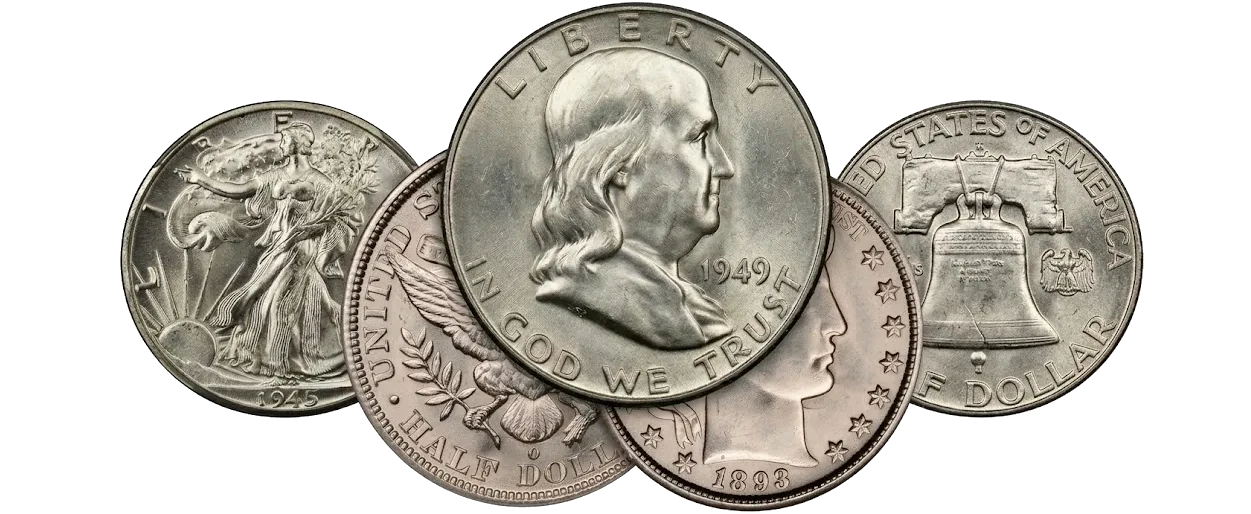
The most immediate way to determine if your half dollars are worth money is to look at the date. The U.S. Mint changed the composition of these coins several times, and the silver content is the “floor” for their value.
- 1964 and Earlier (90% Silver): Any half dollar dated 1964 or before is made of 90% silver. This includes the iconic Walking Liberty, the Franklin, and the first year of the Kennedy series. These are always worth several times their face value based on the “spot price” of silver alone.
- 1965 to 1970 (40% Silver): While the mint stopped using 90% silver in 1965, Kennedy half dollars minted between 1965 and 1970 still contain 40% silver. Many people mistakenly spend these, not realizing they carry a significant premium.
- 1971 to Present (Base Metal): With very few exceptions (such as special silver Proof Sets), half dollars minted from 1971 onwards are made of copper and nickel. Unless they are in perfect “Mint State” condition or have a visible mint error, they are generally only worth 50 cents.
Expert Tip: If you have a bag of pre-1971 half dollars, do not take them to a bank. A bank will only give you 50 cents each. American Rarities provides a “Remote In-Home Appraisal” where we evaluate the bulk silver value plus any collector premiums.
Half Dollar Silver Content by Year
Silver content is the floor under every silver half dollar’s value. Here is how much silver each type of half dollar contains, based on U.S. Mint standards:
| Years and Type | Weight | Silver FinenessFineness | Pure Silver (troy oz)Silver oz |
|---|---|---|---|
| 1892–1915 Barber | 12.50 g | 90% | 0.3617 |
| 1916–1947 Walking Liberty | 12.50 g | 90% | 0.3617 |
| 1948–1963 Franklin | 12.50 g | 90% | 0.3617 |
| 1964 Kennedy | 12.50 g | 90% | 0.3617 |
| 1965–1970 Kennedy | 11.50 g | 40% | 0.1479 |
| 1971–present Kennedy (circulation) | 11.34 g | None (copper-nickel clad) | 0 |
| 1794–1891 early halves (Bust and Seated Liberty) | 12.44–13.48 g | 89.24%–90% | 0.3600–0.3868 |
These are exact figures for new, uncirculated coins. The melt value formula below uses the standard 0.715 troy ounces per $1 face value (0.3575 per 90% silver half), which allows for normal wear.
A few later coins also contain silver: the 1976-S Bicentennial halves sold in special 40% silver sets, silver proof Kennedy halves made for collector sets (90% silver from 1992, and .999 fine silver from 2019), and the 2014 50th-anniversary silver and gold Kennedy halves. To learn more about silver coin values in general, see our guide to 90% silver coins.
How to Tell if a Half Dollar Is Silver
- Check the date: 1964 and earlier means 90% silver; 1965 to 1970 means 40% silver.
- Look at the edge: A 90% silver half has a solid silver-white edge. A clad half (1971 and later) shows a copper stripe. The 40% silver halves show a faint, grayish stripe.
- Weigh it: A 90% silver half dollar weighs 12.5 grams, a 40% silver half weighs 11.5 grams, and a clad half weighs about 11.34 grams. A small digital scale can catch silver coins hiding in the wrong date range.
- Listen and look: Silver halves have a brighter ring and often tone to gray, gold or blue over time, while clad coins tend to look duller.
Silver vs. clad at a glance:
| Type | Edge | Weight |
|---|---|---|
| 90% silver (1964 and earlier) | Solid silver-white, no stripe | 12.5 g |
| 40% silver (1965–1970) | Faint gray stripe | 11.5 g |
| Copper-nickel clad (1971 and later) | Clear copper-colored stripe | About 11.34 g |
What Is a Silver Half Dollar Worth?
Silver melt value: the quick formula
Melt value ≈ face value × 0.715 × spot price of silver
Use this for 90% silver dimes, quarters and half dollars dated 1964 and earlier. Every $1 in face value of these coins holds about 0.715 troy ounces of silver.
| Coin | Silver per Coin | Melt Value |
|---|---|---|
| 90% silver half dollar (1964 and earlier) | 0.3575 troy oz | 0.3575 × spot |
| $1 face value of 90% silver (2 halves, 4 quarters or 10 dimes) | 0.715 troy oz | 0.715 × spot |
| 40% silver Kennedy half (1965–1970) | 0.1479 troy oz | 0.1479 × spot |
Worked example: If silver is $X per ounce, one 90% silver half dollar is worth about 0.3575 × $X in silver. A roll of 20 halves is $10 face, so it holds 10 × 0.715 = 7.15 ounces and is worth about 7.15 × $X. A 40% silver Kennedy half is worth about 0.1479 × $X.
Why 0.3575 and not 0.3617? A new, uncirculated 90% silver half contains exactly 0.3617 troy ounces (see the silver content table above). The quick formula uses the standard 0.715 troy ounces per $1 face (0.3575 per half), which allows for normal wear on circulated coins.
Silver value is only the starting point. Key dates, high grades, proofs, varieties and errors are worth more than their silver, which is why every coin in your group should be checked by an expert before you sell.
Identifying Valuable Types: From Walkers to Kennedys
Not all half dollars are created equal. Depending on the design and the mint mark, some are highly sought after by collectors (numismatists).
Barber Half Dollars (1892–1915)
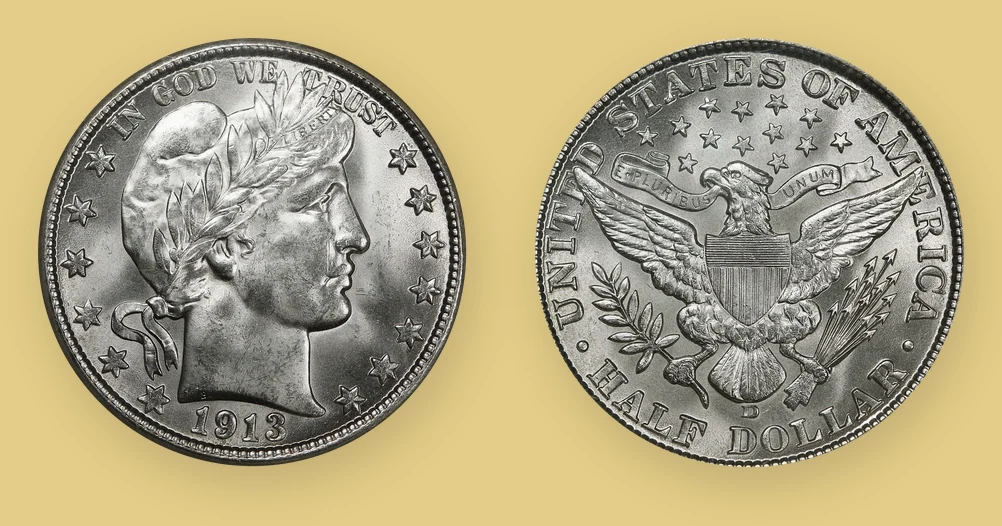
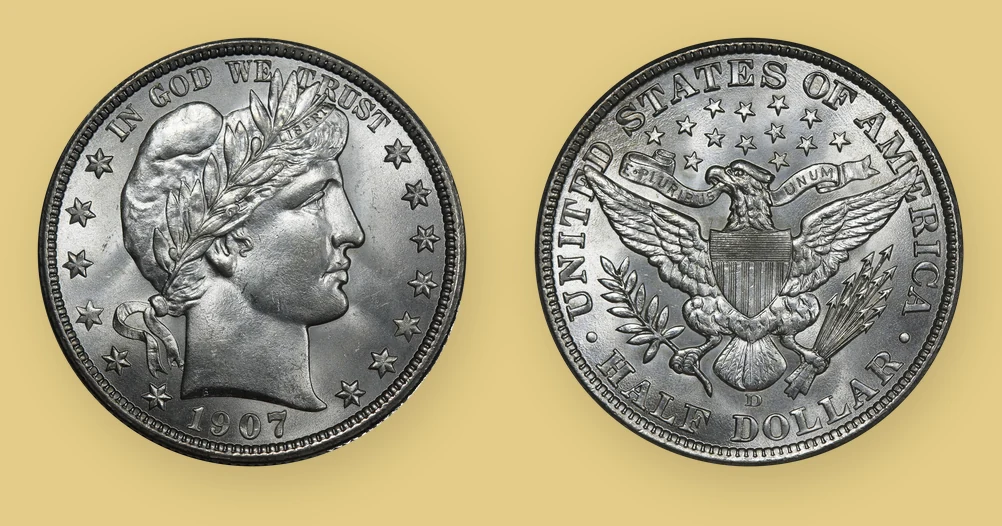
Named for designer Charles E. Barber, these halves show Liberty wearing a cap and laurel wreath, with a heraldic eagle on the back. Every Barber half is 90% silver. The mint mark (O for New Orleans, S for San Francisco or D for Denver) is on the back, below the eagle’s tail; Philadelphia coins have no mint mark. Most Barber halves spent decades in circulation, so sharp examples are hard to find.
- Key dates: 1892-O, 1892-O Micro O, 1892-S, 1893-S, 1896-S, 1897-O and 1897-S.
- Low-mintage Philadelphia dates: 1913, 1914 and 1915 were made in small numbers and are scarce in every grade.
- Grade check: If you can read all seven letters of LIBERTY on the headband, the coin is in a better grade than most survivors, which adds to its value. Worn-smooth coins with a readable date are still worth their silver.
- Proofs: Barber proofs were made every year from 1892 to 1915 in small numbers and are prized by collectors.
- Don’t clean them: Natural gray or toned surfaces are normal on Barber halves. Cleaning lowers their value.
Walking Liberty Half Dollars (1916–1947)
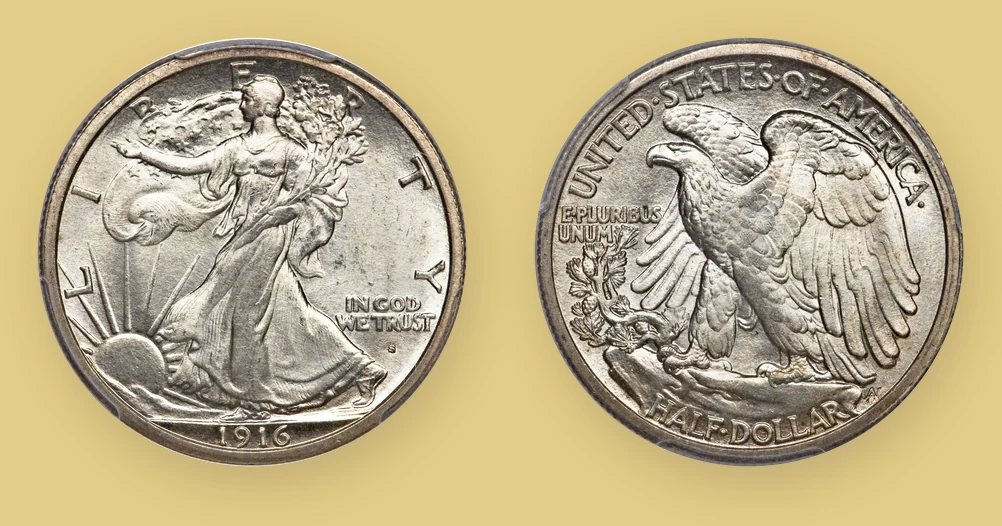
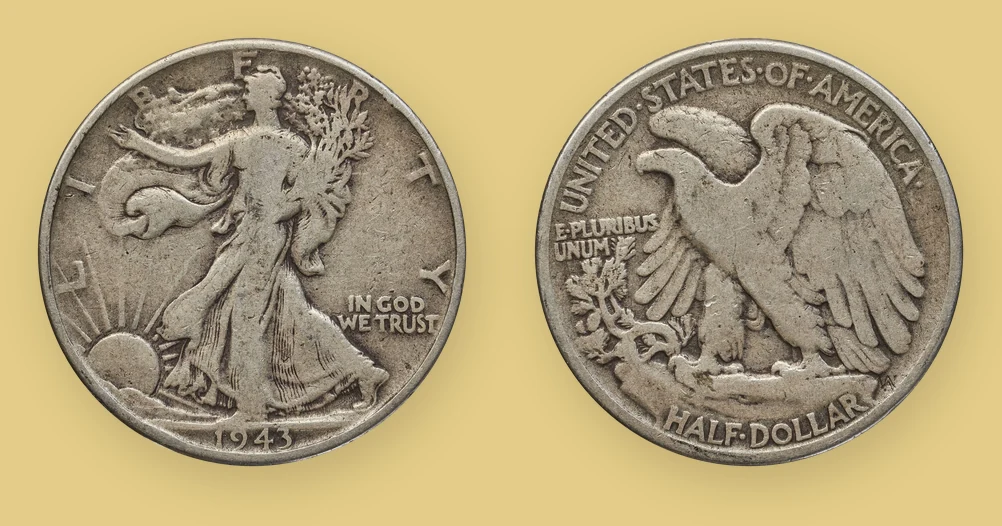
Considered by many to be the most beautiful U.S. coin ever minted, “Walkers” are highly collectible.
- What to Look For: Early dates (1916, 1917, 1921) and coins with mint marks (found on the reverse near the rim) from San Francisco (“S”) or Denver (“D”).
- Key Date Spotlight: A 1921-S Walking Liberty in high grade is one of the most valuable coins in the series. Even in “well-loved” condition, these are prized assets.
- Mint mark location: On 1916 and some 1917 coins, the mint mark is on the front, below “IN GOD WE TRUST.” From 1917 on, it is on the back, near the rim at about seven o’clock.
- More key dates: 1916-S, 1917-S (mint mark on the front), 1919-D, 1921, 1921-D and 1938-D. The 1919, 1919-S, 1920-D and 1923-S are also scarcer than most dates.
- Common dates: Walkers from 1941 to 1947 were made in large numbers. In circulated grades they are mostly valued for their silver, but uncirculated, well-struck coins bring premiums.
- Full strikes: Look for a fully detailed head, a complete left hand and clear skirt lines. Well-struck, uncirculated Walkers bring strong premiums.
- Proofs: Walking Liberty proofs were made only from 1936 to 1942 and are popular with collectors.
- Missing years: No Walking Liberty halves were made in 1922, 1924 to 1926, or 1930 to 1932.
Franklin Half Dollars (1948–1963)
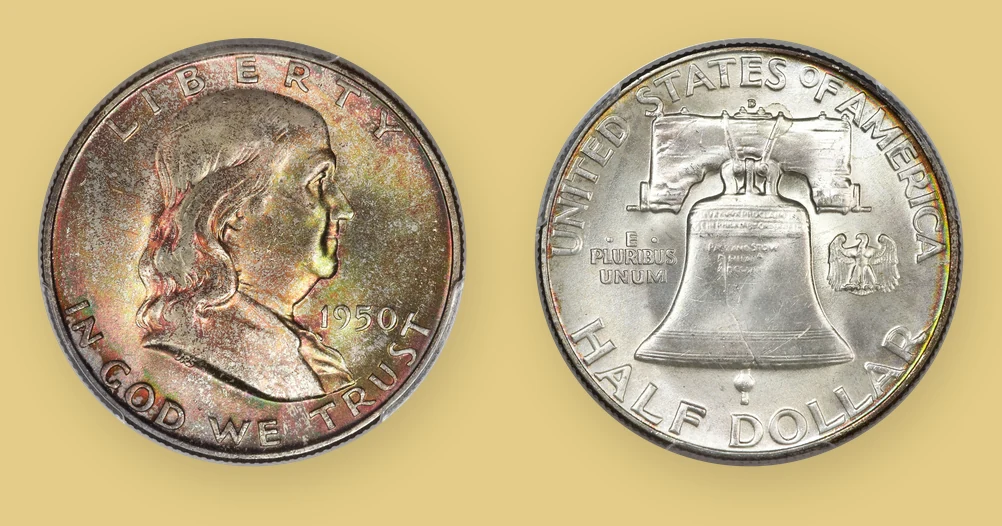
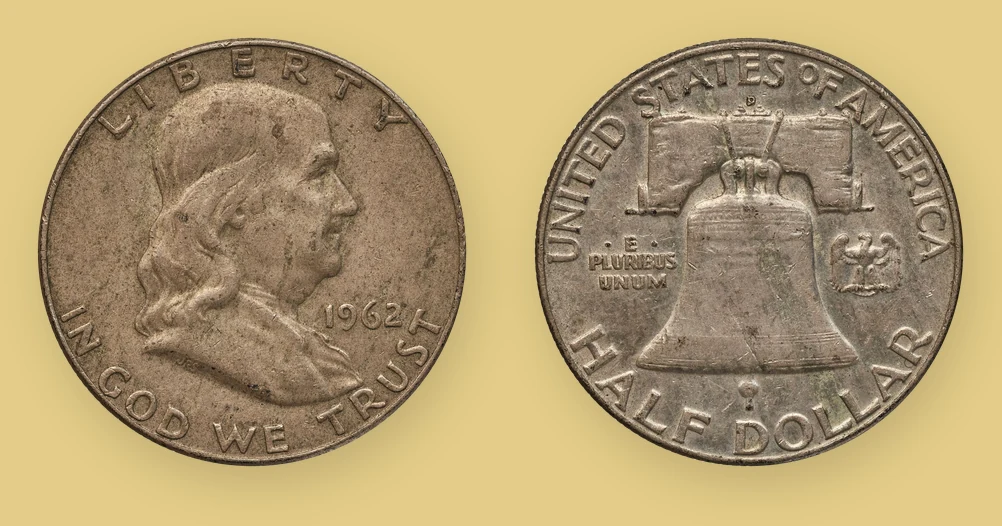
These coins feature Benjamin Franklin and the Liberty Bell. While they are common in 90% silver “junk” bags, certain versions stand out.
- The “Full Bell Lines” (FBL): Collectors pay a massive premium for Franklin halves where the horizontal lines on the Liberty Bell are sharp and unbroken.
- Key Dates: Look for the 1949-S and the 1955 “Bugs Bunny” die clash variety.
- Designer and mint mark: John R. Sinnock designed the Franklin half. The mint mark is on the back, just above the Liberty Bell’s beam.
- Low mintages: The 1955 has the lowest mintage of the series, and the 1953 is also lower than most dates. The 1949-S, 1952-S and 1953-S are scarcer than other branch-mint dates.
- Full Bell Lines: The 1953-S, 1954-S and 1955 are especially hard to find with full, unbroken lines across the bottom of the bell.
- Proofs: Franklin proofs were made from 1950 to 1963. Proofs with frosted designs on mirror fields (Cameo and Deep Cameo) are especially valuable.
- Common dates: Most circulated Franklins from 1957 to 1963 are valued for their 90% silver, but every one is worth well over face value.
Kennedy Half Dollars (1964–Present)
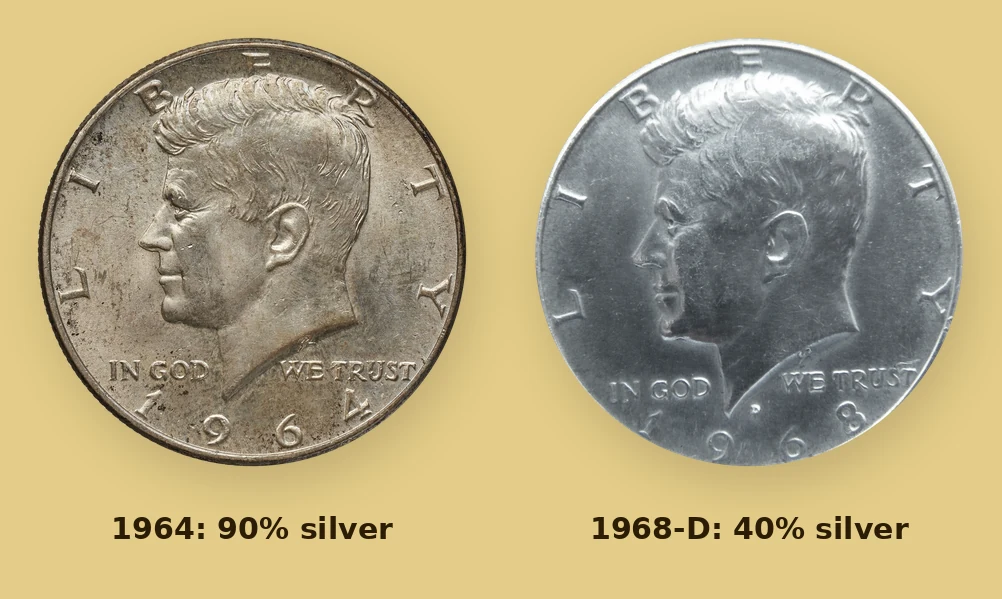
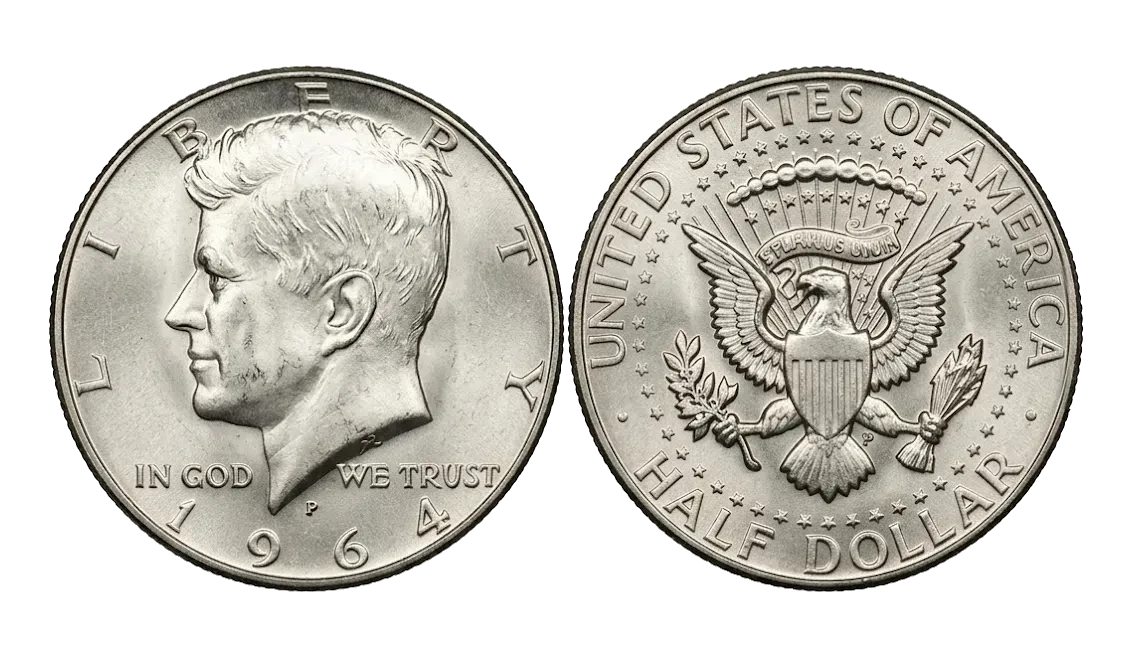
The 1964 Kennedy is a staple of many collections because it was the only year the 90% silver Kennedy was intended for general circulation.
- The 1970-D Rarity: In 1970, the mint only produced half dollars for official Mint Sets. If you find a 1970-D in a collection, it is a “Key Date” that carries a significant collector premium over its silver value.
The Kennedy half was designed by Gilroy Roberts (front) and Frank Gasparro (back). Here are other Kennedy halves worth looking for:
- 1964 “Accented Hair” proof: An early proof variety with extra lines in Kennedy’s hair above the ear.
- 1965 to 1970, 40% silver: No mint marks were used from 1965 to 1967. Special Mint Set (SMS) coins from those years have a satin finish.
- 1974-D Doubled Die Obverse: Look for strong doubling on “IN GOD WE TRUST” and “LIBERTY.”
- 1976 Bicentennial: Dated 1776–1976 with Independence Hall on the back. Circulation coins are clad, but the 1976-S 40% silver coins from collector sets contain silver.
- 1982-P “No FG”: Frank Gasparro’s initials are missing from the back, near the eagle’s tail.
- 1987-P and 1987-D: Not made for circulation; they were issued only in Mint Sets.
- 1998-S Matte Finish: A special silver issue sold in a set with a Robert F. Kennedy dollar.
- 2002 to present: Kennedy halves are no longer made for circulation. They are made for collectors in rolls, bags and sets.
- 2014 50th Anniversary: The Mint issued gold and silver versions, plus special-finish clad coins.
Early Half Dollars (1794–1891)
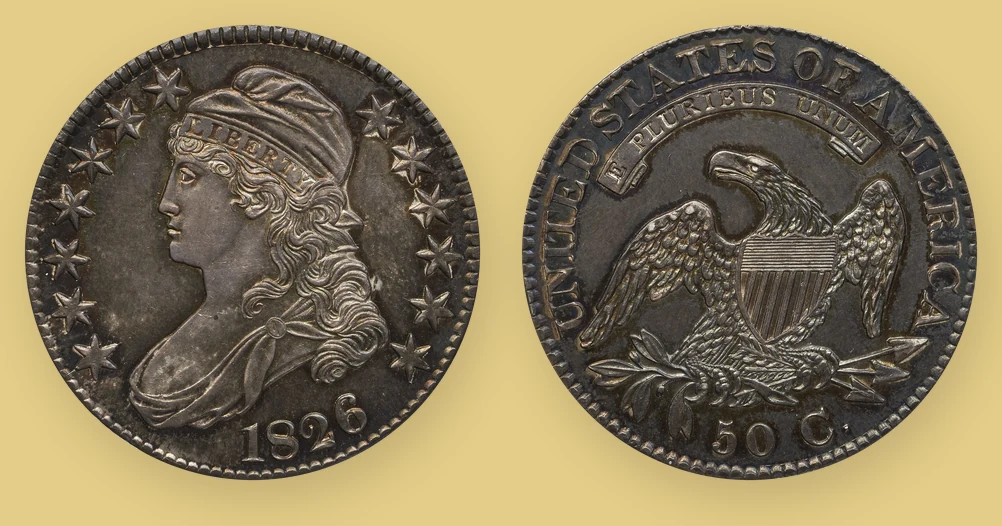
Before the Barber half, the U.S. Mint made four earlier designs: Flowing Hair (1794–1795), Draped Bust (1796–1807), Capped Bust (1807–1839) and Seated Liberty (1839–1891). All are silver, and all are scarcer than the halves most people find today, so even worn examples are collectible. Key coins include the 1794 Flowing Hair, the 1796–1797 Draped Bust with a small eagle, the 1838-O Capped Bust and Carson City (“CC”) Seated Liberty halves.
Many early halves were holed, cleaned or repaired over the years. Leave yours as they are and send us clear photos of both sides; we will tell you what you have.
Commemorative Half Dollars
From 1892 to 1954, the U.S. Mint made more than 140 different commemorative half dollars honoring events, places and people. These include the 1892–1893 Columbian Exposition, the 1915-S Panama-Pacific Exposition, the Pilgrim Tercentenary, the Oregon Trail, the Texas Centennial and the Booker T. Washington and Carver/Washington issues. All of these classic commemoratives are 90% silver, and many carry collector premiums, especially in high grades with original surfaces.
Modern commemorative halves began in 1982 with the George Washington 250th Anniversary half, which is 90% silver. Many later modern commemorative halves are copper-nickel clad, so check the coin’s specifications before assuming it contains silver.
Half Dollar Values by Year: Quick Reference Chart
Use this chart to see which half dollars are worth more than face value. Actual value depends on date, mint mark, condition and the current price of silver.
| Years | Series | Metal | What Usually Drives the Value |
|---|---|---|---|
| 1892–1915 | Barber | 90% silver | Key dates and sharp grades |
| 1916–1947 | Walking Liberty | 90% silver | Silver value, key dates, strike and grade |
| 1948–1963 | Franklin | 90% silver | Silver value, Full Bell Lines, proofs |
| 1964 | Kennedy | 90% silver | Silver value, high grades, Accented Hair proof |
| 1965–1970 | Kennedy | 40% silver | Silver value; 1970-D and SMS coins |
| 1971–present | Kennedy | Copper-nickel clad | Face value unless uncirculated, proof, variety or error |
| 1794–1891 | Early halves (Bust and Seated Liberty) | 89.24%–90% silver | Rarity, date and grade; collectible in any condition |
Why Your Coin’s Condition Is Everything
In the world of rare coins, “condition is king.” A common 1964 Kennedy half dollar in circulated condition is worth several times its face value for its silver alone. However, if that same coin is in “Gem Uncirculated” condition, showing no wear and original mint luster, its value can skyrocket.
Avoid the “Cleaning Trap”: We cannot stress this enough, never clean your coins. Even a light rubbing with a cloth can leave “hairline” scratches that destroy the numismatic value. At American Rarities, we prefer coins with their original “skin” and toning, even if they look dark or “dirty” to the untrained eye. Learn why a coin cleaning mistake can destroy value.
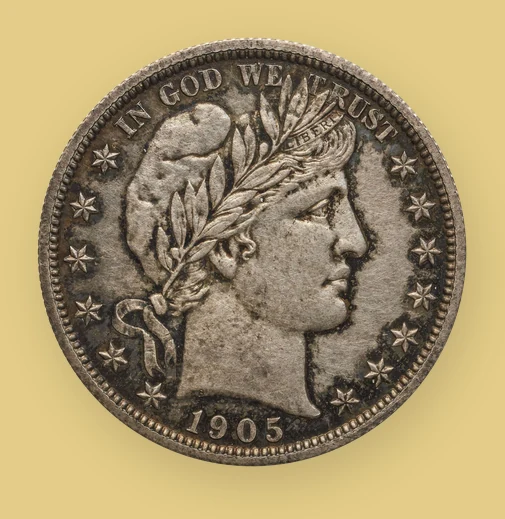
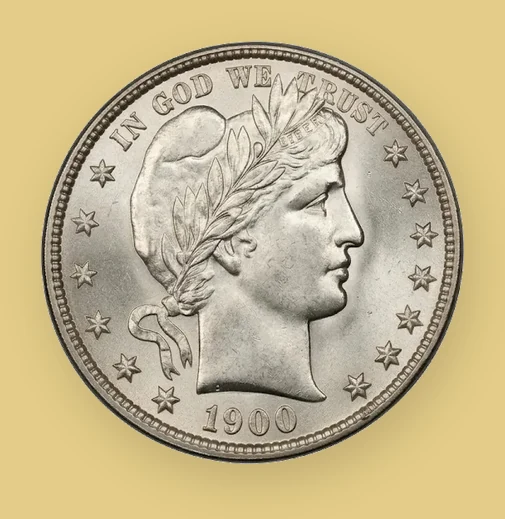
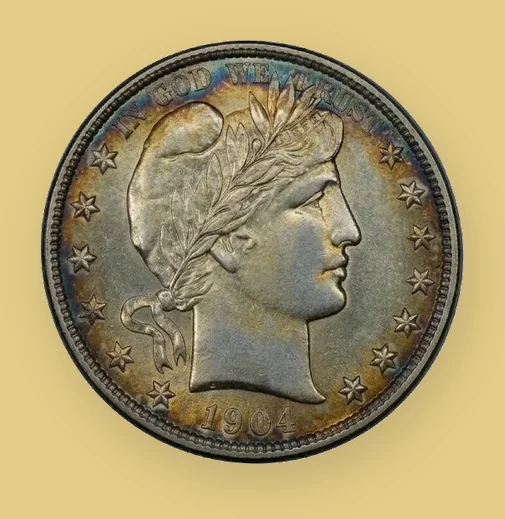
Where Each Half Dollar Series Shows Wear First
- Barber: The word LIBERTY on the headband and the cheek.
- Walking Liberty: Liberty’s head, left hand and the skirt lines, plus the eagle’s breast feathers.
- Franklin: Franklin’s cheek and hair, and the lines across the Liberty Bell.
- Kennedy: Kennedy’s cheek and hair above the ear, and the eagle’s center feathers.
Proofs, Mint Sets and Certified Half Dollars
Proof half dollars have mirror-like fields and are made for collectors. If your halves are still in original government packaging, keep them that way, since original sets are easier to value. Our guide on how to sell proof and mint sets explains more.
High-value half dollars are often certified and encapsulated by a third-party grading service. Learn about the differences between PCGS, NGC and ANACS, or read about how we buy PCGS, NGC and ANACS certified coins.
Half Dollar Errors and Varieties Worth Looking For
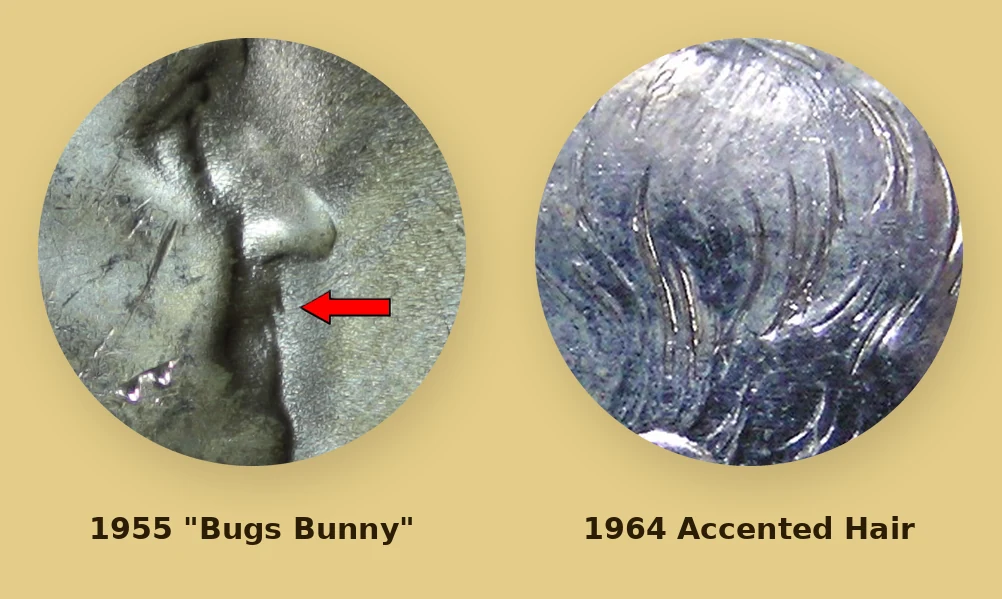
Mint errors and die varieties can make even a common half dollar valuable. Here are the most important ones to look for:
- Off-center strikes: Part of the design is missing because the coin was struck out of position. Coins with a visible, full date are the most desirable.
- Double and multiple strikes: The coin was struck more than once, leaving overlapping designs.
- Broadstrikes and clipped planchets: Coins that are spread out too wide, or are missing a curved or straight piece of metal.
- Transitional and wrong-metal errors: A 1965 half struck on a 90% silver blank, or a 1964 half struck on a clad blank. Weighing the coin is the easiest way to spot these.
- Missing clad layer: A clad Kennedy half with a copper-colored side, because the outer layer separated before striking.
- Doubled dies: Doubling on the letters or date, such as the 1974-D Doubled Die Obverse Kennedy.
- Design varieties: Such as the 1955 “Bugs Bunny” Franklin, the 1964 Accented Hair Kennedy and the 1982-P No FG Kennedy.
What is not an error: Scratches, dents, plating, “magician” coins and other damage that happened after the coin left the Mint. Many coins listed online as errors are simply damaged. If you are not sure, send us a photo and we will tell you what you have.
How to Sell Your Half Dollars for Top Dollar
Many folks who inherit collections feel overwhelmed. Should you go to a local pawn shop? List them on eBay?
- The Pawn Shop Pitfall: Generalist buyers often offer only a fraction of the silver melt value and almost never pay for “numismatic” (collector) rarity.
- The eBay Hassle: Between listing fees, shipping risks, and “cherry-picking” buyers, selling a collection yourself can be a full-time job.
The American Rarities Advantage
We offer a streamlined, 100% no-risk way to sell your collection:
- Expert Evaluation: Our team has over 30 years of experience. We identify the rare dates and high-grade coins that others miss.
- Written Offers: We provide a transparent, written appraisal and offer in a timely manner.
- Nationwide Service: From Chicago to Dallas to Seattle, we serve collectors across the U.S. We can arrange a private, in-person meeting for large estates or provide a secure mail-in service.
- No Fees: Unlike auction houses, we charge zero fees. The price we offer is the price you get.
Selling more than half dollars? Our guides explain how to sell coins online, how to sell a coin collection and how to sell inherited coins. If you have silver dollars too, visit our silver dollar buyer page.
How to Sell Your Half Dollars in 3 Simple Steps
Send Photos and/or a List
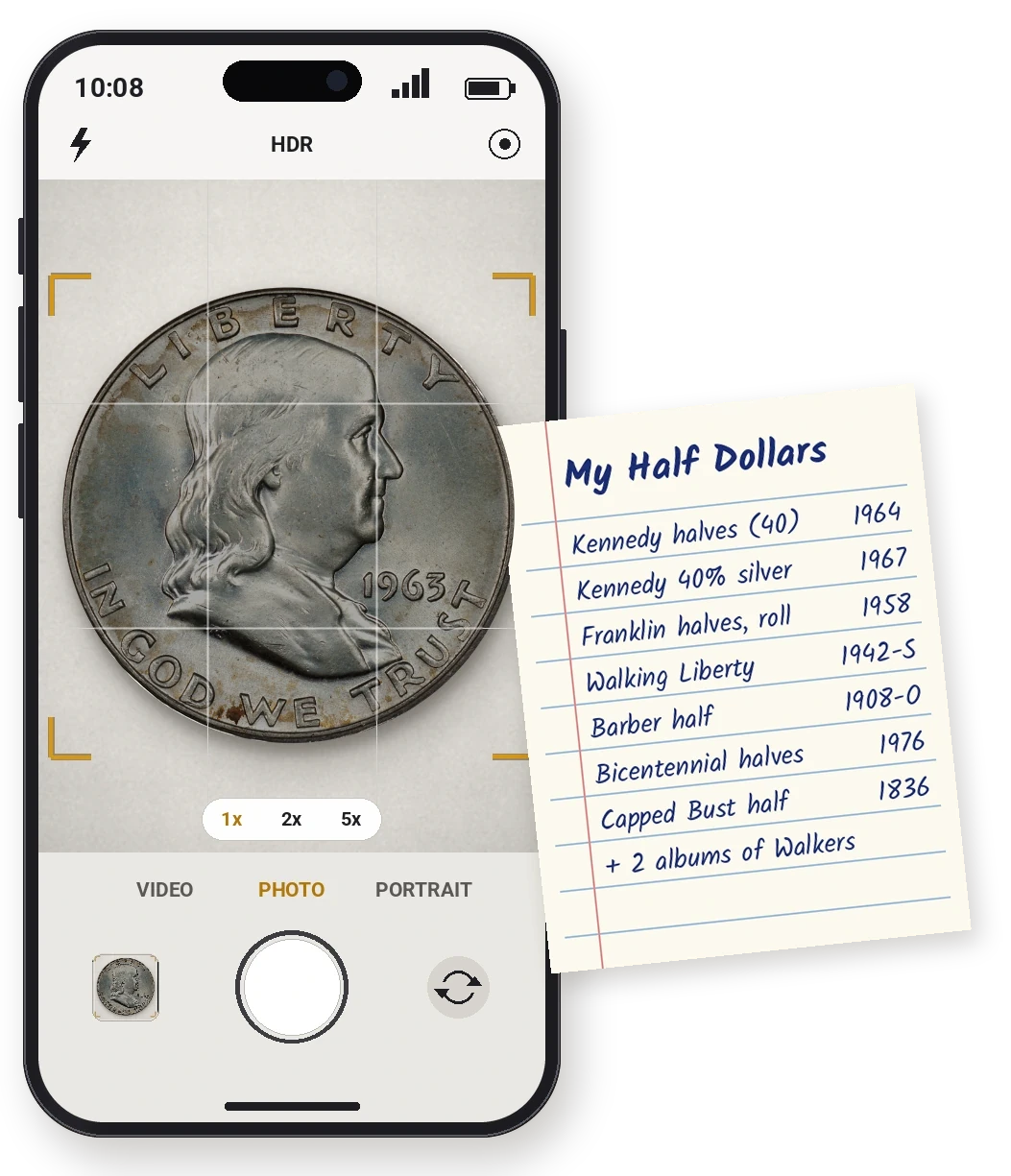
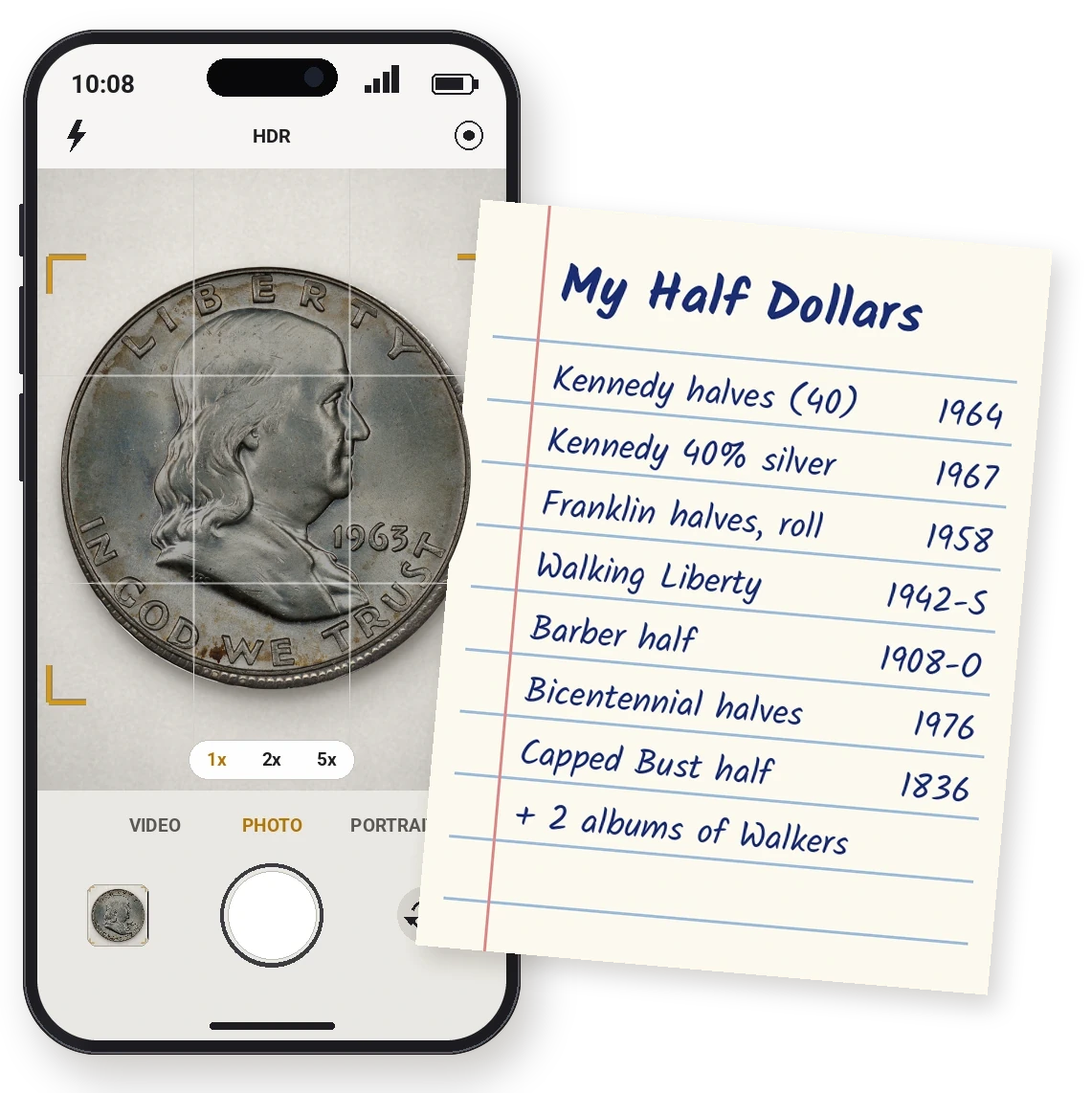
Text photos of the fronts and backs to 720-600-4740, email them to staff@americanrarities.com, or use our secure form. A simple list of dates and quantities works too.
Free Appraisal and Written Offer
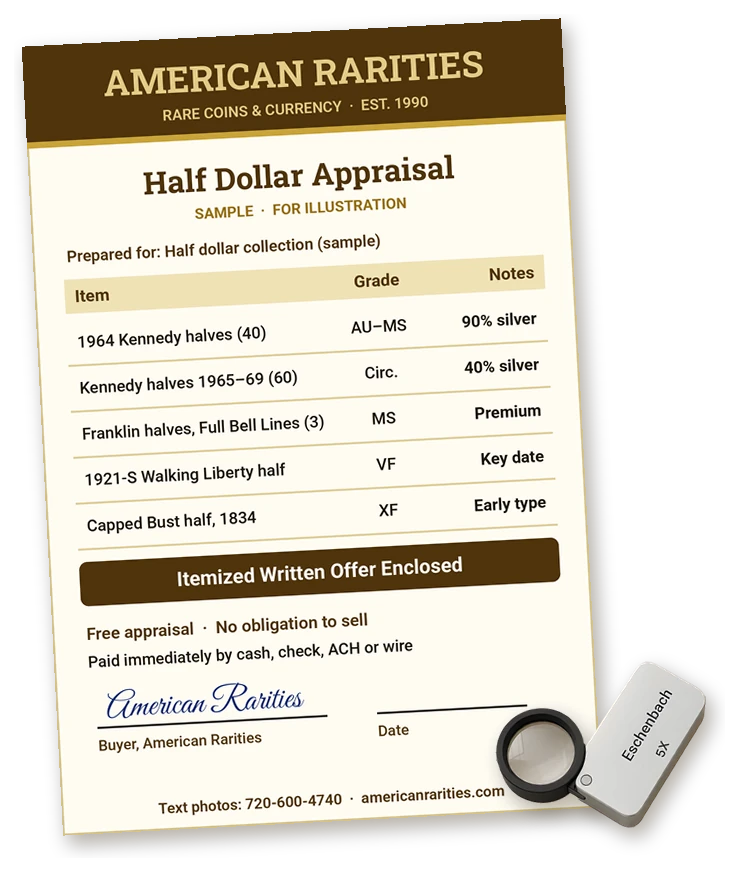
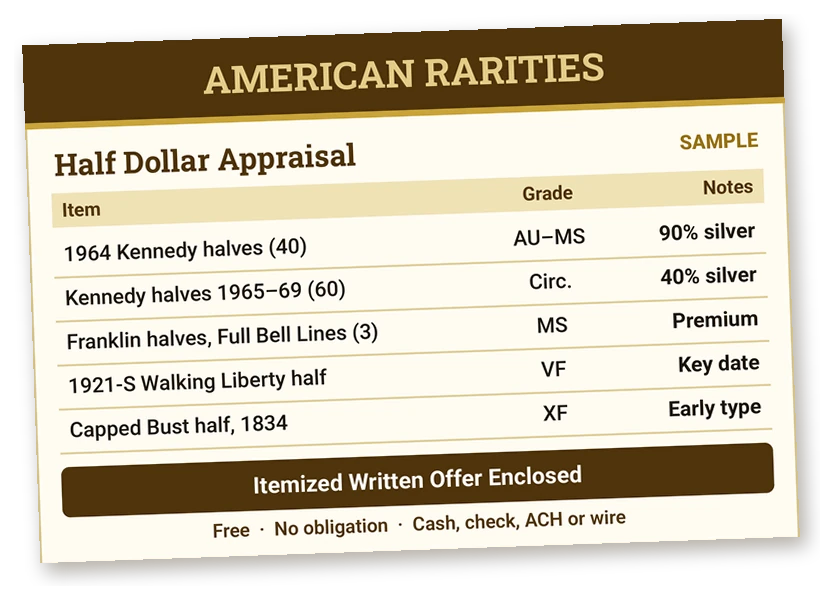
An expert sorts silver from clad and checks for key dates, varieties and errors. All appraisal requests are reviewed in the order they are received. Some appraisals take minutes, while larger, more complex collections can take a few days. Either way, you’ll get a response from us. You get an itemized, written offer with no obligation.
Get Paid
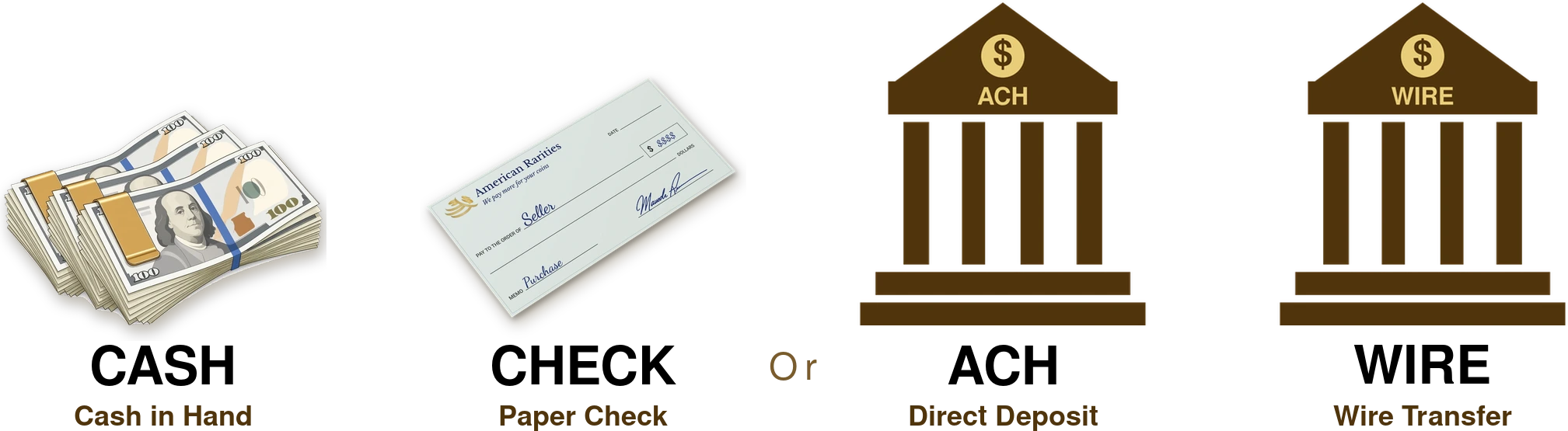
If you accept, ship your coins fully insured at our expense, or meet with us in person. You are paid by cash, check, ACH or wire transfer.