

You are currently viewing Donating Coins to Charity: Form 8283, Qualified Appraisals and the Related-Use Rule
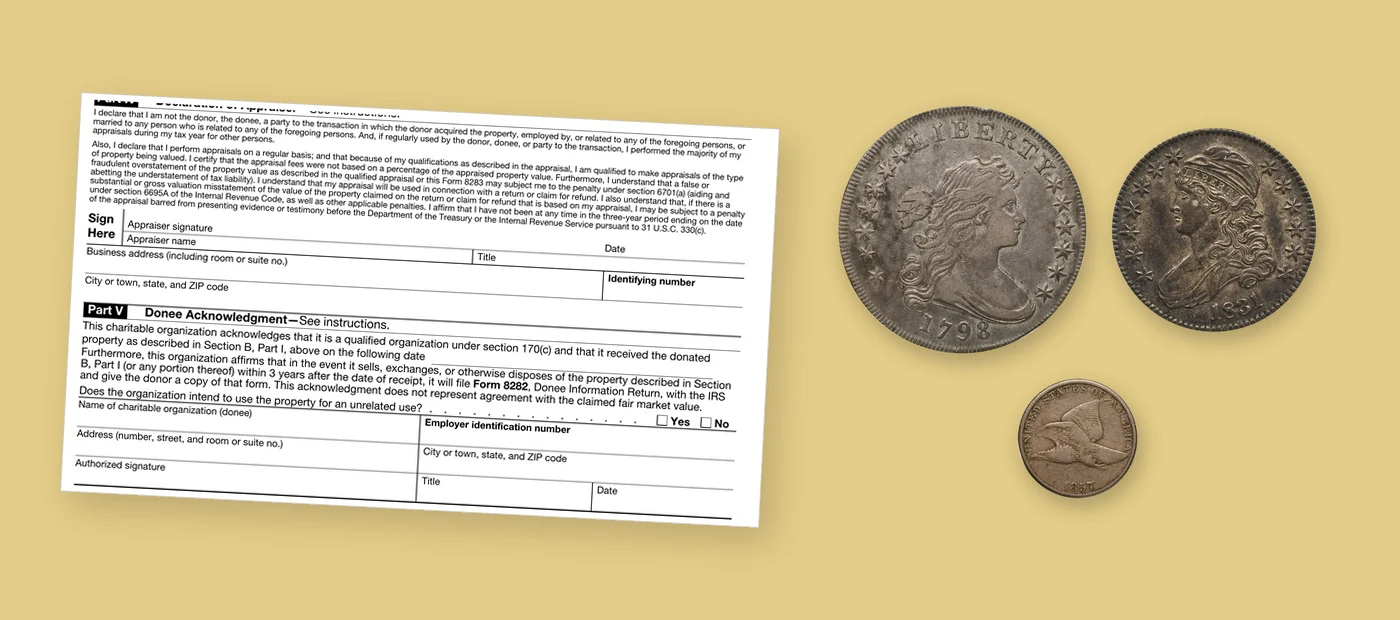
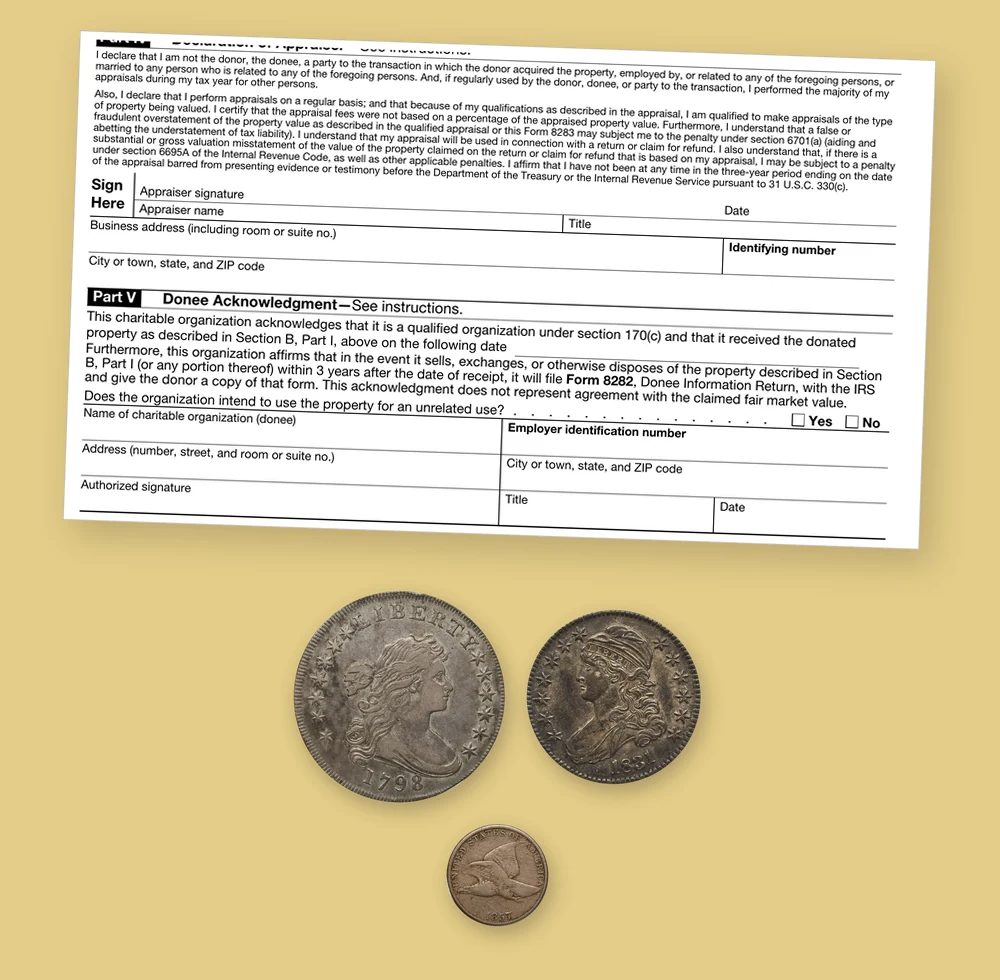
IRS Form 8283 (Rev. December 2025), page 2, Parts IV and V, from irs.gov; U.S. government work, public domain (IRS logo not shown). Coin photos: Bibliothèque nationale de France, Département des Monnaies, médailles et antiques (Gallica), public domain, via Wikimedia Commons (library media 42780).

Donating Coins to Charity: Form 8283, Qualified Appraisals and the Related-Use Rule

  • Post published:
  • Post category:Articles
Donating coins to charity: IRS Form 8283 Section B with 1798 Draped Bust dollar, 1831 Capped Bust half dollar and 1857 Flying Eagle cent

The Short Answer

Donating coins to charity can earn you a deduction if you itemize and the charity is qualified. If your deduction for the coins is more than $500, you file Form 8283, Noncash Charitable Contributions, with your return. Download IRS Form 8283 (fillable PDF). If the deduction for a coin, or for a group of similar items, is more than $5,000, you also need a qualified appraisal from a qualified appraiser, and Section B of Form 8283 must be signed by the appraiser and by the charity.

How much you can deduct depends on how long you held the coins and on what the charity does with them. Coins are tangible personal property, so a museum that displays them and a charity that sells them can produce very different deductions.

Not tax or legal advice. This guide is general information about federal rules as of November 2026. Tax law changes and every situation is different, so confirm the details with your CPA, tax attorney or estate attorney before you file, sign or transfer anything.

Decorative gold separator bar

When Form 8283 and an Appraisal Are Required

The IRS treats a coin collection as a group of similar items. You add up all the coins you donate in the year, even if they go to different charities, to see which rules apply. Here is how the thresholds in the Form 8283 instructions and Publication 561 line up:

Deduction claimedWhat you need
Under $250A receipt from the charity
$250 to $500A contemporaneous written acknowledgment (CWA) from the charity
Over $500 up to $5,000A CWA and Form 8283, Section A
Over $5,000A CWA, a qualified appraisal and Form 8283, Section B, signed by the appraiser (Part IV) and the charity (Part V)
Over $500,000All of the above, with the qualified appraisal attached to the return

If you give similar items to more than one charity and the total is over $5,000, you file a separate Section B for each charity. The appraisal must describe every coin separately, except that the appraiser may give a group description for items whose total value is $100 or less.

Decorative gold separator bar

How Much You Can Deduct for Donated Coins

The deduction is not always the coins’ fair market value. Three rules matter most:

  • Holding period. Coins held one year or less are ordinary income property. The deduction is limited to fair market value minus the gain you would have had on a sale, which usually means your cost. Inherited coins are treated as held for more than one year.
  • Related use. Coins held more than one year are capital gain property. For tangible personal property, you can generally deduct full fair market value only if the charity uses the coins for its exempt purpose, such as a museum adding them to an exhibit or a university using them for teaching. If the charity puts them to an unrelated use, for example by selling them to raise cash, the deduction is reduced by the appreciation, which usually leaves your cost basis.
  • Sales by the charity. If you claimed more than $5,000 and the charity sells or otherwise disposes of the coins within three years, it files Form 8282 and sends you a copy. Unless the charity certifies the exempt use, your deduction may be limited or partly recaptured.

Percentage-of-income limits also apply. Gifts of capital gain property to public charities are generally limited to 30% of adjusted gross income, with a five-year carryover, and starting in 2026 itemizers can deduct charitable gifts only to the extent they exceed 0.5% of AGI. Publication 526 has the details, and your CPA can run the numbers for your return.

Decorative gold separator bar

What a Qualified Appraisal Must Include

Form 8283 is only a summary. The appraisal itself must be a written report prepared under the substance and principles of the Uniform Standards of Professional Appraisal Practice. For coins, the report should include:

  • A description detailed enough for a stranger to match the report to the coins: date, mint mark, denomination, variety, grade and any PCGS, NGC or ANACS certification number
  • The physical condition of each coin
  • The date of contribution, which is the valuation effective date
  • Any agreement with the charity about how the coins may be used or sold
  • The appraiser’s name, address, taxpayer identification number and qualifications
  • A statement that it was prepared for income tax purposes, and the appraiser’s required declaration
  • The fair market value, the method used (for coins, usually comparable sales) and the specific sales relied on
  • The date the report was completed

Timing. The appraisal must be signed and dated no earlier than 60 days before the donation, and you must receive it before the due date, including extensions, of the return that first claims the deduction.

Fees. The appraisal fee cannot be a percentage of the appraised value, and you cannot deduct it as part of the charitable gift.

Price guides. Publication 561 cautions that coin price guides are not always reliable evidence of value and that only a trained grader can tell Mint State and circulated grades apart. An insurance appraisal value is not fair market value either. Our guide to coin insurance appraisals explains the difference.

Decorative gold separator bar

Who Can Sign the Appraiser Declaration

A qualified appraiser has an appraisal designation for the type of property, or the required coursework plus at least two years of experience valuing it, and regularly prepares paid appraisals. Several people are excluded no matter how qualified they are:

  • You, as the donor, and the charity receiving the coins
  • The dealer or person you bought the coins from, unless you donate them within two months of buying them and the appraised value is not more than what you paid
  • Employees of any of those parties, and people related to them
  • An appraiser who does most of their appraisals for those parties
  • Anyone paid a prohibited percentage fee, or barred from practice before the IRS

So if you bought the coins from us, we generally cannot be the appraiser for your donation. Ask any appraiser to put their education and experience in writing, and let your CPA confirm they meet the rules for your gift.

Decorative gold separator bar

Donate the Coins or Sell Them and Donate Cash?

If the charity is going to sell the coins anyway, donating them may limit your deduction to your cost. Selling them yourself and giving the cash avoids the related-use question, but the sale is taxable. Long-term gains on collectibles, including coins and bullion, are taxed at up to 28% federally. Cash gifts to public charities are generally deductible up to 60% of AGI.

Which works better depends on your basis, your tax bracket and the charity. If you are thinking about selling first, we can give you a free written offer to compare. Our guide to bullion vs. rare coin tax treatment explains why the two are taxed differently.

Decorative gold separator bar

How American Rarities Helps Donors

Founded in 1990, American Rarities has purchased over $400 million in rare coins, bullion and collectibles. We are ANA Life Members, an authorized PCGS, NGC and ANACS dealer, rated A+ by the BBB and 4.7 stars on Google. We can:

  • Give you a free appraisal and written offer if you are deciding whether to sell some coins and donate the cash.
  • Prepare a formal, itemized written appraisal report for a fee when you are not selling, with photos, grades, certification numbers, the method and the comparable sales used.
  • Work with your CPA so the report’s item list matches Form 8283.

To get started, text photos to 720-600-4740, email staff@americanrarities.com or use the form below. If the coins came from an estate, see our Form 706 coin appraisal checklist and step-up in basis guide.

Three Steps to an Appraisal
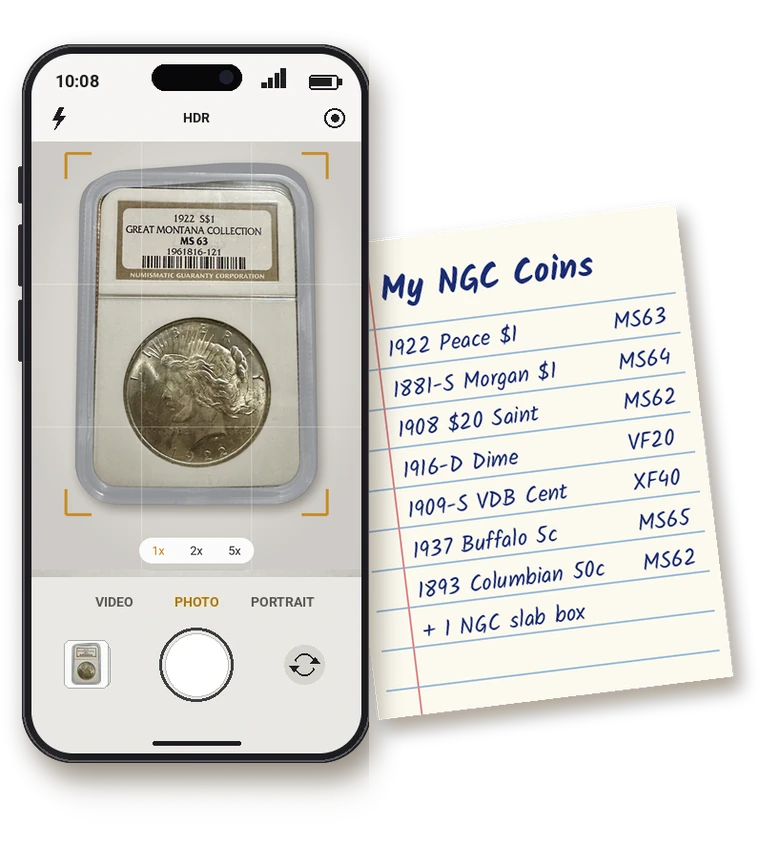
Smartphone with a light camera screen photographing a 1922 Peace dollar in an NGC MS63 holder, overlapping a handwritten list of NGC coinsSmartphone with a light camera screen photographing a 1922 Peace dollar in an NGC MS63 holder, overlapping a handwritten list of NGC coins
Step 1

Send Photos and/or a List

Send photos or an inventory: text photos to 720-600-4740, email staff@americanrarities.com or use the form below. Tell us the date you plan to donate and whether you need a formal report, an offer or both.
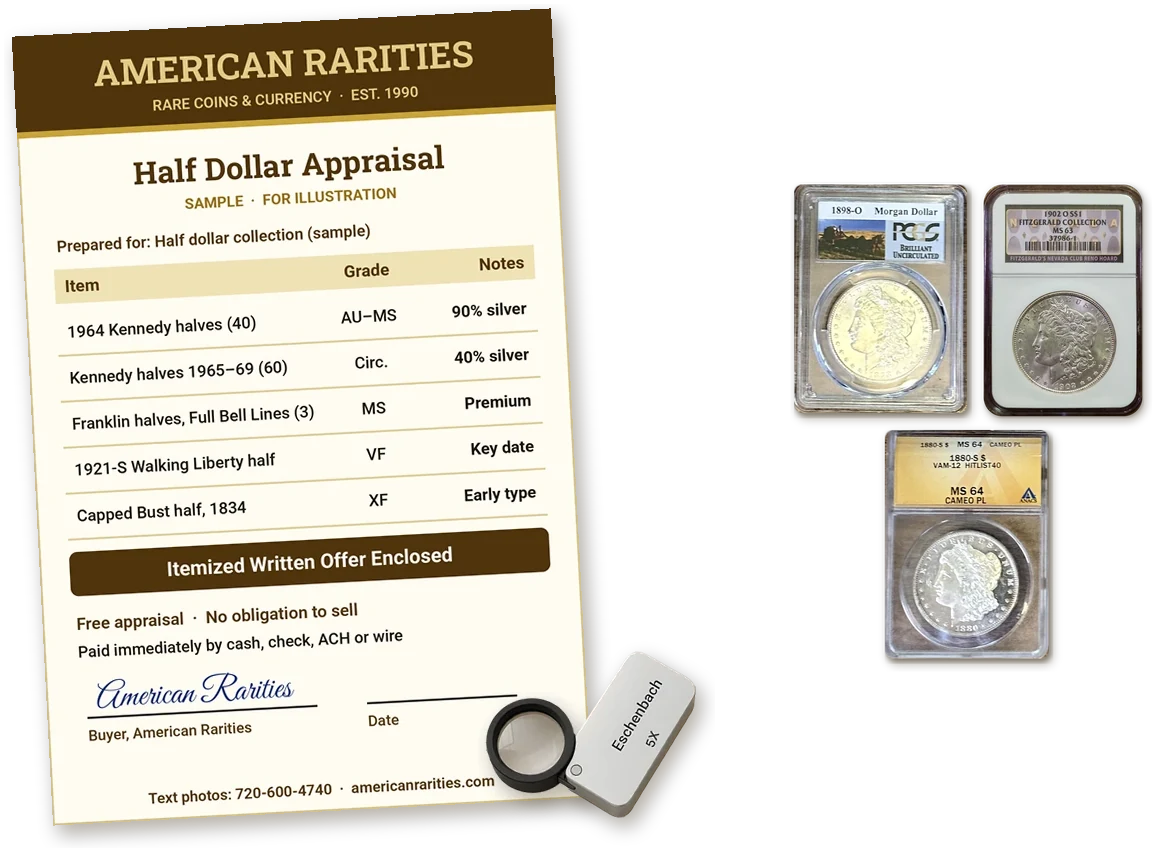
A sample American Rarities written appraisal and offer sheet with a loupe, beside PCGS, NGC and ANACS certified Morgan silver dollarsA sample American Rarities written appraisal and offer sheet with a loupe, beside PCGS, NGC and ANACS certified Morgan silver dollars
Step 2

Free Appraisal and Written Offer

Appraisals are usually done within 24 hours, though larger collections may take longer. If so, we’ll let you know. A formal written appraisal report for a donation is a separate, fee-based document.


Delivery truck beside a taped carton addressed to American Rarities, or an American Rarities buyer examining gold coins with a loupe at a home visitPhone version: delivery truck with a taped carton addressed to American Rarities, or our buyer examining gold coins with a loupe at a home visit
Step 3

Ship or Meet

Ship fully insured at our expense, or meet us in person. We can meet you at your bank. If you decline our offer, we return your items fully insured.

Decorative gold separator bar

Donating Coins to Charity: Frequently Asked Questions

Do I need an appraisal to donate coins worth less than $5,000?

No qualified appraisal is required, but you still have to support the value you claim. Over $500 you file Form 8283, Section A, and for gifts of $250 or more you need a written acknowledgment from the charity.

Can the charity appraise the coins I donate?

No. The charity receiving the coins is excluded from being your qualified appraiser, and so are its employees.

Can the dealer who sold me the coins appraise them for the donation?

Generally no. A party to the transaction in which you acquired the coins is excluded, unless you donate within two months of buying and the appraised value is not more than your purchase price.

What happens if the charity sells my coins?

If you claimed more than $5,000 and the charity disposes of the coins within three years, it files Form 8282. Unless it certifies that it used the coins for its exempt purpose, your deduction may be limited or partly recaptured.

Are all my coins one group for the $5,000 test?

Yes. The IRS lists coin collections as similar items, so you add together all the coins you donate in the year, even to different charities, to decide whether a qualified appraisal and Section B are needed.

Can American Rarities appraise coins I plan to donate?

Yes. We prepare formal, itemized written appraisal reports for a fee when there is no sale. If you bought the coins from us, the party-to-the-transaction rule may prevent us from being your appraiser, so check with your CPA.

Decorative gold separator bar

Free Appraisal for Coins You Plan to Donate

Email, Text, or Use This Form To Send Us Your Inventory List or Pictures


Upload clear photos of fronts and backs and we'll reply with a free appraisal.

    Decorative gold separator bar

    Leave a Reply