
Step-Up in Basis for Inherited Coins: The CPA’s Checklist
Coins and precious metals are some of the hardest assets to value on an estate’s balance sheet. A shoebox of silver dollars, a safe full of gold bars and a cabinet of certified rare coins can each be worth very different amounts, and the client usually has no idea which is which. Because the date-of-death value becomes the beneficiaries’ basis under IRC section 1014, that value affects the estate tax return, if one is filed, and every later sale.
This guide is written for CPAs, enrolled agents and other tax professionals. It covers the fair market value standard as it applies to coins and bullion, the documentation that holds up, the alternate valuation date and consistent basis reporting, the collectibles rate and holding period, how sales are reported, special basis rules and the mistakes we see most often. For the plain-language version for executors and heirs, see our guide to the tax implications of liquidating bullion vs. rare coins in an estate.
This guide is general information for tax professionals, not tax or legal advice for any particular estate. Rules, thresholds and forms change, so confirm current law before you rely on any point. Figures are stated as of October 2026, and each rule is linked to the IRS, the Internal Revenue Code or the Treasury regulations so you can check the source.
Fair Market Value on the Date of Death
Under Treasury Regulation 20.2031-1(b), fair market value is the price at which property would change hands between a willing buyer and a willing seller, neither being under any compulsion to buy or sell and both having reasonable knowledge of the relevant facts. Two parts of the same paragraph matter most for coins:
- No forced-sale price. Fair market value is not what the estate would get in a quick or distressed sale.
- The right market. Value is set in the market where the item is most commonly sold to the public. For property the public generally buys at retail, the regulation says fair market value is the retail price of the item or a comparable item. Its example is a used car: the value is what a member of the public would pay for a comparable car, not what a dealer would pay for it.
Retail Versus Wholesale, and Why It Matters
A dealer’s cash offer is a wholesale number, because the dealer has to resell the coin. The estate tax value of a coin that collectors normally buy at retail or at public auction will usually be higher than that offer. For the CPA, that cuts both ways:
- Taxable estates. A dealer’s buy price is generally not the reportable value, and using it can understate the gross estate.
- Non-taxable estates. A properly supported higher value gives the heirs a higher basis. If the coins are later sold to a dealer for less than that value, the result may be a loss rather than a gain. Whether that loss is deductible depends on the facts, since IRS Tax Topic 409 notes that losses on personal-use property aren’t deductible.
Neither side is served by guessing. The appraisal should say which market it relied on, such as recent public auction results or retail sales of comparable coins, and why. The appraisal itself is our formal written report. It is separate from any offer to buy.
Bullion Versus Numismatic Coins
Most estates hold both kinds of coin, and each needs its own valuation method. Sort the inventory into the two groups first. Some coins fall between them, such as common-date gold or silver coins that sell for a modest premium over their metal value, and an experienced numismatist should make that call.


Bullion: Spot-Based Valuation
Bars, rounds and modern bullion coins are valued mainly by their fine metal content. A sound bullion valuation lists each product, its fine weight and quantity, the metal price on the valuation date and the source of that price, and any premium or discount at which that product actually trades. Death on a weekend or holiday raises a practical question about which price to use, and the report should explain the choice.
Our guides on how to sell gold coins and how to sell silver dollars explain how metal content is priced.
Numismatic Coins: Expert Appraisal
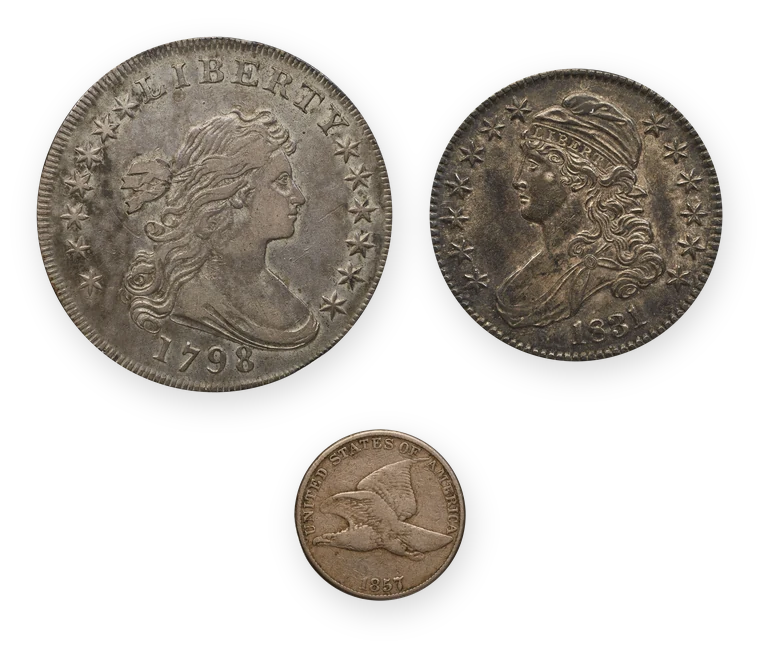
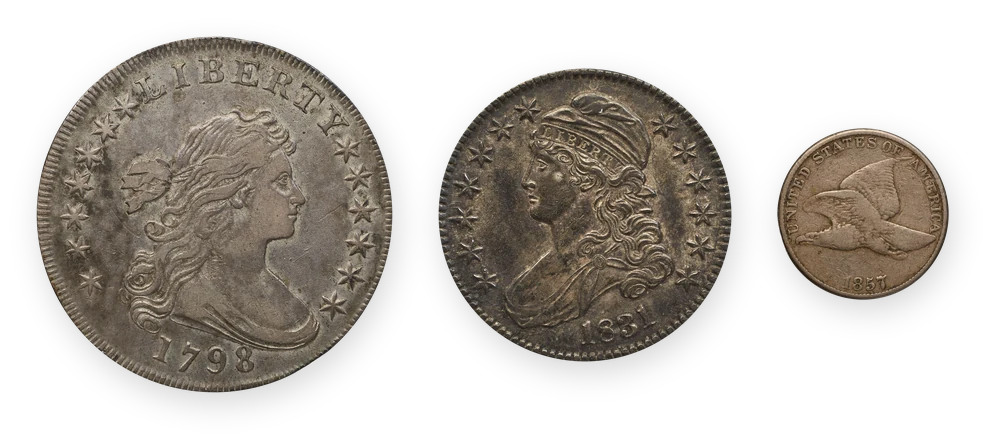
Rare and collectible coins are valued by date, mint mark, variety, grade, eye appeal, certification and market demand. Two coins of the same type can differ in value many times over, and the metal price says little about them. These coins need an expert appraisal by someone who grades and trades coins, item by item.
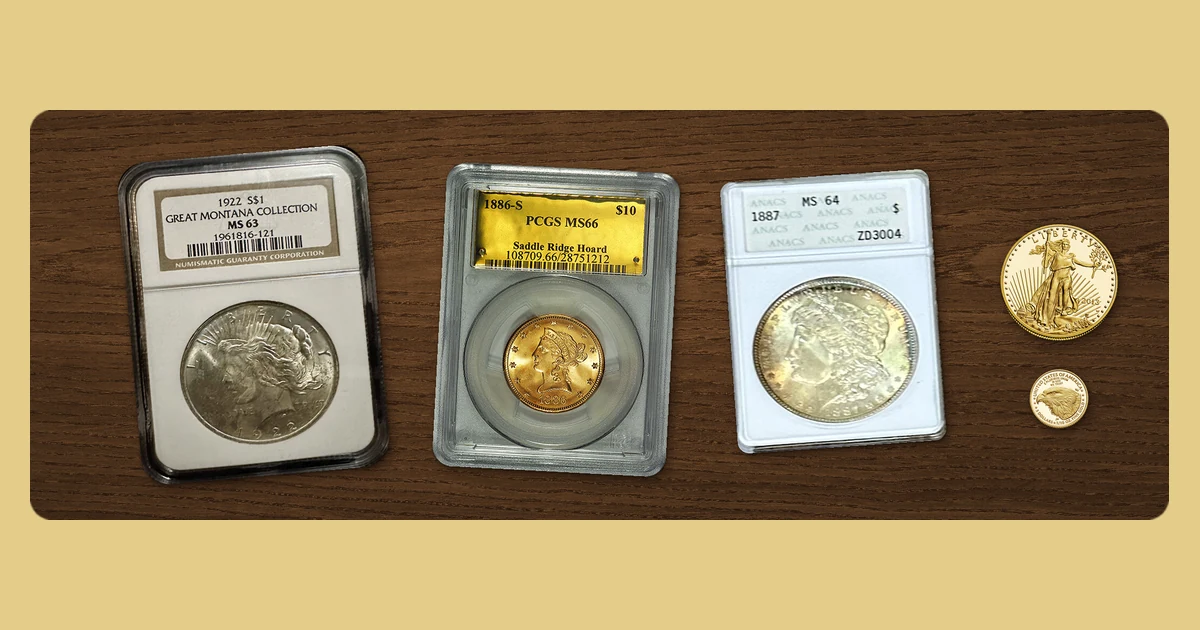
Coins already graded by PCGS, NGC or ANACS should stay in their holders. The certification number lets anyone verify the grade, as our page to sell PCGS, NGC and ANACS coins explains.
Documentation That Holds Up
When a Form 706 is filed, Treasury Regulation 20.2031-6 sets the baseline. Household and personal effects should be itemized, and items in the same room worth no more than $100 each may be grouped. If articles of marked artistic or intrinsic value, which the regulation says include coin or stamp collections, total more than $3,000, the return must include the appraisal of an expert or experts, under oath. The executor must also sign a statement under penalties of perjury about the completeness of the itemized list and the disinterested character and qualifications of the appraiser. The Form 706 instructions repeat this requirement.
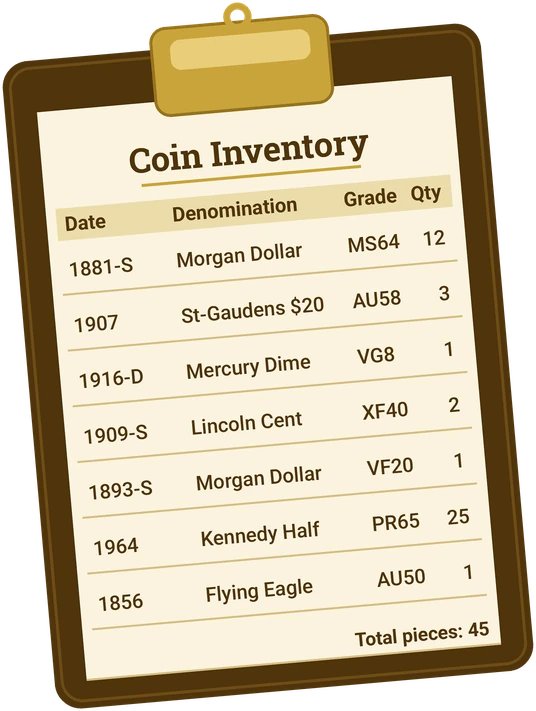

A report that holds up under review usually includes:
- The valuation date and purpose. The date of death or alternate valuation date, and the reason for the report.
- An itemized inventory. Country, denomination, date, mint mark, variety and quantity for each item or tightly defined group.
- Grade and certification. The grading service and certification number for each certified coin, and the appraiser’s grade for raw coins.
- Method and market. For bullion, the fine weight and dated metal price. For numismatic coins, the comparable sales or market data relied on.
- Photos. Clear images of the better coins, so the grade and condition can be reviewed later.
- The appraiser’s qualifications. Experience and credentials, a signature and the date.
Disinterested Appraiser
Because the executor has to declare the appraiser’s disinterested character, think about who prepares the report if the same firm may later buy the coins. Our formal appraisal report is prepared as its own engagement, separate from any offer to buy, so the estate’s advisors can document that distinction. A free offer sheet is useful for deciding whether to sell, but it is not a substitute for the formal report.
If the heirs later give coins to charity, a different rule applies. The qualified appraiser and qualified appraisal rules in Treasury Regulation 1.170A-17 are written for charitable deductions, not for estate valuation. Fiduciaries may also find our tangible asset appraisal audit checklist useful.
Valuation Date, Consistent Basis and Form 8971
The Alternate Valuation Date
Under IRC section 2032 and Treasury Regulation 20.2032-1, the executor may elect to value the gross estate six months after death. Property sold, distributed or otherwise disposed of within those six months is valued as of that date. The election:
- is allowed only if it reduces both the value of the gross estate and the sum of the estate tax and generation-skipping transfer tax, net of credits;
- applies to all of the property in the gross estate, not to selected items;
- is made on Form 706, and may be made on a late return filed no later than one year after the due date, including extensions;
- is irrevocable once made, except on a later return filed by the due date; a protective election is available in some cases.
Bullion follows the daily metal price, so a falling market may make the election worth modeling for a taxable estate. Rare coin values tend to move more slowly. For decedents dying in 2026, the IRS lists a basic exclusion amount of $15,000,000 (as of October 2026). Most estates owe no estate tax and cannot use the election. Check the IRS page on what’s new for estate and gift tax for current figures.
Consistent Basis Under Section 1014(f)
Section 1014(f) says a beneficiary’s basis cannot exceed the value finally determined for estate tax purposes, or, if that value has not been finally determined, the value reported on the statement furnished under section 6035. Under section 1014(f)(2), the rule applies only to property whose inclusion in the estate increased the estate tax. The final regulations in Treasury Regulation 1.1014-10 (T.D. 9991, 2024) apply to estate tax returns filed after September 17, 2024. An underpayment from inconsistent basis reporting is subject to the accuracy-related penalty under section 6662(b)(8) and (k).
Form 8971 and Schedule A
According to the Instructions for Form 8971 and Schedule A, an executor required to file Form 706 under section 6018 must file Form 8971 and give each beneficiary a Schedule A. A return filed only to elect portability or make a generation-skipping transfer tax election does not carry this requirement. The due date is 30 days after the Form 706 is due, including extensions, or 30 days after it is filed, whichever comes first. Points that matter for coins:
- Rare coins are reportable. U.S. dollars are excepted property, but the regulation defines U.S. dollars as bills and coins worth their face amount. Coins and currency with numismatic value are expressly not included.
- Some property is excepted. Excepted property includes household and personal effects that do not require an appraisal under section 20.2031-6(b), and property the estate completely sells in a taxable transaction before distribution. If the estate sells the coins first, there may be no beneficiary basis to report on Schedule A.
- Supplements. If values change on examination or property is found later, the executor must supplement the statements.
When no Schedule A is required, IRS Publication 551 says heirs can generally use the appraised value at the date of death for state inheritance or transmission tax purposes. In practice, the itemized date-of-death appraisal is the heirs’ best evidence of basis.
Rates, Net Investment Income Tax and Holding Period
The 28% Collectibles Rate
Under IRC section 1(h)(4) and (5), gain from collectibles held more than one year is 28-percent rate gain. A collectible is defined by reference to section 408(m) without the IRA exception for American Eagles and certain bullion, so bullion and rare coins alike are generally collectibles. Tax Topic 409 describes this as a maximum 28% rate, not a flat rate, so taxpayers in lower brackets can pay less. Individuals compute it on the 28% Rate Gain Worksheet in the Schedule D (Form 1040) instructions, and estates and trusts use the line 18c worksheet in the Schedule D (Form 1041) instructions.
Net Investment Income Tax
Gain on the sale of coins held as an investment is generally net investment income under section 1411. Tax Topic 559 lists the individual thresholds as $200,000 (single or head of household), $250,000 (married filing jointly or qualifying surviving spouse) and $125,000 (married filing separately). For an estate or trust, the 3.8% tax applies to the lesser of undistributed net investment income or adjusted gross income above the start of the top bracket, which the IRS shows as $15,650 for 2025 and which is adjusted each year. That much lower threshold is one reason the decision about who sells matters.
Holding Period
Section 1223(9) treats property with a section 1014 basis as held for more than one year if it is sold within one year after death. Inherited coins therefore produce long-term gain or loss, even if they are sold soon after death. The Form 8949 instructions say to report inherited property in Part II and enter “INHERITED” in column (b). Coins the estate or an heir bought separately follow the normal holding period rules.
Reporting the Sale
- Form 8949 and Schedule D. Under the Form 8949 instructions, a disposition of collectibles uses adjustment code “C” with zero in column (g), so the gain flows to the 28% worksheet. Collectibles sales cannot be reported directly on Schedule D under the exception for basis-reported transactions.
- Form 1041 when the estate sells. If the executor sells before distribution, the gain or loss belongs on the estate’s Form 1041. Publication 559 says a domestic estate with gross income of $600 or more for its tax year must file. The amount of gain that flows out to beneficiaries depends on distributable net income and the governing instrument.
- Heirs who sell after distribution. Each heir reports their own sale, using the date-of-death or alternate valuation value as basis, consistent with any Schedule A.
What the Dealer Reports
Under the Instructions for Form 1099-B and Treasury Regulation 1.6045-1, a dealer must report a precious metals sale only when the metal is in a form, and in at least the minimum quantity, that the Commodity Futures Trading Commission has approved for delivery under a regulated futures contract. Sales for the same customer within 24 hours are added together. When a reportable sale involves collectibles, the dealer checks the box 3 “Collectibles” box. Most rare coin purchases do not produce a Form 1099-B, and the seller reports the sale either way.
Form 8300 is filed by a business that receives more than $10,000 in cash, as the IRS Form 8300 Reference Guide explains. When a dealer buys coins from an estate, the dealer is paying, not receiving, so the purchase itself generally does not call for a Form 8300. For more detail, see our page on coin and bullion laws.
Special Basis Rules
- Community property. Under section 1014(b)(6), the surviving spouse’s half of community property also takes a new basis, if at least half of the community interest is included in the decedent’s gross estate. Publication 551 lists Arizona, California, Idaho, Louisiana, Nevada, New Mexico, Texas, Washington and Wisconsin. Coins acquired during marriage in those states may receive a full basis adjustment, so the date-of-death appraisal should cover the whole collection, not just the decedent’s half.
- Gifts within one year of death. Under section 1014(e), if the decedent received appreciated coins by gift within one year before death and they pass back to the donor or the donor’s spouse, the basis is the decedent’s adjusted basis, not the date-of-death value.
- Jointly held property. Coins held in joint tenancy, or by spouses as a qualified joint interest, may receive only a partial basis adjustment. Publication 551 explains these rules.
Common Mistakes
- Using face value. A 1921 Morgan dollar is not worth $1, and a $20 gold piece is not worth $20. Face value is the right number only for money that is worth exactly face value.
- Using the decedent’s cost. Old receipts do not set an heir’s basis under section 1014. They matter for coins the heir bought, for section 1014(e) cases and as background, but not as the date-of-death value.
- Using retail asking prices. Prices on dealer websites and price guides are asking prices, often for coins in better condition. They are not evidence of what comparable coins actually sold for.
- Using a dealer’s buy price as the estate tax value. For coins the public buys at retail, a wholesale offer can understate fair market value, as explained above.
- No itemization. “One box of old coins, $5,000” will not support a return or a later basis claim. List the items, or at least tightly defined groups.
- Cleaned or damaged coins. Cleaning sharply reduces a coin’s value. Families often clean coins before an appraisal, and appraisers sometimes miss earlier cleaning. Tell the client not to clean, polish or remove coins from their holders.
- Bullion valued at the wrong date. A metal price from the day the appraisal was written, instead of the valuation date, can be off by a meaningful amount.
Quick Reference
| Issue | Rule | Where It Applies |
|---|---|---|
| Fair market value | Willing buyer, willing seller; market where most commonly sold to the public | Reg. 20.2031-1(b) |
| Coin collection appraisal | Expert appraisal under oath if the total is over $3,000 | Reg. 20.2031-6(b) |
| Heirs’ basis | Value at date of death or alternate valuation date | IRC 1014(a) |
| Alternate valuation | Six months after death; must lower gross estate and tax | IRC 2032 |
| Consistent basis | Basis cannot exceed the final estate tax value | IRC 1014(f); Form 8971 |
| Capital gains rate | Maximum 28% for collectibles | IRC 1(h)(4)–(5) |
| Holding period | Treated as long-term when basis is under section 1014 | IRC 1223(9) |
| Dealer reporting | Form 1099-B only for certain bullion forms and quantities | Reg. 1.6045-1; Form 1099-B instructions |
How American Rarities Helps
Founded in 1990, American Rarities has purchased over $400 million in rare coins, bullion and collectibles. For CPAs and their clients we provide:
- Formal date-of-death appraisal reports, itemized, for any historical date, on request. Our estate appraisals and liquidation page explains the process.
- Free appraisals and itemized written offers when the estate is considering a sale. If a formal report is needed with no plan to sell, we charge a competitive hourly or flat fee.
- Authentication, including XRF metal analysis and digital microscopy.
- Nationwide service, by fully insured mail-in or an in-person visit for larger estates.
- A clean paper trail, with an itemized bill of sale and payment by cash, check, ACH or wire.
More detail is on our page of IRS-compliant numismatic appraisals for CPAs. If you work alongside other advisors, see our pages for the probate and estate lawyer, for the bank trust officer and for the wealth advisor.
Important Note
This guide is general information for tax professionals, not tax or legal advice for any particular estate. Rules, thresholds and forms change, so confirm current law before you rely on any point. Figures are stated as of October 2026, and each rule is linked to the IRS, the Internal Revenue Code or the Treasury regulations so you can check the source.
Ready to Sell: Referring a Client With Coins or Bullion
When a client’s estate includes coins, currency or precious metals, you can send them to us, or contact us yourself on the estate’s behalf. We work with the executor, keep you copied if you like and provide the documents you need for the return and the heirs’ basis.
Four Steps for Your Client


Send the Inventory
You or your client can text photos to 720-600-4740, email photos or an inventory to staff@americanrarities.com or use the form below. Tell us the date of death and whether you need a formal report, an offer or both.


Appraisal and Written Offer
Appraisals are usually done within 24 hours. You get an itemized written offer for the estate file. A formal date-of-death appraisal report is available on request as a separate document.
Ship Insured or Meet in Person
Ship fully insured, or meet us in person for larger estates anywhere in the country.


Get Paid
When the executor accepts, we pay you immediately by cash, check, ACH or wire, with an itemized bill of sale for the tax file.
American Rarities holds a 4.7-star Google rating and an A+ rating with the BBB, we are ANA Life Members, and we are an authorized PCGS, NGC and ANACS dealer. Estate planners can learn more on our page for estate planners, and heirs can read how to sell inherited coins or what to do with old coins found in an estate.
You can also call 800-622-5680. Calls go to our answering service, so leave a message and we will call you back. Or visit our contact a rare coin buyer page.
Step-Up in Basis and Date-of-Death Values: Frequently Asked Questions for CPAs
What is the basis of inherited coins and bullion?
Under IRC section 1014, it is generally the fair market value on the date of death, or on the alternate valuation date if the executor elects it under section 2032. If the estate filed Form 706 and the property increased the estate tax, the basis cannot exceed the value finally determined for estate tax purposes under section 1014(f).
Should date-of-death value be the retail price or a dealer’s buy price?
Treasury Regulation 20.2031-1(b) sets fair market value in the market where the item is most commonly sold to the public, and for items the public generally buys at retail, at the retail price of a comparable item. For most collectible coins, that points to what collectors pay, not a dealer’s wholesale offer. The appraisal should explain the market it used.
When does an estate need an expert appraisal of a coin collection?
When a Form 706 is filed and articles of marked artistic or intrinsic value, including coin collections, total more than $3,000, Treasury Regulation 20.2031-6(b) requires an expert appraisal under oath. The executor also declares the completeness of the list and the appraiser’s disinterested character and qualifications.
Are rare coins excepted property on Form 8971?
No. U.S. dollars are excepted property, but Treasury Regulation 1.1014-10 defines them as bills and coins worth face value and excludes bills and coins with numismatic value. Property the estate sells in a taxable transaction before distribution is excepted.
What rate applies when heirs sell inherited coins?
Gain on coins and bullion is generally collectibles gain under section 1(h)(5), taxed at a maximum 28% rate, and it may also be subject to the 3.8% Net Investment Income Tax. Inherited coins are long-term under section 1223(9), however soon they are sold.
How is a sale of inherited coins reported on Form 8949?
Report it in Part II as long-term, enter INHERITED in column (b), and use adjustment code C with zero in column (g) for collectibles. The gain then flows to the 28% Rate Gain Worksheet in the Schedule D instructions.
Will the dealer issue a Form 1099-B?
Only in limited cases. Under the Form 1099-B instructions, precious metals sales are reportable only for forms and minimum quantities approved for delivery under a CFTC regulated futures contract. Most rare coin purchases are not reportable, and the seller reports the sale either way.
Does the surviving spouse get a step-up on community property coins?
Under section 1014(b)(6), the surviving spouse’s half of community property also takes a new basis, if at least half of the community interest is included in the decedent’s gross estate. Publication 551 lists the community property states.
Can American Rarities prepare a date-of-death appraisal without buying the coins?
Yes. We prepare formal, itemized date-of-death appraisal reports for any historical date. When there is no plan to sell, we charge a competitive hourly or flat fee. If the estate is considering a sale, our appraisal and written offer are free.
Free Appraisal for Your Client’s Estate Coins
Email, Text, or Use This Form To Send Us Your Inventory List or Pictures
Email: staff@americanrarities.com | Text: 720-600-4740