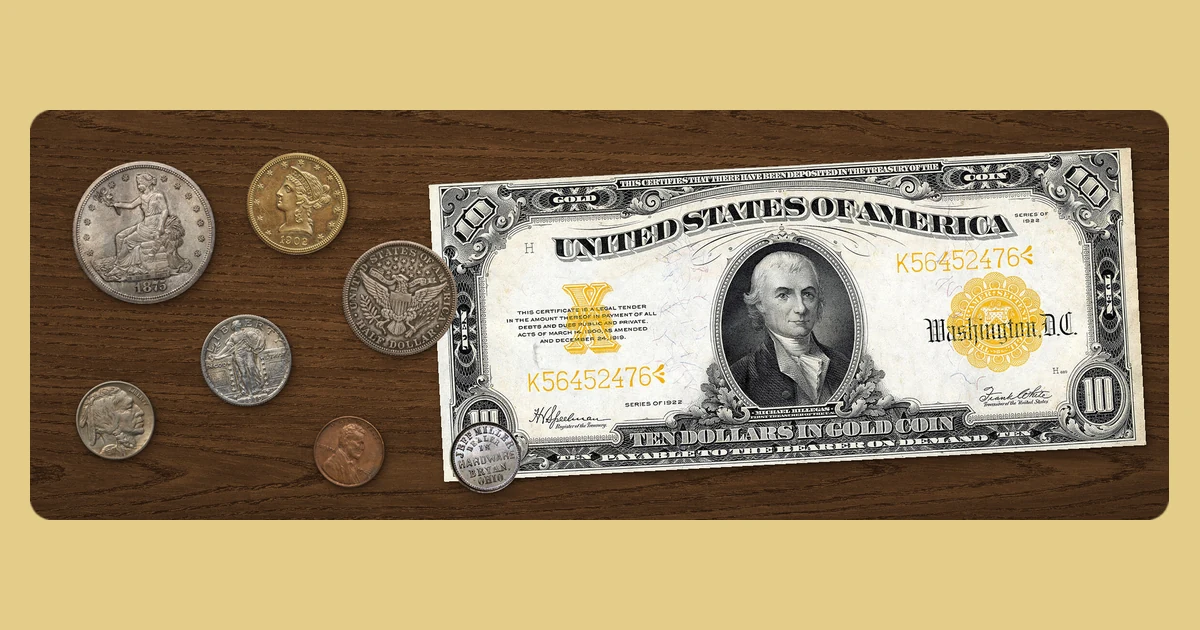

A 1922 gold certificate, a trade dollar, a gold eagle and other old U.S. coins and a Civil War token on a walnut tabletop, on a gold background
What to Do With Old Coins Found in an Estate, a guide from American Rarities. Coin photos: Bibliothèque nationale de France, Département des Monnaies, médailles et antiques (Gallica), public domain, via Wikimedia Commons. Token photos by Stevehayden via Wikimedia Commons, public domain (PD-Coin scan, PD-old). 1922 $10 gold certificate photo by Godot13 (National Numismatic Collection, National Museum of American History) via Wikimedia Commons, licensed CC BY-SA 4.0 (File:US-$10-GC-1922-Fr-1173.jpg); front cropped and placed on a tabletop by American Rarities, and this modified image is shared under CC BY-SA 4.0. Walnut tabletop: “American walnut veneer” scan by Poly Haven, CC0.

What to Do With Old Coins Found in an Estate

  • Post published:
  • Post category:Articles
Old coins and paper money found in an estate, including a 1922 $10 gold certificate, an 1875-S Trade dollar and a 1902 $10 gold eagle

Found Old Coins While Settling an Estate?

It happens all the time. You are clearing out a parent’s house, opening a safe deposit box or sorting a desk drawer, and you find coins: a coffee can of old cents, a roll of silver dimes, a few heavy silver dollars, a small gold coin wrapped in tissue, a blue album with half the holes filled. You may have no idea whether you are looking at pocket change or something important, and if you are the executor or a family member helping out, you also have to account for it properly.

This guide is for that moment of discovery. It walks you through what to do first, how to recognize what you found, which finds are usually common and which deserve a closer look, how to document the coins for the estate, how to get an appraisal and how to sell. If you already know you have an inherited collection and are ready to sell it, our guide on how to sell inherited coins covers the selling side in depth, and our guide on how to sell a coin collection covers collections of any origin.

Founded in 1990, American Rarities has purchased over $400 million in rare coins, paper currency and collectibles, and much of that has come from estates. Here is what we tell families, executors and trustees who call us after they find old coins.

Decorative gold separator bar

Step 1: What to Do First

The first few days after you find old coins matter more than most people realize. Coins are small, easy to carry off and easy to damage, and the most common mistakes happen before anyone knows what the coins are worth. Before you do anything else, take care of three things:

  • Secure them. Gather the coins you find into one safe place, such as a locked closet, a home safe or a safe deposit box, and limit who has access. In an estate with several heirs, it helps to have two people present whenever the coins are handled or moved. If the house will be empty, do not leave coins behind.
  • Do not clean them. It is tempting to polish a dark coin to see it better, but cleaning almost always lowers a coin’s value, sometimes by a great deal, and it cannot be undone. Leave dirt, toning and even green spots alone. Our article on the coin cleaning mistake that destroys value explains why.
  • Do not split them up. Resist the urge to divide coins among family members, hand them out as keepsakes or spend the old silver before the coins are identified and valued. Keep coins in the albums, rolls, envelopes, holders and boxes you found them in, because the packaging often tells an appraiser something.

Handle coins by their edges, over a soft surface, and only as much as you need to. If you are not the executor, let the executor or the estate’s attorney know what you found before anything leaves the house. If a professional organizer or downsizing company is clearing the home, share our what to do first guide for professional organizers and downsizing experts with them.

Decorative gold separator bar

Step 2: Search the Whole House

Collectors and savers rarely keep everything in one place. Before you assume you have found it all, take a careful look in the places where coins and currency tend to hide:

  • Bedrooms and closets. Dresser drawers, jewelry boxes, sock drawers, coat pockets, shoe boxes and the backs of closet shelves.
  • Desks and files. Envelopes, file folders, checkbook boxes and books. Old paper money is often tucked between pages.
  • Safes and lockboxes. Home safes, gun safes, fireproof boxes and any keys that might open a safe deposit box at a bank.
  • Basements, garages and attics. Coffee cans, jars, tool chests and boxes marked with something unrelated.
  • Paperwork. Receipts from coin dealers, statements from the U.S. Mint, old appraisals, insurance riders and notes the owner left. These can point you to coins you have not found yet.

If the owner bought from the U.S. Mint by mail, you may find stacks of proof sets and mint sets in their original boxes. If they saved change for decades, you may find rolls and bags. Write down where each group was found as you go. That record will help you later.

Decorative gold separator bar

Step 3: Recognize What You Found

You do not need to be an expert to sort estate coins into a few broad groups. Knowing which group a coin belongs to tells you whether it is likely valued for its metal, for its rarity or both, and which of our guides to read next. These are the finds we see most often:
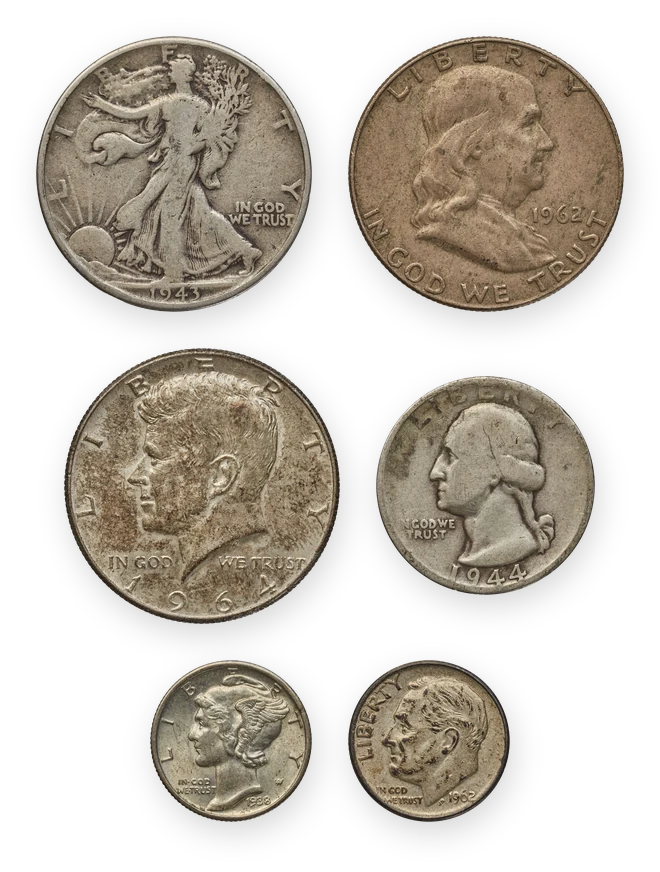
Six U.S. 90% silver coins in pairs at true relative size: a 1943 Walking Liberty half dollar, a 1962 Franklin half dollar, a 1964 Kennedy half dollar, a 1944-S Washington quarter, a 1938-S Mercury dime and a 1962 Roosevelt dimeSix 90% silver coins at true relative size: 1943 Walking Liberty, 1962 Franklin and 1964 Kennedy halves, a 1944-S quarter and two dimes

Pre-1965 Silver Coins

U.S. dimes, quarters and half dollars dated 1964 and earlier are 90% silver. Look for Mercury and Roosevelt dimes, Washington quarters and Walking Liberty, Franklin and 1964 Kennedy half dollars. Kennedy halves from 1965 to 1970 are 40% silver. Even worn silver coins are worth more than face value, and a few dates are scarce.

Our page on 90% silver coins value explains how silver content is valued, and our page on junk silver bags covers larger quantities.
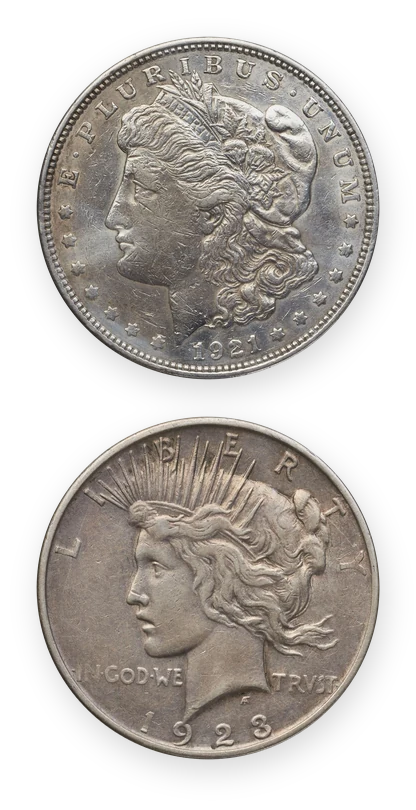
A 1921 Morgan silver dollar above a 1923-D Peace silver dollar, at true relative sizeA 1921 Morgan silver dollar beside a 1923-D Peace silver dollar, at true relative size

Old Silver Dollars

Large silver dollars are among the most common and most rewarding estate finds. Morgan dollars were struck from 1878 to 1921 and Peace dollars from 1921 to 1935. Many are common, but the date, the mint mark and the condition can make a big difference, so each one should be looked at individually.

Our guide on how to sell silver dollars covers them in detail, along with our Morgan silver dollar price guide and our page on U.S. silver dollar values.
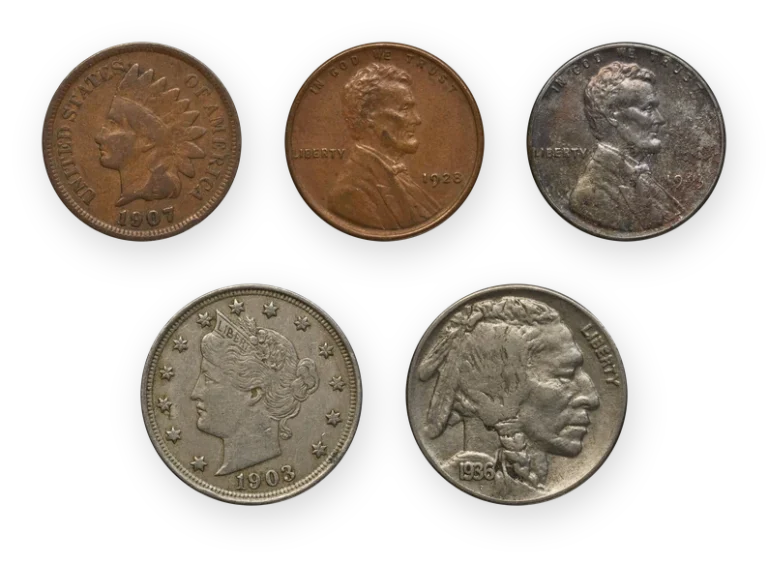
Three old U.S. cents above two old nickels at true relative size: a 1907 Indian Head cent, a 1928 Lincoln wheat cent, a 1943 zinc-coated steel cent, a 1903 Liberty Head nickel and a 1936 Buffalo nickelA row of old U.S. cents and nickels at true relative size: a 1907 Indian Head cent, a 1928 Lincoln wheat cent, a 1943 zinc-coated steel cent, a 1903 Liberty Head nickel and a 1936 Buffalo nickel

Old Cents and Nickels

Jars of old cents and nickels turn up in almost every estate. Indian Head cents, Lincoln wheat cents, the gray 1943 steel cents, Liberty Head nickels and Buffalo nickels all look old and interesting. Most of them are common, but a few dates and mint marks are scarce, and wartime nickels from 1942 to 1945 contain silver.

Look through them before anyone cashes them in, and see our article on the 1943 steel cent and 1943 copper cent for one famous example.
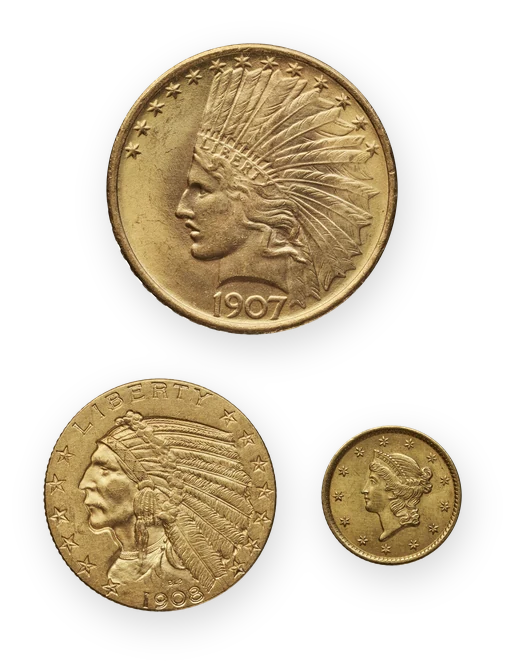
A 1907 Indian Head $10 gold eagle above a 1908 Indian Head $5 gold coin and a tiny 1849 gold dollar, at true relative sizeA row of U.S. gold coins at true relative size: an 1849 gold dollar, a 1908 Indian Head $5 and a 1907 Indian Head $10

Gold Coins

U.S. gold coins were struck for circulation until 1933, in sizes from the tiny gold dollar, smaller than a dime, to the large $20 double eagle. Gold coins are often wrapped in tissue, tucked into small envelopes or kept in a safe deposit box, and the small ones are easy to miss. Modern bullion coins such as American Gold Eagles may turn up too.

Every gold coin is worth at least its gold content, and many older ones carry a collector premium. Our guide on how to sell gold coins explains what to check.

A large 1838 Hard Times token with a kneeling woman in chains above a smaller 1863 Our Little Monitor Civil War token, at true relative sizeAn 1838 Hard Times token beside an 1863 Our Little Monitor Civil War token, at true relative size

Tokens and Odd Pieces

Not everything round and metal is a coin. Hard Times tokens from the 1830s and Civil War tokens from the 1860s were privately made and often look like worn foreign coins or cents, yet many are collectible. You may also find medals, transit tokens, casino chips and souvenir pieces.

Keep anything you are unsure about with the coins and let an appraiser sort it out.

Other Common Estate Finds

  • Rolls and bags. Bank rolls and cloth bags can hold anything from face-value pocket change to rolls of silver dimes or silver dollars. Do not break open sealed rolls or bags yourself. See our page on silver dollar bags.
  • Proof sets and mint sets. Flat plastic cases and paper envelopes from the U.S. Mint are very common. Some contain silver or scarce varieties, while many modern sets are worth close to face value. Our guide on how to sell proof and mint sets explains how to tell them apart.
  • Certified coins. Coins sealed in hard plastic holders by PCGS, NGC or ANACS have already been graded. Never open a holder. Learn more on our page to sell PCGS, NGC and ANACS coins.
  • Foreign coins. Travel money is usually common, but foreign gold and older silver can be valuable. See our pages on foreign coin collections and foreign coins value.
  • Old paper money. Large-size notes, gold certificates, silver certificates and star notes can be worth well over face value. Keep them flat and unfolded, and read our guide on how to sell paper currency.
Decorative gold separator bar

Step 4: Common Finds Versus Valuable Finds

Most estate coins are worth something, and a few can be worth far more than the rest. You cannot judge value by age or appearance alone: a heavily worn coin can be rare, and a shiny one can be common. This table shows, in general terms, which finds are usually common and which deserve a closer look:

What You FoundUsually CommonWorth a Closer Look
Pre-1965 dimes, quarters and halvesWorn coins with common dates, valued for silverKey dates, scarce mint marks and coins in high grades
Morgan and Peace dollarsCommon dates in circulated conditionScarce dates and mint marks, and coins that look nearly new
Old cents and nickelsMost wheat cents and worn nickelsKey dates, error coins and unusually well-kept pieces
U.S. gold coinsCommon dates, still valued at least for goldOlder and scarcer dates, branch mints and high grades
Proof sets and mint setsMany modern clad setsOlder sets, silver sets and sets with rare varieties
Foreign coinsModern travel changeGold, older silver and scarce issues
Paper moneyRecent small-size notesLarge-size notes, gold certificates, star notes and fancy serial numbers

Price guides and online listings will tempt you, but asking prices are not selling prices, and a coin’s grade can change its value many times over. Treat what you read online as a rough guide only, and watch out for counterfeit and altered coins, which do turn up in estates.

Decorative gold separator bar

Step 5: Document the Coins for the Executor
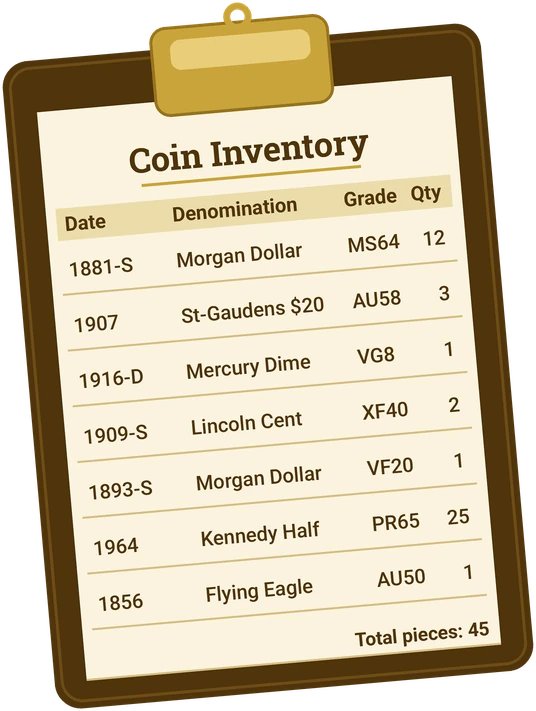
Clipboard with a coin inventory list showing date, denomination, grade and quantity columns for Morgan dollars, a Saint-Gaudens $20 and other U.S. coins, on a transparent background

Whether you are the executor yourself or helping one, a simple written record protects everyone. It shows the heirs what was found, helps the estate’s attorney through probate, and gives the appraiser a head start.

Your inventory does not need to be technical. Describe what you see in plain words, and take photos as you go.

  • What and how many. List each coin or group, such as “a roll of 1964 dimes” or “twelve proof sets, 1970s,” with the date and any mint mark you can read.
  • Where it was found. Note the room, drawer, box or bank, and who was present.
  • Photos. Photograph the front and back of the better-looking coins and the outside of rolls, bags, albums and sets, in good light.
  • Paperwork. Keep receipts, certificates, old appraisals and notes together with the coins they describe.
  • Chain of custody. If coins move to a safe deposit box or to an appraiser, record when, where and by whom.

The estate may need a date-of-death value for its tax return or for dividing the estate fairly. The IRS explains the federal estate tax and how property is valued, and our page on IRS-compliant numismatic appraisals covers formal appraisals for estates. When the estate is ready to sell, our guide to the tax implications of liquidating bullion vs. rare coins in an estate explains how the sale is taxed. If a bank or trust company is handling the estate, see our notes for the bank trust officer.

Decorative gold separator bar

Step 6: Get a Professional Appraisal

Once the coins are secured, sorted and listed, the next step is a professional appraisal of the whole group. An experienced numismatist can tell quickly which coins are valued for their metal, which carry a collector premium and which, if any, are worth grading. Have the coins appraised together, before anything is divided or sold, so every heir is working from the same numbers.

  • Choose a qualified appraiser. Look for a long history, membership in the American Numismatic Association and authorization from the major grading services.
  • Ask for it in writing. A written, itemized appraisal lists each coin or group with its value, which makes it easy to share with the executor, the attorney and the heirs.
  • Know which kind you need. An offer to purchase tells you what a dealer will pay today. A formal appraisal for probate, estate tax or insurance is a separate document. Tell the appraiser which one you need.
  • Watch for red flags. Be cautious of anyone who wants to buy on the spot before giving you a written value. Our fiduciary’s audit checklist lists the warning signs.

Our pages on coin collection appraisal, free online coin appraisal and estate appraisals and liquidation explain how we work with families, executors and trustees.

Decorative gold separator bar

Step 7: Decide How to Sell

Not every estate needs to sell its coins, and some families keep a few pieces for sentimental reasons. When the estate is ready to sell, you have a few options:

  • Sell everything to one reputable dealer. One appraisal, one written offer and one payment. This is usually the simplest and fastest choice for an estate, and it is easy to document for the heirs and the court.
  • Sell part and keep part. An itemized offer lets you sell most of the coins and keep any with special meaning.
  • Auction. A few truly rare coins may do well at auction, but auctions take months and charge fees, and they rarely make sense for common coins.
  • Avoid quick sales. Pawn shops, jewelry buyers, coin counting machines and spending old silver at face value usually leave money behind.

Whatever you choose, compare written offers, and do not let anyone rush you. Our article on mistakes to avoid when selling rare coins covers the common pitfalls, and if the estate is large, our page on how to sell a large coin collection explains how we can meet you at your bank. For coins that will be kept, our article on proper storage explains how to protect them.

Decorative gold separator bar

Ready to Sell the Coins You Found?

Whether you found a single coffee can of old cents or a lifetime of silver, gold and sets, the steps are the same: secure the coins, leave them uncleaned and together, figure out what you have, write it down, get a professional appraisal and then decide how to sell. We have helped families, executors and trustees with estate coins since 1990, and we would be glad to help you.

Four Simple Steps to Sell the Coins You Found

Step 1
Smartphone camera photographing an 1889 Morgan silver dollar over a handwritten Estate Coins Found list of wheat cents, silver dimes and old bills

Gather the Coins, Then Send Photos or a List

Bring everything you found to one table: loose coins, rolls, cans, albums, sets and old bills. Leave them uncleaned and in the holders, envelopes and boxes they came in. You don’t need to know what anything is worth.

Photograph the front and back of the coins that stand out, plus one picture of each roll, album or can, or simply write a list of what you found and where. Text the photos to 720-600-4740, email them with your list to staff@americanrarities.com or use the form below.

Step 2
Sample American Rarities written appraisal and offer for coins found in a family estate, itemizing Morgan and Peace dollars and gold, with a loupe

Free Appraisal and Written Offer

An experienced numismatist reviews everything you sent. All appraisal requests are reviewed in the order they are received. Some appraisals take minutes, while larger, more complex collections can take a few days. Either way, you’ll get a response from us.

You get a free, no-obligation written offer, itemized so the executor and every heir can see what each coin or group is worth. If the estate also needs a formal appraisal for probate or estate tax, just tell us; that is a separate document.

Step 3
A closed, taped and padlocked carton addressed To: American Rarities, Fully Insured, or our buyer examining an 1860-O Seated Liberty dollar with a 1924-D Standing Liberty quarter, a 1909 wheat cent and an 1856 Seated dime on the table

Ship Fully Insured or Meet in Person

Pack the coins in a sturdy, closed box and ship it fully insured at our expense, or meet our buyer in person at the house or at your bank, which works well for larger estates. If you decline our offer, we return your items fully insured.

Step 4

Get Paid

When you accept, we pay you immediately by cash, check, ACH or wire, so the executor can deposit the proceeds and divide them as the will or the court directs.

American Rarities holds a 4.7-star Google rating and an A+ rating with the BBB, we are ANA Life Members, and we are an authorized PCGS, NGC and ANACS dealer. Attorneys and fiduciaries can learn more on our pages for the probate and estate lawyer and for estate planners.

You can also call 800-622-5680. Calls go to our answering service, so leave a message and we will call you back. Or visit our contact a rare coin buyer page.

Decorative gold separator bar

What to Do With Old Coins Found in an Estate: Frequently Asked Questions

What should I do first when I find old coins in an estate?

Secure them in one safe place, do not clean them and do not split them up. Keep them in the albums, rolls, envelopes and holders you found them in, let the executor know what you found and write down where each group came from.

Should I clean old coins I found before getting them appraised?

No. Cleaning almost always lowers a coin’s value and cannot be undone. Even gentle wiping can leave fine scratches. Leave dirt, toning and spots alone and let an appraiser see the coins exactly as you found them.

How can I tell if the old coins I found are valuable?

Start by sorting them into groups such as pre-1965 silver, silver dollars, old cents and nickels, gold, sets, foreign coins and paper money. Age alone does not make a coin valuable; the date, mint mark, condition and demand matter most. A professional appraisal is the most reliable way to find the valuable pieces.

Can heirs divide the coins before they are appraised?

It is best not to. Dividing coins before they are identified and valued makes it hard to split the estate fairly, and the best coins are not always the ones that look the most valuable. Have everything appraised together first.

What should the executor record about coins found in an estate?

List what was found and how many, where each group was found and who was present, take photos, keep any receipts or old appraisals with the coins, and note every time the coins are moved. This record helps with probate, estate tax questions and dividing the estate.

Is a dealer’s offer the same as an appraisal for probate or estate tax?

No. An offer to purchase tells you what a dealer will pay today, while a formal appraisal for probate, estate tax or insurance is a separate written document. Tell the appraiser which one the estate needs.

How do you pay for coins found in an estate?

All appraisal requests are reviewed in the order they are received. Some appraisals take minutes, while larger, more complex collections can take a few days. Either way, you’ll get a response from us. The written offer is free with no obligation. When you accept our offer, we pay you immediately by cash, check, ACH or wire.

Decorative gold separator bar

Free Estate Coin Appraisal and Offer

Email, Text, or Use This Form To Send Us Your Inventory List or Pictures


Upload files of inventory lists and front and back photos of your items.

    We can help build your inventory list. Use the Collection List Maker to photograph your items and we'll build the inventory list for you.

    Decorative gold separator bar